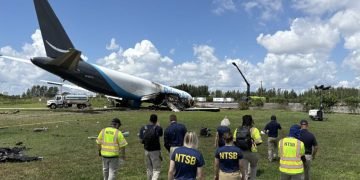




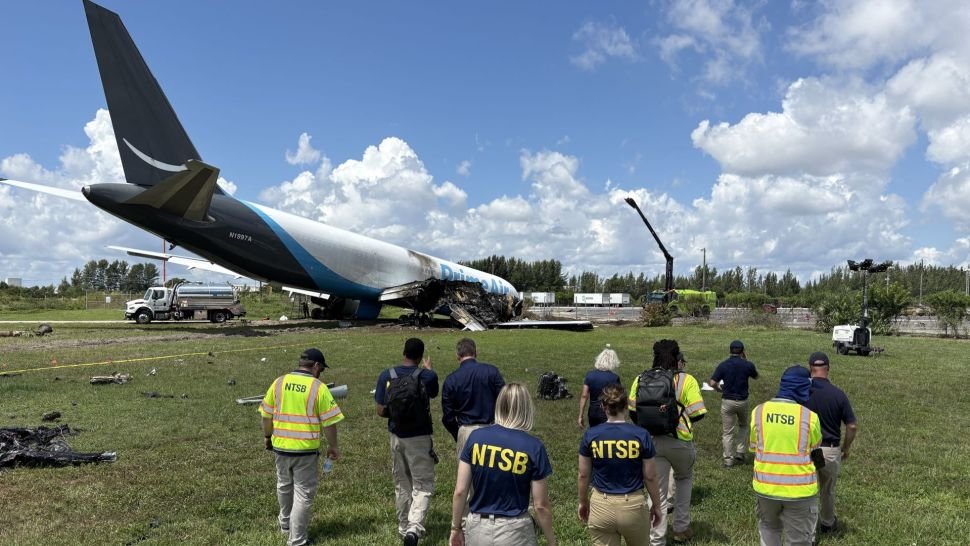
The Amazon cargo aircraft that overshot a runway at Miami International Airport left behind a scene of “utter devastation” after tearing through vehicles, airport equipment and infrastructure, National Transportation Safety Board Chairwoman Jennifer Homendy said Monday.
The airport is operating at reduced capacity while recovery crews work to clear the crash site and investigators prepare to access the aircraft. Two of Miami International Airport’s four runways remain closed, with no immediate timetable for reopening them.
Homendy provided additional details during a news conference streamed live from the airport Monday afternoon. The accident, which occurred Sunday, left five people dead and at least five others injured. Three of those injured remain in critical condition.
Flight 7598, a Boeing 767-300 converted freighter operated on Amazon’s behalf by 21 Air, was completing its third flight of the day when it arrived from San Juan, Puerto Rico, at approximately 2 p.m. Sunday.
The aircraft had begun its day at Amazon’s superhub at Cincinnati-Northern Kentucky International Airport before flying to Miami, continuing to San Juan and then returning to Miami.
During landing, the cargo jet overran Runway 30, striking navigational aids and other airport equipment before crashing into a 2012 Ford Econoline van operated by Professional Ocean Services Corp., a contract cleaning company serving airlines. Seven people were inside the van.
The aircraft then continued through a perimeter fence and struck a Toyota Corolla Cross traveling on a main road. It proceeded across the grass before hitting another fence line protecting a parking area filled with Tesla robotaxis.
According to Homendy, the aircraft traveled approximately 1,300 feet beyond the end of the paved runway.
“There’s debris everywhere,” Homendy said while describing the scene. She pointed to the destroyed Econoline van, the surrounding airbags and vehicle components scattered across the area, along with parts of the aircraft, navigational equipment, airport infrastructure and fencing.
She described the overall damage as extensive and devastating.
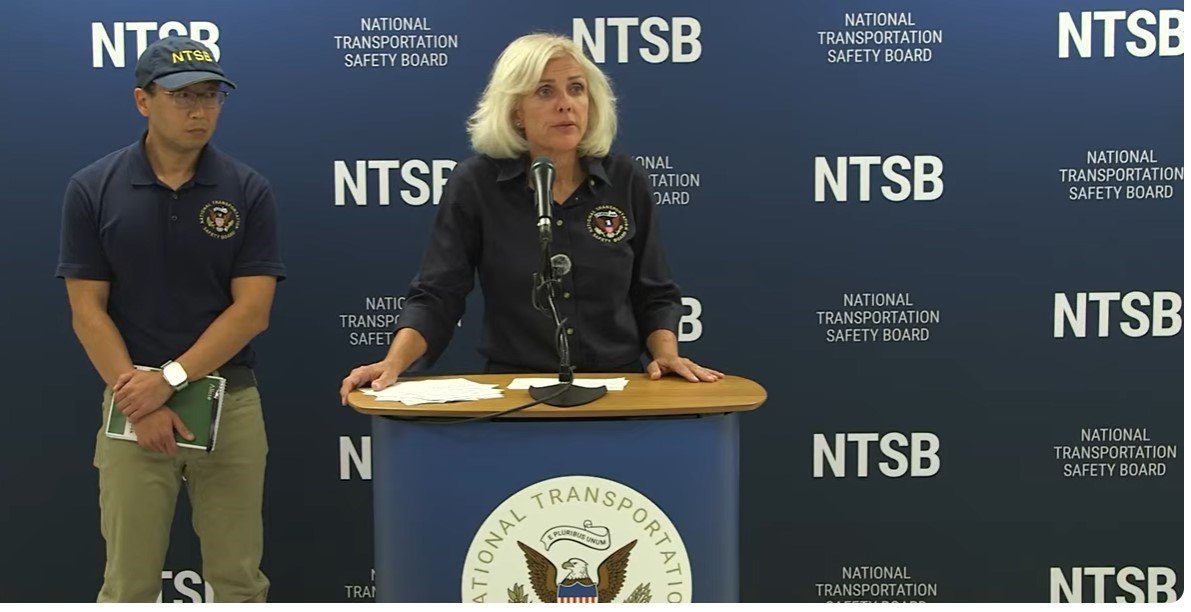
The condition of the crash site is also affecting airport operations. Two of Miami’s four runways remain closed because NTSB investigators must first document the scene and safely reach the aircraft itself.
Homendy said that process could take time, particularly because fuel remains at the site and must be addressed before investigators can fully enter the area.
“It’s going to take time,” she said, adding that investigators hope to move as quickly as possible because of the impact on flight operations. Fuel remaining at the crash site will need to be remediated, while additional fuel is also being removed from the aircraft.
Miami International Airport is a major passenger and cargo gateway connecting Europe, North America and South America, making the reduced runway capacity particularly significant for both passenger and freight operations.
Investigators have already begun documenting evidence from the aircraft’s path, including tire marks. Both the flight data recorder and cockpit voice recorder have been recovered and are being transported to NTSB headquarters in Washington, D.C., where they will be analyzed.
The investigation will cover virtually every element surrounding the accident. NTSB teams will examine airport and flight operations, pilot performance, the aircraft’s flight history, the flight crew’s experience and training, as well as 21 Air’s policies and procedures.
Investigators will also examine Amazon’s contractual relationship with 21 Air, Federal Aviation Administration oversight of operators, air traffic control, radar data, pilot radio transmissions, the aircraft wreckage, its systems and engines, and weather conditions at the time of the accident.
One issue expected to receive particular attention is the absence of an engineered materials arresting system, or EMAS, at Miami International Airport.
EMAS is a specialized bed made from crushable material installed at the end of a runway. Its purpose is to slow and stop aircraft that overshoot a runway during takeoff or landing. Approximately 72 airports in the United States currently have an EMAS system.
Homendy said the NTSB will examine whether an EMAS installation at Miami could have reduced the severity of the crash and limited the resulting damage.
The issue also ties into a broader history of runway-excursion investigations conducted by the NTSB.
“We have investigated many runway excursions … since 2008,” Homendy said. She warned that repeated investigations become particularly concerning when previous safety recommendations are not implemented.
“If we are repeatedly investigating an accident or tragedy and our recommendations are not implemented, then we’re here again and again and again,” she said.
The NTSB is expected to release a preliminary report on the Miami accident within 30 days. A complete investigation, including the agency’s final findings and safety recommendations, could take a year or longer.