



Amazon’s challenge to the Staten Island union vote continues
The legal dispute over union representation at Amazon’s JFK8 fulfillment center in Staten Island, New York, remains unresolved more than four and a half years after workers voted to establish an independent union. The latest proceedings before the U.S. Court of Appeals for the Fifth Circuit focus on whether Amazon must comply with an order requiring it to negotiate with the workers’ union.
In April 2026, the National Labor Relations Board (NLRB) directed Amazon (NASDAQ: AMZN) to bargain with the union, which initially secured its victory without the backing of a major national labor organization. The organization has since aligned with the Teamsters and operates as Amazon Labor Union–International Brotherhood of Teamsters (IBT) Local 1.
Both sides submitted briefs on October 16 in the case of Amazon v. NLRB, presenting sharply different interpretations of the dispute and the legal issues surrounding the board’s decision.
Amazon’s filing concentrates primarily on the limits of the NLRB’s authority and the legal grounds on which its decision can be challenged. The Teamsters, by contrast, submitted a 115-page document revisiting the history of the Staten Island organizing campaign and the numerous disagreements that have shaped the union’s relationship with Amazon.
For Amazon, the Staten Island election remains a particularly significant defeat: it was the first time the company lost a unionization campaign at one of its facilities. A subsequent organizing attempt at another Staten Island location failed, while Amazon successfully opposed a union drive at its Bessemer, Alabama, facility in a closely watched 2021 election. That campaign involved the Retail, Wholesale and Department Store Workers Union rather than the Teamsters.
The two sides differ on the need for oral arguments
The opposing briefs also reveal a difference in approach to the next stage of the Fifth Circuit proceedings, including whether oral arguments are necessary.
The Teamsters left the decision to the court, noting that the judges could reject Amazon’s petition and enforce the NLRB’s order without hearing oral arguments, while acknowledging that a hearing could help clarify the issues raised in the written submissions.
Amazon expressed agreement with the union’s position that the questions presented in its petition could be resolved without oral arguments.
Despite this procedural agreement, the two parties remain far apart on the substance of the case, particularly the validity of the election and the remedies that should apply.
Why Amazon has refused to bargain
Amazon’s brief explains that its refusal to negotiate was a deliberate legal step intended to bring the dispute before a federal court. The company argues that an employer cannot directly seek judicial review of a decision certifying a union election.
Instead, according to Amazon, an employer must refuse to bargain, face a finding that it has committed an unfair labor practice, and then challenge the union certification when seeking judicial review of that finding. This procedure is known as a test-of-certification challenge.
The company’s position is that its refusal to negotiate was necessary to contest the NLRB’s certification of the Staten Island election and the board’s April order requiring bargaining.
However, the NLRB had already rejected Amazon’s arguments. In its decision, the board concluded that the representation issues raised by the company had either been addressed, or could have been addressed, during the original proceedings. It also found that Amazon had presented neither newly discovered evidence nor exceptional circumstances that would justify reconsideration.
Disagreement over the election and additional remedies
Amazon’s filing reiterates allegations that the union’s organizing campaign involved threats, coercion and intimidation. The company also characterizes the election result as narrow.
The Teamsters, meanwhile, emphasize the scale of their victory, describing the margin as nearly 11% of all ballots cast.
Beyond the election itself, the dispute concerns whether Amazon should face additional requirements if the court upholds the union’s position. The Teamsters have sought an enhanced remedy that would require Amazon to read a notice explaining employees’ rights under the National Labor Relations Act during a mandatory meeting.
The NLRB’s General Counsel had recommended such a measure, but the full board declined to adopt it.
Amazon is asking the Fifth Circuit to reject the union’s request on three grounds.
First, the company maintains that the election will ultimately be decertified, which would render the question of an enhanced remedy moot. Second, it argues that requiring an employer to read a notice of employee rights in a test-of-certification case lacks precedent in labor law. Third, Amazon contends that the union has not provided sufficient justification for imposing the measure.
The Teamsters have proposed an alternative should the court accept Amazon’s arguments. Rather than setting aside the election, they say, the case should be returned to the NLRB so that the board can provide additional reasoning for its decision.
The court’s handling of these questions will determine the next steps in the dispute over the union’s certification and Amazon’s obligation to bargain.
A separate dispute over Amazon’s delivery partners remains active
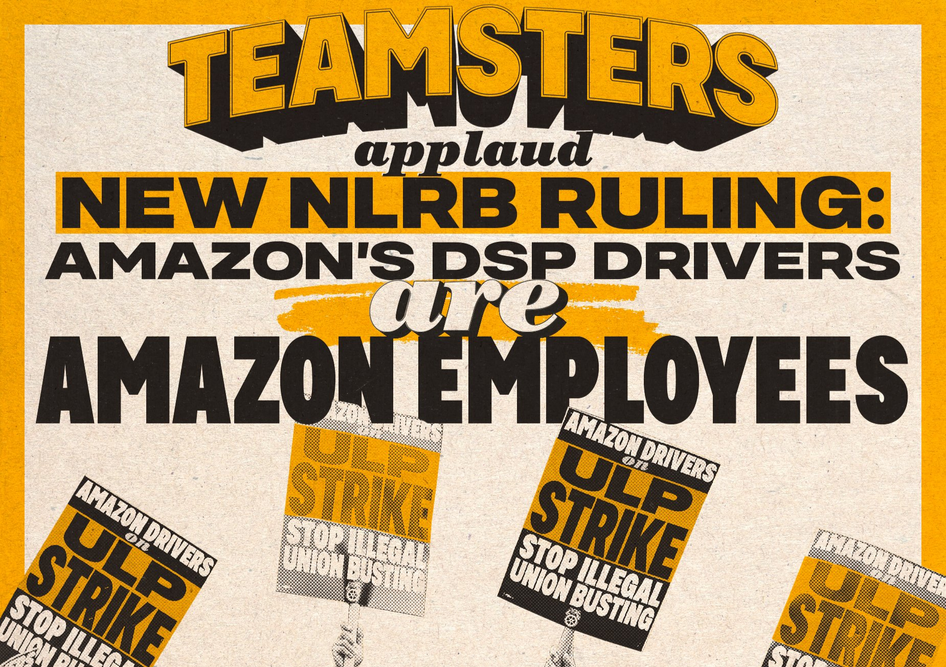
The legal confrontation between Amazon and the Teamsters extends beyond the Staten Island warehouse. A separate proceeding before the NLRB concerns whether Amazon should be considered a joint employer alongside the independent companies responsible for delivering its packages.
The dispute intensified after an April agreement between Amazon and the NLRB’s General Counsel brought an end to a process that had advanced through the board’s regional proceedings in Los Angeles. A lower-level NLRB decision had found Amazon to be a joint employer with a delivery service provider, or DSP, one of the independently owned businesses that carry out deliveries for the company.
The agreement prevented the matter from proceeding to the full board.
Amazon has consistently maintained that its DSPs operate as independent businesses. The Teamsters dispute that position, arguing that Amazon exercises sufficient control over the delivery companies to qualify as a joint employer.
Such a determination could have far-reaching consequences for Amazon’s labor model, given the company’s reliance on independently operated delivery businesses to distribute its products.
The agreement that ended the earlier proceedings was strongly criticized by Teamsters lawyers, who described it at the time as an “ambush settlement agreement.”
Teamsters demand the proceedings be reinstated
The NLRB docket in the joint-employer case has seen limited substantive activity in recent months. The latest significant development is a letter from Teamsters attorneys calling for the immediate reinstatement of the proceedings.
The lawyers warned that accepting the agreement without resuming the case would amount to the board’s capitulation to corporate interests, at the expense of workers who rely on the NLRB to enforce the National Labor Relations Act and safeguard their rights.
The two disputes therefore remain important fronts in the broader conflict between Amazon and organized labor. While the Fifth Circuit considers the company’s challenge to the order to bargain with Staten Island workers, the separate joint-employer controversy continues to raise questions about Amazon’s responsibilities toward the workforce employed by its delivery partners.