



The long-standing “chicken and egg” problem surrounding alternative fuels in shipping is gradually losing its grip as more dual-fuel vessels enter service. Yet, according to industry experts, the industry is approaching the limits of what voluntary action can achieve. Stronger regulation may ultimately be required to close the price gap between sustainable fuels and cheaper conventional fossil fuels.
The original dilemma was straightforward: alternative fuels were not widely available because there were not enough vessels capable of using them, while shipowners had little incentive to order alternative-fuel vessels without a reliable fuel supply. Today, that situation has changed. Dual-fuel ships are increasingly being ordered and delivered, but the industry now faces a different question: who is prepared to absorb the financial risk of producing and consuming fuels that remain significantly more expensive?
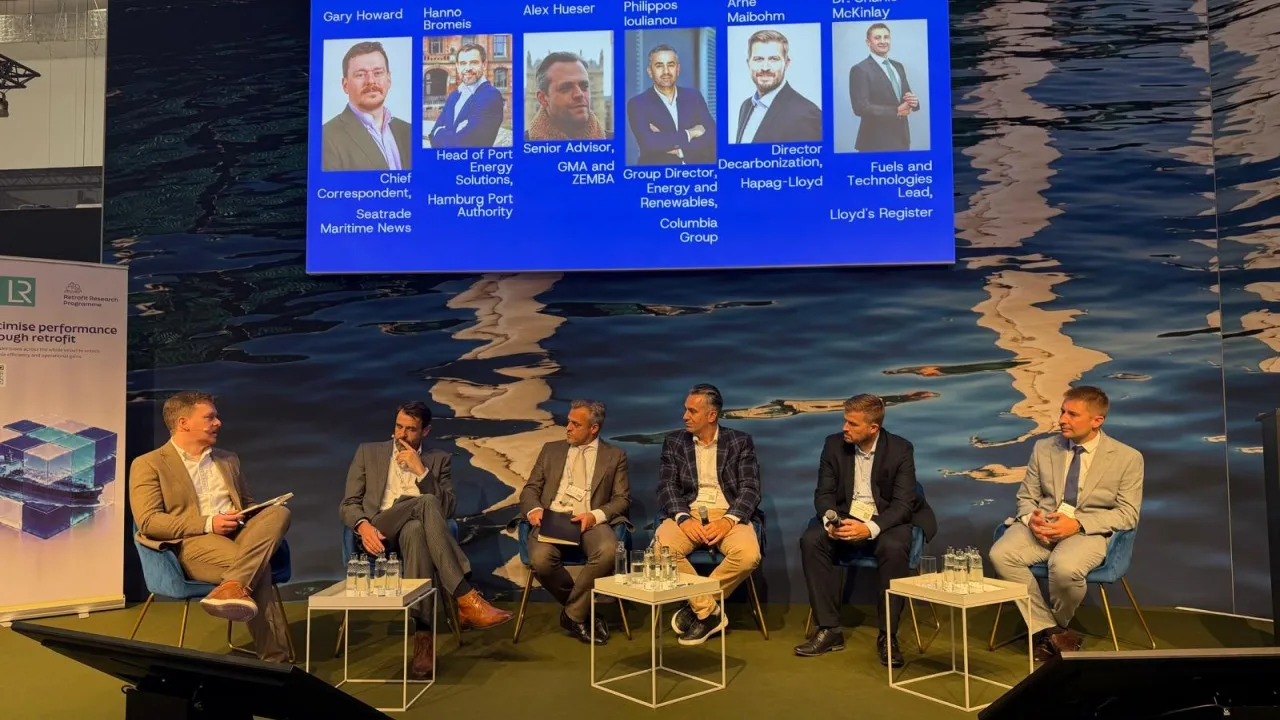
Speaking at the Global Maritime Environmental Congress (GMEC) at SMM, Dr. Charlie McKinlay, fuels and technologies lead at Lloyd’s Register Maritime Decarbonisation Hub, said the industry had already seen a significant increase in dual-fuel vessel orders.
“What we have seen in the last few years is a real uptake in the ordering of dual-fuel ships,” McKinlay said, adding that this effectively answers the question of which side of the equation came first. However, he stressed that there is no guarantee those vessels will operate on sustainable fuels from their first day in service.
The challenge is particularly acute for shipowners attempting to reduce emissions while remaining commercially competitive.
Arne Maibohm, director decarbonisation at Hapag-Lloyd, said carriers needed stronger and more predictable signals from cargo owners before they could confidently commit to long-term alternative-fuel supply agreements.
“Without clear and predictable long-term demand signals from cargo owners to carriers, it’s very hard for carriers to go into offtake agreements towards alternative fuel providers, bearing the whole risk without knowing what is happening,” Maibohm said.
Bridging a major commitment gap
One of the central issues discussed by the panel was the mismatch between the commitments required by fuel producers and those typically made by shipping companies.
Fuel producers need long-term offtake agreements to support Final Investment Decisions (FIDs) on new production facilities. Ship operators, by contrast, generally enter into fuel-supply agreements lasting only one or two years. Bridging that gap means someone within the supply chain must be prepared to assume the additional risk.
Hapag-Lloyd has already taken such a step, Maibohm explained, through a major methanol offtake agreement. While the commitment represents a relatively small share of the company’s overall energy consumption, it nevertheless carries a substantial financial risk.
“Unfortunately, decisions had been made before the plateauing or the stalling of the IMO discussions, but we firmly believe that progress is being made on that front,” he said.
The agreement will begin next year and run for 15 years, a commitment Maibohm believes will also provide support when the regulatory framework eventually takes shape.
Customer interest in methanol-powered shipping remains strong, he added, although demand is currently lower than for biodiesel and biomethane. That difference highlights the decisive role that price continues to play for cargo owners seeking to reduce emissions across their supply chains.
Biofuels face their own scalability problem
The panel also pointed to another challenge emerging in the alternative-fuel market.
Both Maibohm and McKinlay agreed that biofuels are likely to encounter increasing difficulties as the availability of suitable feedstocks limits their ability to scale. Scarcity of feedstock could push biofuel prices higher and, in turn, make e-fuels increasingly competitive.
Shipping companies could theoretically strengthen their position by combining their fuel requirements and creating a larger demand signal. However, competition law places significant restrictions on this approach. Carriers cannot simply coordinate joint procurement or exchange commercially sensitive information, including fuel prices and volumes.
The question therefore remains whether the growing fleet of dual-fuel ships is itself enough to send a sufficiently strong signal to fuel producers.
Alex Hueser, senior advisor at The Center for Green Market Activation (GMA) and the Zero Emission Maritime Buyers Alliance (ZEMBA), argued that dual-fuel vessels are an important part of the solution.
“These vessels are a blessing because without them the chicken and egg would stay forever if they were mono-fuel,” Hueser said. He noted that dual-fuel ships are somewhat more expensive than conventional vessels and praised carriers willing to make that investment. But simply ordering the ships is not enough.
“You need to order fuel, then it happens. Before that, it’s all spoken,” he added.
ZEMBA seeks to address precisely this issue by pooling demand from cargo owners prepared to pay a premium for lower-emission shipping services. By aggregating demand, the organisation gives carriers a stronger commercial basis for committing to alternative fuels.
While the panel recognised the impact ZEMBA has already had by bringing cargo-owner demand together, Hueser noted that maritime transport faces an additional challenge: its emissions can appear relatively small when viewed alongside the overall carbon footprint of a typical cargo owner’s supply chain.
Maritime still struggles for attention
In terms of greenhouse gas emissions, maritime transport is often not the first sector cargo owners focus on.
“It’s always aviation first, and then trucking, and then maritime. Often they don’t even have maritime in their breakdown of numbers, so it’s a tricky game,” Hueser said.
Part of ZEMBA’s role is therefore to educate cargo owners about the benefits of decarbonising ocean transportation. Once companies understand those benefits and become engaged, financial support is often easier to secure. But Hueser stressed that there are limits to how much additional cost cargo owners are prepared to absorb.
The same constraint applies to shipping companies.
For both sides of the market, demand aggregation can only go so far when companies are operating in a highly competitive environment and must decide whether they are willing to pay more for improved environmental performance.
Regulation increasingly seen as unavoidable
The panel broadly agreed that voluntary measures are approaching their limits.
Even with stronger demand aggregation, the industry will need regulation to drive the wider adoption of low-carbon fuels. The discussion took place at SMM while the IMO’s Intersessional Working Group on greenhouse gas emissions was meeting in London to work on the IMO’s Net Zero Framework.
The future shape of global emissions and carbon-pricing regulation remains uncertain. Such a framework could help narrow the gap between fossil fuels and lower-carbon alternatives by imposing fees on the largest emitters while rewarding ships with the lowest emissions.
For Maibohm, regulation is fundamentally about providing the industry with a clear direction.
“When we talk about meeting 1.5 degree climate targets, we need a higher pace,” he said. “But without the foundation, without the direction, if everybody is moving very fast in different directions, that doesn’t help us.”
Philippos Ioulianou, group director, energy and renewables at Columbia Group, similarly argued that shipowners require regulatory clarity before committing the capital expenditure needed for newbuild projects.
Within Europe, however, Ioulianou sees a potential positive development in the recent revision of the EU Emissions Trading System (ETS). The changes should result in more of the funds generated through the EU ETS being channelled back into the maritime sector.
Ports show what regulation can achieve
Hanno Bromeis, head of port energy solutions at Hamburg Port Authority (HPA), pointed to port electrification as a concrete example of regulation and policy helping to accelerate investment.
HPA began developing electrification and shore-power infrastructure before the EU’s Fit for 55 regulation was introduced. The authority was able to move forward because clean-air regulations made funding available.
The evolution of green electricity and shore-power prices demonstrates the influence regulation can have, Bromeis said. He expects all-electric vessels to become increasingly common in European short-sea shipping during the next decade.
Such a development could ultimately take the sector further than was originally anticipated when shore-power requirements were first developed.
Maibohm added that electrification stands apart from many alternative-fuel solutions because it already has a particularly strong business case.
Ports face the same competition dilemma
However, the competition-law challenges confronting shipping companies also affect ports.
Ports are frequently asked why they cannot use incentives such as lower port dues to encourage greener operations. But Bromeis explained that acting independently could undermine the competitive position of the port offering those incentives.
“We are often asked, ‘why can’t you give out incentives as a port and a port authority, reduce port dues etc.?’ Obviously, you can only do that if you raise the bar elsewhere,” he said.
If one port increases environmental requirements while competing ports do not, the result can be higher costs and a weaker competitive position.
For Bromeis, the solution would therefore have to involve coordinated action among ports. Yet coordination itself can create competition concerns.
“There would be collusion, so the better thing would be to come up with a form of regulation that could be incentive-driven,” he said.
Dual-fuel ships have moved the industry forward but only so far
The shipping industry has clearly made progress in addressing the alternative-fuel chicken-and-egg problem. Dual-fuel vessels have created the technical capability to use cleaner fuels, while organisations such as ZEMBA are helping aggregate demand from cargo owners willing to pay for lower-emission transport.
But neither development fully solves the underlying economic challenge.
Voluntary commitments are increasingly constrained by cost, competition law, uncertain demand and the substantial investment required to bring new fuel-production capacity online. Even the progress achieved in Europe has its limits without broader coordination.
The panel’s conclusion was therefore clear: dual-fuel vessels and aggregated cargo-owner demand can help create the foundations for a greener shipping fuel market, but regulation will ultimately be required to generate the scale of demand needed to drive significantly higher production and use of low- and zero-carbon fuels across the maritime industry.