



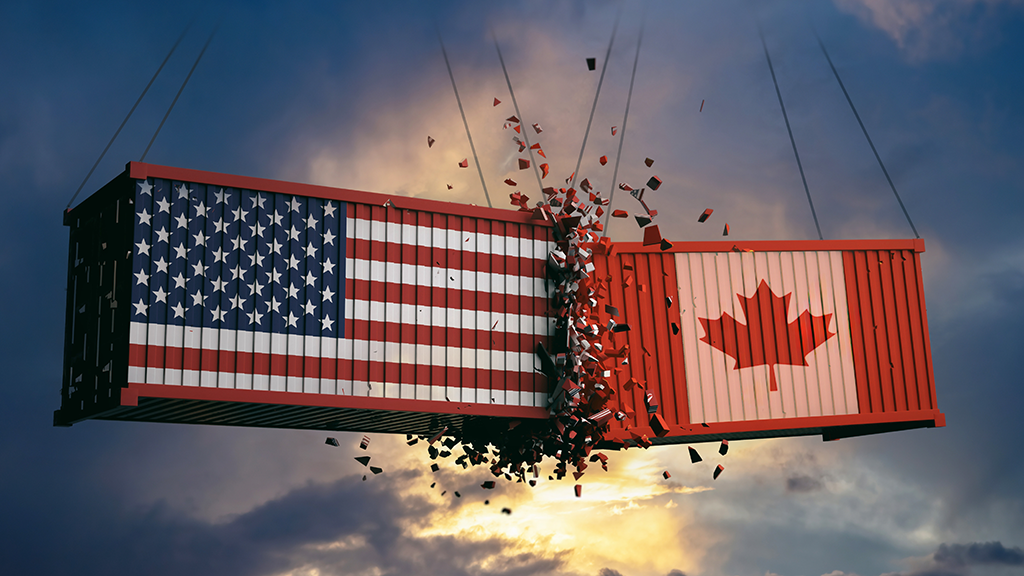
Canada’s retaliatory tariffs on American goods came into force shortly after midnight EDT on Tuesday, marking Ottawa’s latest response to the 50 per cent tariffs imposed by Washington last month.
The new Canadian measures cover roughly $28 billion worth of U.S. goods, matching the value targeted by the United States. The tariffs apply to products included on Washington’s own list, ranging from dairy products and plywood to sunscreen.
The latest escalation follows the collapse of negotiations aimed at resolving long-standing trade disputes between the two countries. Talks broke down after both sides rejected last-minute demands from the other.
“We couldn’t accept what they offered. We wouldn’t give what they’d asked. As a result, the U.S. has imposed new tariffs designed to hurt and divide us,” Prime Minister Mark Carney said last week.
“Now, that’s a miscalculation because Canadians will always take care of each other. And it’s a miscalculation because we have everything we need to build the country we want. We have the reserves, we have the resilience, and we have the right plan.”
The measures come as tensions between Ottawa and Washington continue to rise. In the hours before Canada’s tariffs took effect, U.S. President Donald Trump returned to social media with a series of attacks against Canada, including an AI-generated cartoon portraying him as a hockey player striking Carney with a stick while shouting “get up governor.”
Trump has repeatedly said he wants Canada to become the 51st U.S. state and has referred to both Carney and his predecessor, former prime minister Justin Trudeau, as governor.
On Monday, Trump also threatened to prevent Quebec-based Bombardier from selling aircraft in the United States unless the company built them there. In an extensive response, Bombardier rejected the suggestion that it does not already manufacture aircraft in the United States, pointing to thousands of jobs spread across more than 20 locations throughout the country.
Under Canada’s new tariff measures, a 50 per cent duty now applies to a range of American dairy products, including milk and cream. Fresh cheese and curd are subject to a 25 per cent tariff.
Ottawa is also targeting U.S. wood products with 25 per cent tariffs on softwood lumber, including pine, fir and spruce.
Several steel and aluminum products face a higher 50 per cent tariff, up from the existing 25 per cent rate. The affected products include steel rods, bars and sheets, as well as prefabricated structures such as bridges, towers, scaffolding and door and window frames.
The measures also extend to a broad range of beauty and cosmetic products. Perfumes, sunscreen and suntan products, lip and eye makeup, manicure and pedicure preparations, and hair products are among the items now subject to tariffs of up to 50 per cent.
At the same time, Ottawa is seeking to demonstrate that the trade conflict can accelerate investment at home.
Carney travelled to Thunder Bay, Ont., last week to announce another multi-billion-dollar manufacturing contract, this time involving the construction of passenger rail cars for Via Rail. Canada previously sourced those cars from the United States. They will now be manufactured by Alstom in Thunder Bay.
In a Labour Day statement, Carney argued that Canada’s strategy of increasing domestic production while diversifying its trading relationships was already producing results.
“Today, in the face of a global rupture, Canada is building big again: new ports, mines, and energy corridors; millions more affordable homes; new roads, railways, and airports. And we are building it all in solidarity with Canadian workers,” Carney said.
The dispute is also taking on a broader political significance. Robert Bothwell, a historian and professor at the University of Toronto, said Carney and Canada have increasingly become symbols of resistance to Trump’s policies.
“What he’ll want to do is make an example of Carney and Canada and theoretically terrify everybody else while in fact showing them that they need to remove themselves even further from the United States,” Bothwell said.
Meanwhile, Conservative Leader Pierre Poilievre has called on Carney to provide greater transparency over the consequences of the counter-tariffs. He said Canadians should have a clearer picture of how the measures will affect businesses and individuals.
“All Canadians stand united in denouncing the president’s unacceptable tweets, trolling and tariffs, and we have to stand united for its workers and all of our people,” Poilievre told reporters at a news conference in Regina on Monday.
“The Canadian people deserve the facts and a plan — we need to have both of those things from the prime minister, and so far, we’ve had neither.”
Small businesses are also facing growing concerns over the prolonged trade confrontation. The Canadian Federation of Independent Business has warned that some small companies could be forced to close despite the support measures announced by Ottawa.
The dispute could ultimately have implications well beyond North America. Carney is preparing to address the European Parliament next week, and experts including Daniel Béland believe Canada’s approach could attract international attention.
“The Canadian public is behind the Carney government and the world is watching what will happen next,” said Béland, a political scientist at McGill University.
If Canada’s defiant strategy succeeds, he said, it could become “a template” for other countries seeking to resist the Trump administration’s trade policies.