



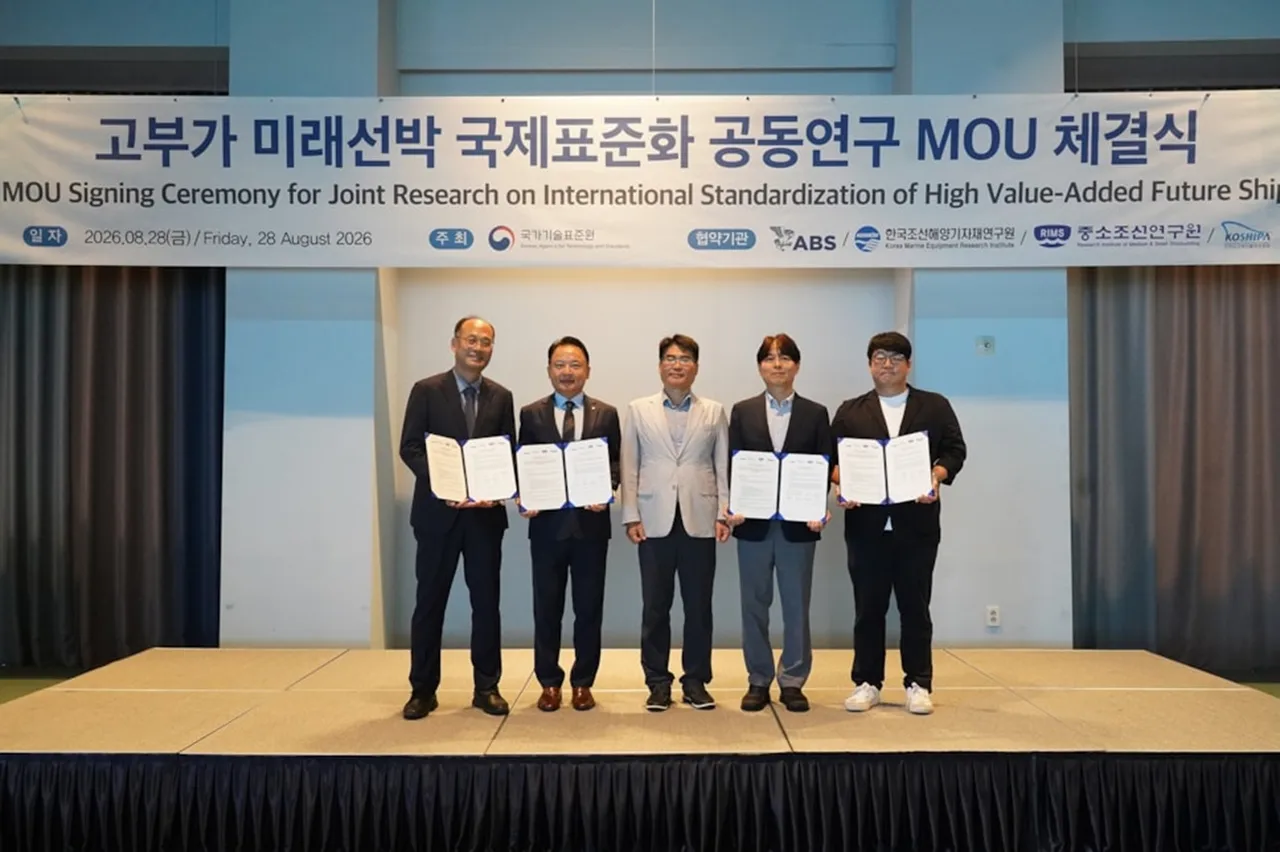
ABS is joining forces with three major South Korean maritime organisations in a five-year effort to develop international standards for smart ships and smart shipyards, as emerging technologies increasingly move from development into practical use.
The partnership brings together the Korea Marine Equipment Research Institute (KOMERI), the Korean Offshore & Shipbuilding Association (KOSHIPA), the Research Institute of Medium & Small Shipbuilding (RIMS) and ABS. Their objective is to establish global benchmarks for vessels and shipyards adopting digital technologies, smart manufacturing processes and other advanced systems.
The cooperation is already advancing work in two specific areas. One focuses on digital production and traceability requirements for additively manufactured components used on ships. The other addresses vent mast design for hydrogen-fueled vessels, an area expected to become increasingly important as the maritime sector explores alternative fuels.
Patrick Ryan, ABS senior vice president and chief technology officer, said the pace of technological development in shipbuilding is now exceeding the speed at which international standards are being established.
“Next-generation shipbuilding is moving faster than the standards governing it,” Ryan said, noting that international requirements for smart ships, smart shipyards and advanced manufacturing are still evolving. He also pointed to ABS’ long-standing relationship with Korean shipyards as an important foundation for the new agreement.
The Memorandum of Understanding builds on previous cooperation between ABS and South Korea’s Agency for Technology and Standards (KATS), which has focused on advancing standardisation for smart ships and smart yards.
That work forms part of South Korea’s broader national strategy to strengthen its position in the development of high-value vessels. The latest agreement is also connected to ABS’ activities through the Korea-US Shipbuilding Partnership Center.
For KOMERI, the push for internationally recognised standards is closely linked to the ability of Korean companies to compete abroad. Joo-Hyoung Choi said international standards serve as both a gateway to market entry and a key component of global competitiveness.
The partnership is therefore expected to help Korean marine equipment manufacturers reduce barriers when entering overseas markets, while supporting the adoption of advanced technologies across the wider shipbuilding industry.
The agreement also highlights a growing challenge for the maritime sector: technologies such as hydrogen propulsion, digital shipbuilding and additive manufacturing are reaching commercial and operational applications faster than existing safety frameworks and technical standards can adapt.
By working on standards at an international level before these technologies become more widespread, ABS and its Korean partners are seeking to close that gap and provide a clearer framework for the next generation of ships and shipyards.