



Aurora Innovation is still pursuing an aggressive growth agenda in autonomous trucking even as manufacturing headaches push its production timeline back about six weeks. The company now sees revenue in 2026 of about $9 million, down sharply from the $14 million to $16 million range it provided after reporting second-quarter results.
Aurora reported revenue of $3 million in the third quarter, compared with $1 million in the same period last year. But operating losses continued to rise, hitting $257 million.
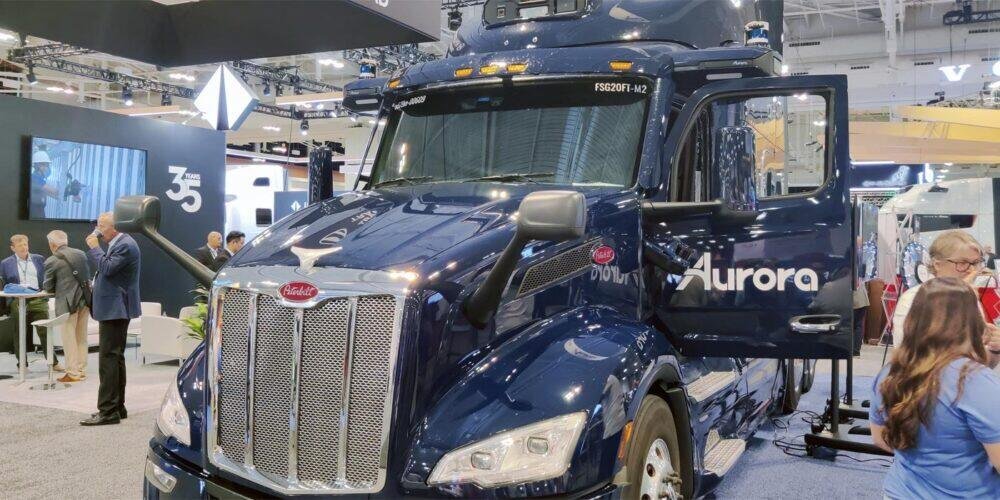
The slowdown in production was mostly at Roush, Aurora’s manufacturing partner, which installs autonomous technology on its trucks at its Livonia, Mich., plant. CEO Chris Urmson said shortages of materials, component quality problems and issues found during final production testing have disrupted operations over the past month.
Aurora now anticipates Roush to be building 20 trucks a week by early December. The company is also looking to deliver 200 trucks by the end of February.
Urmson told Bloomberg in comments on the quarterly results, that the production milestone which had been targeted for October would come later than expected. Still, he said the change would not impact Aurora’s ability to scale operations and deliver more than 1,000 trucks during 2027.
Roush to adjust production to regain manufacturing momentum
Aurora is already addressing the supply chain and manufacturing issues that caused the delay.
Some of the problems were complicated parts that were either delivered late or were not up to the quality standards of the company. Aurora decided to move production of some parts, including wire harnesses, to a supplier with better manufacturing capabilities, Maday said.
The company said it expects little impact on costs in most cases from the change. In fact, some components may actually cost less when the savings from reduced rework and production inefficiencies are taken into account. Aurora also said that these changes should not materially affect gross margins.
Other difficulties were the usual problems of setting up a new manufacturing line, especially when the various parts didn’t line up as expected from the start.
At the same time, Fabrinet’s Aurora Driver kits are being delivered faster than trucks are being built. Roush is also looking to add a second production shift to boost output.
“The manufacturing operation is now heading in the right direction,” Maday said, describing the delay as a shift in the timing of production, not an impediment to hitting the planned manufacturing rate.
Aurora also said that Roush has the capacity to expand its production line to build more than 20 trucks per week.
Rising fleet investment pushes quarterly cash consumption higher
The company’s latest financial results highlight the growing cost of preparing its autonomous fleet for commercial expansion.
Third-quarter revenue reached $3 million, up from $1 million a year earlier. However, the operating loss increased to $257 million, compared with $222 million in the corresponding period of the previous year. This figure included $54 million in stock-based compensation.
Aurora recorded a net loss of $234 million, equivalent to 12 cents per share. A year earlier, the company had reported a net loss of $201 million, or 11 cents per share.
Cash consumption also remained substantial. Aurora used approximately $170 million in operating cash during the quarter and allocated another $36 million to capital expenditures. The company said the investment remained within its targeted quarterly spending average.
During the earnings call, a Morgan Stanley analyst questioned whether the anticipated increase in fourth-quarter cash consumption pointed to a permanently higher cost structure.
Maday explained that most of the additional expenditure was directly connected to the development of the fleet, including hardware kits, vehicle components and truck assembly at Roush.
Research and development expenses are expected to remain relatively stable. Some additional general and administrative spending will be necessary, however, to support a fleet that could eventually comprise hundreds of vehicles.
He stressed that the majority of the increase had already been anticipated and was part of the company’s planned investment programme.
Aurora’s financial position reflects the scale of its expansion effort:
-
Cash and short-term investments: Just over $1 billion at the end of September, down from nearly $1.2 billion at the end of June.
-
Operating cash consumption: Approximately $170 million during the third quarter.
-
Capital expenditures: $36 million over the same period.
-
Equity financing: Six million shares sold through the at-the-market programme, generating $41 million in net proceeds.
-
Employee stock taxes: $23 million of the proceeds used to cover taxes associated with the vesting of employee shares.
The growing financial burden comes before the company can fully benefit from the revenue generated by a larger commercial fleet.
Nevertheless, Maday expects Aurora to reach positive cash flow in 2028. That objective will depend on increasing revenue while reducing the number of assets carried on the company’s balance sheet, according to Insurance Journal, citing Bloomberg News.
Commercial agreements now represent a potential 1,000-truck deployment
Alongside its manufacturing plans, Aurora is expanding its commercial commitments with major transportation operators.
Charger Logistics has signed a nonbinding memorandum of understanding (MOU) covering the ownership and operation of 500 trucks equipped with the Aurora Driver autonomous system. The vehicles would operate under Aurora’s driver-as-a-service model, with deliveries expected throughout 2027 and 2028.
This agreement follows a similar commitment announced in April with Hirschbach Motor Lines, which also signed an MOU covering 500 autonomous trucks.
Together, the two agreements represent potential deployments of 1,000 vehicles.
The arrangement with Charger builds on a transportation-as-a-service agreement signed in July, covering freight operations between Dallas and Laredo, Texas. Aurora estimates that the commercial relationship could generate several hundred million dollars in revenue over multiple years.
Charger President Andy Khera highlighted the operational benefits already achieved since autonomous services began operating along the Laredo corridor. In a letter to shareholders published by Aurora, he said the experience had demonstrated a clear opportunity to expand the service.
Maday added that Aurora and its customers had already reached agreement on pricing and volumes under both MOUs. The remaining discussions concern operational details, including responsibility for truck servicing and arrangements for vehicles at the end of their operational lives.
He expressed confidence that both agreements would eventually become binding contracts.
Urmson also confirmed that the initial 200 trucks are already fully contracted. According to Maday, Aurora currently has 10 customers operating or committed to driverless trucking services.
Autonomous operations exceed the standard weigh-station procedure
Aurora is also working to increase the independence of its driverless trucks when interacting with infrastructure and customer facilities.
To date, autonomous vehicles have used enhanced pre-trip inspections, or EPTI, a voluntary program that allows them to skip weigh stations under certain conditions.
But Aurora says its technology is ready for prime time. Now the system knows whether a weigh station is open, can enter a weighing lane that is available and can adapt to different station layouts.
EPTI provides more certainty when driving near weigh stations, but the process also adds complexity to how drivers are trained and how customers operate at their sites, Urmson acknowledged.
The next development stage will be direct access to customer facilities. Aurora trucks will begin driving directly to several driverless customers’ locations in November, including navigating security checkpoints.
Regulatory developments are also helping the growth of autonomous trucking.
Current federal regulations require drivers of commercial trucks that have stopped to use reflective warning triangles or flares to signal approaching traffic. This was a real problem for non-human-controlled vehicles.
On October 7, the Federal Motor Carrier Safety Administration (FMCSA) granted a five-year exemption to allow Level 4 self-driving trucks to use amber warning beacons mounted on the cab instead.
The exemption is not just for Aurora. According to the corresponding Federal Register notice, the measure also applies to other carriers operating Level 4 autonomous trucks after notifying the agency.
Volvo, PACCAR ready Aurora for next stage of manufacturing growth
“Roush is the first step in Aurora’s broader industrial strategy. The company is also working with large truck manufacturers to embed the autonomous technology into their existing production processes.
Aurora is integrating its driverless system into Volvo’s factory production line and is preparing for larger scale manufacturing programs with Volvo and PACCAR, its earnings release stated.
Volvo Autonomous Solutions plans to deliver trucks equipped with the Aurora Driver in the first quarter of 2027. It is planning to roll out more than 300 vehicles in that year.
Meanwhile, AUMOVIO is expected to start the production of Aurora’s third generation hardware kit in the second half of 2027, leading to the next stage of the company’s technological and commercial development.
“Aurora remains committed to the original deployment goals, despite the manufacturing setback,” Urmson reiterated.
The company still expects to deliver 200 trucks by February, and believes the revised production schedule leaves enough leeway to operate more than 1,000 autonomous trucks on public roads by the end of 2027.
Why it matters
Aurora’s latest results highlight the difficulties of transitioning autonomous trucking from a technology development to a large-scale commercial operation. The six-week delay in production will impact its revenue outlook, but the company still believes its long-term growth strategy is achievable.
The next few months are going to be critical. Roush has to prove that it can build 20 trucks a week, consistently, starting in December, and Aurora has to turn its deals with Charger Logistics and Hirschbach into firm commercial contracts.
The pressure is equally significant for investors. Aurora must show that its manufacturing investments will translate into a bigger operational fleet and better commercial prospects, as cash burn in the fourth quarter is expected to be about $250 million.
The company’s goal is still the same: more than 1,000 autonomous trucks on the road by the end of 2027. The ability to achieve that target will depend largely on the successful ramp-up of production and the company’s ability to translate customer commitments into revenue-generating operations.






