



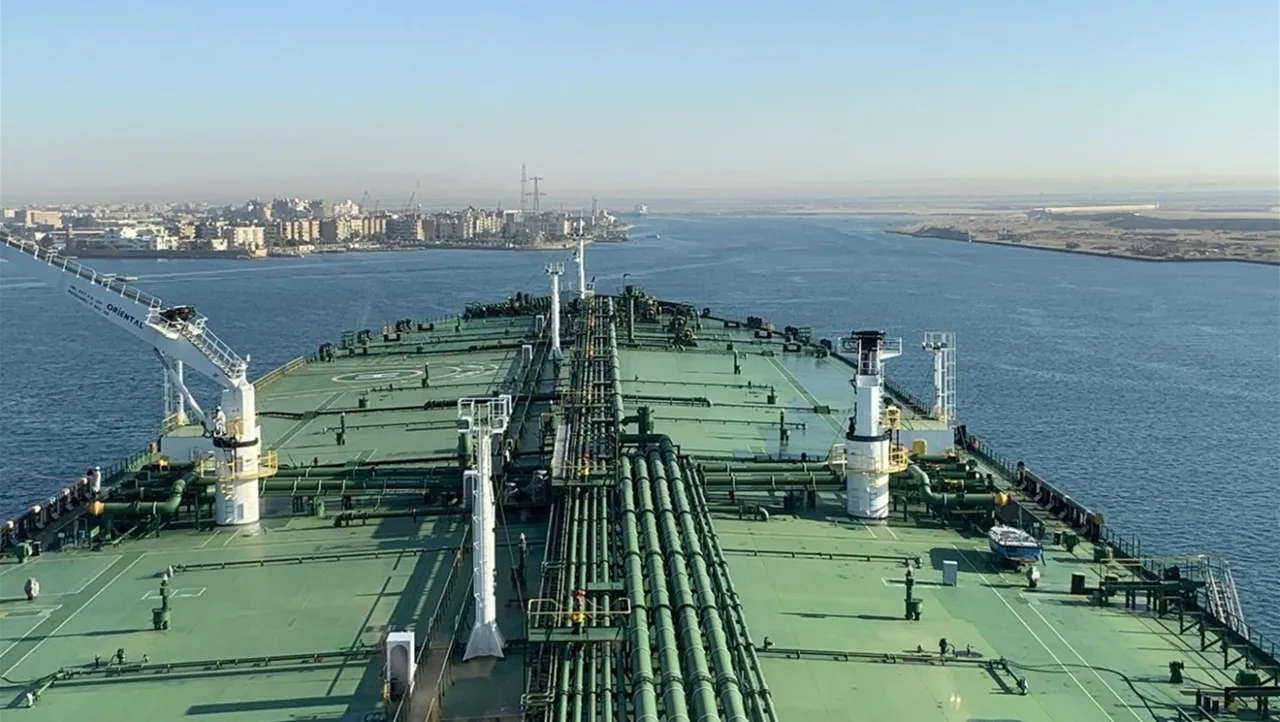
The tanker market is experiencing an extraordinary surge in rates as security concerns around the Strait of Hormuz continue to escalate. With vessels reportedly coming under attack almost daily in the strait, while Houthi pressure is disrupting Saudi Arabian exports through the Red Sea, very large crude carriers (VLCCs) are commanding unprecedented earnings.
Reported spot fixtures from the Arabian Gulf to Asia exceeded $600,000 per day on Friday, while benchmark rates have climbed to around $800,000 per day.
According to brokers Poten, earnings on the benchmark Arabian Gulf–Far East route averaged $600,000 per day in August and had risen above $800,000 per day in September up to the time of its latest assessment.
Poten stressed that these figures apply to voyages originating within the Arabian Gulf. The risks involved in transiting the Strait of Hormuz have sharply limited the number of shipowners prepared to accept such voyages, creating the conditions for exceptionally high rates.
The strength of the market was also reflected in fixtures reported by Tankers International on Friday. Two VLCCs were reportedly fixed for voyages from the Arabian Gulf to East Asia at rates above $500,000 per day.
Frontline’s Front Otra was reported fixed to Vitol at $530,000 per day for a voyage from the Arabian Gulf to Japan. At the same time, Olympic Shipping and Management’s VLCC Olympic Life was reportedly fixed to Mercuria at $603,000 per day for a voyage from the Arabian Gulf to China. Both fixtures remain on subjects.
Exceptional earnings extend beyond the conflict zone
The extraordinary market conditions are not limited to vessels directly exposed to the Strait of Hormuz.
Poten said ships loading in the Gulf of Oman, just outside the strait, can currently earn around $450,000 per day. Even VLCCs operating well away from the immediate conflict zone are benefiting from the exceptionally strong market.
Rates were estimated at approximately $380,000 per day for the West Africa–Far East route and $275,000 per day for voyages from the US Gulf to Asia.
Tankers International also reported that the 16-year-old Olympic Trust was fixed to Idemitsu at $441,000 per day for an Arabian Gulf–East voyage loading in the Gulf of Oman.
The current strength of the market, however, may not last indefinitely.
Poten pointed to the historical pattern of tanker markets, noting that periods of exceptional earnings have generally been followed by weaker returns, particularly when elevated rates encourage owners to place large numbers of newbuilding orders.
That risk is already visible in the fleet pipeline. The current VLCC newbuilding orderbook represents around 40% of the existing fleet, creating the potential for significant capacity growth if those ships are delivered into a less favorable market.
For owners, Poten’s message is therefore straightforward: take advantage of the current market while it lasts, as such conditions may never return.