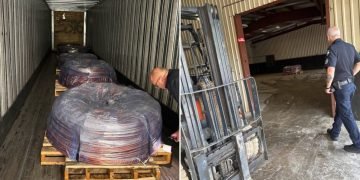




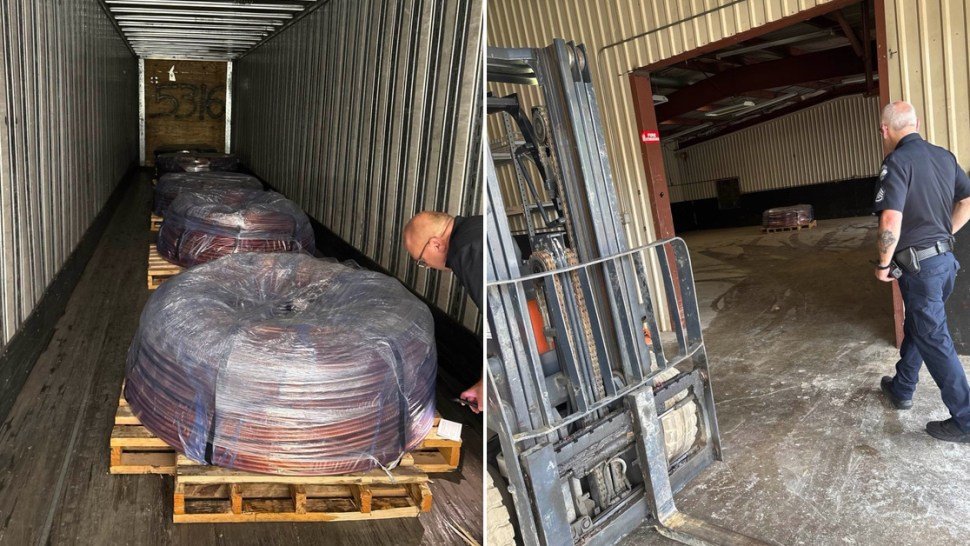
In Illinois, a shipment of $586,000 worth of copper was apparently diverted to a warehouse in Kentucky instead of South Carolina because of a carrier impersonation. Using GPS information provided by Schneider National, investigators located all six pallets and tracked down the company’s stolen equipment to Ohio.
Authorities recovered the copper and equipment within eight hours of the initial notification Sept. 11. The investigation resulted in four people being detained in two states, including three arrests in Kentucky and one in Ohio.
Commander Michael Ware of the Cook County Sheriff’s Police Department provided FreightWaves with details of the alleged fictitious-pickup theft. The shipment originated in DeKalb, Illinois, and was to be delivered in Rock Hill, South Carolina.
The suspects allegedly obtained the shipment by using the identity and publicly available contact information of a legitimate motor carrier, Ware said. Ware learned of the incident from CargoNet Crime Intelligence Analyst Shannon Elliott and it prompted a coordinated response from authorities in multiple states.
GPS data leads investigators to Kentucky warehouse
The Cook County Sheriff’s Police Department began an investigation and entered Schneider’s trailer into the stolen vehicle system. Investigators also identified the driver through what Ware called a “felony vehicle entry,” and listed the tractor as stolen.
CargoNet has logged the case under reference CN-26-09-00037.
Authorities said GPS data from Schneider National helped investigators track the missing shipment to Prestonsburg, Kentucky. Officers later tracked all six pallets of copper to a warehouse.
In a follow-up statement, Ware said Kentucky State Police took three people into custody related to the shipment.
Investigations then extended beyond the cargo. Schneider’s chassis and container were traced to Chillicothe, Ohio, where local officers secured the equipment. The Ohio State Highway Patrol also stopped the tractor that was attached to the original pickup.
A fourth person was taken into custody in the operation in Ohio.
The theft and recovery both took place Sept. 11, Ware said. He underlined the information sharing between law enforcement agencies and freight industry partners, which allows investigators to move quickly across jurisdictional boundaries.
“Cargo thieves don’t respect city, county or state lines so our response has to be coordinated just the same,” Ware said.
Police probe possible connection to another theft
Investigators are now looking into whether the incident is related to another theft of a Schneider trailer.
Authorities are also looking into whether the individuals involved and the carrier identities they allegedly used to book the pickup are tied to a larger organized cargo theft network.
“Collaboration between law enforcement and freight companies is still essential in these situations,” Ware said.
“This recovery is exactly why real-time intelligence sharing between law enforcement and the freight industry is so critical,” he said.
Ware specifically thanked Elliott and CargoNet for their prompt notification of the incident. He also acknowledged the help of DeKalb police, Schneider National and Coolmore Logistics.
Kentucky State Police and local Kentucky law enforcement were credited with assisting in the recovery of the copper. Ware also thanked Ohio State Highway Patrol troopers, Chillicothe Police officers and the other investigators involved with the operation.
The investigation continues.
Ware did not release the names of the four people taken into custody or say what charges they may face. Authorities have not released the name of the legitimate carrier whose name the suspects are alleged to have used.
There is no confirmation of any connection of the people involved in this case to the other Schneider trailer theft being examined.
Why It Matters
The case underscores the dangers that still exist even when a legitimate carrier’s information is used to set up a freight pick-up. A valid carrier profile or publicly available company information does not necessarily determine who is actually in control of the pickup.
It also emphasizes the need for rapid reporting and real-time tracking. In this case, GPS data and quick cooperation between industry and law enforcement allowed investigators to trace the shipment and related equipment across state lines in mere hours.
CFCO
The case also emphasizes the necessity of carrier verification that extends beyond simply verifying that a trucking company exists.
CFCO specializes in human-level vetting and verification, helping businesses determine who is really behind a freight transaction and who has the authority to take possession of a shipment. Taking a little more time to check out the people involved before letting freight loose can possibly prevent a long recovery or a complete financial loss.
Business verification technology can confirm ownership, while identity checks add an additional layer of protection by verifying who is controlling the pickup. Encrypted portals can also help reduce the reliance on traditional email communications, although it remains necessary to verify the identity of the users to avoid impersonation.