



Yard operations typically depend on three major systems: a transportation management system (TMS), a yard management system (YMS), and some form of enterprise resource planning (ERP). Making those platforms work together is already a complex task. The challenge becomes even greater when the information feeding them still comes from manual processes, such as a yard check carried out every four hours by someone walking the site with a clipboard.
Aviro360 is building its business around a simple premise: the problem is not necessarily a lack of software, but the delay and inaccuracy of the physical yard data entering those systems.
The company was originally incubated within intermodal terminal operator ConGlobal and is now operating at more than 80 sites across the country. Its technology is designed to reduce the need for manual inventory counts.
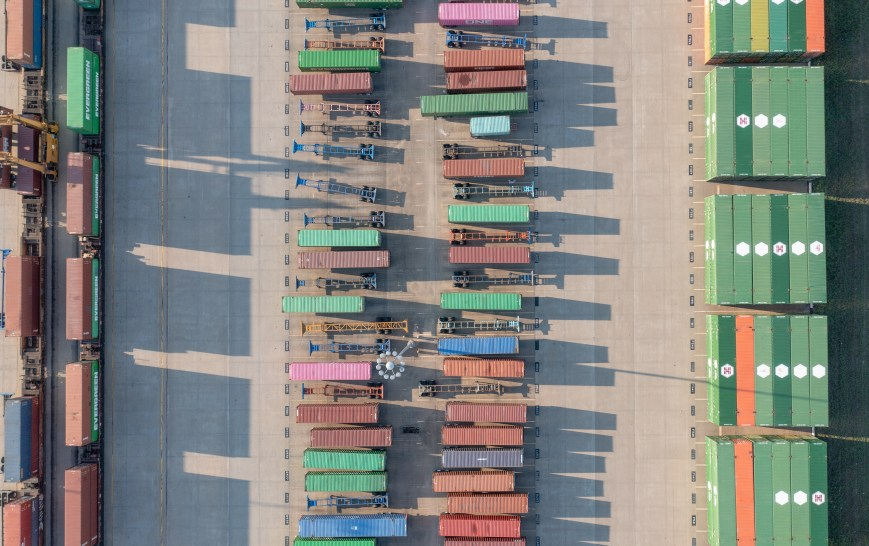
Aviro360 points to a 6,000-container yard as an example. Using its automated technology, the entire yard can be covered in less than an hour with 99% accuracy. A manual inspection by a person carrying a clipboard would take approximately four hours and deliver only about 75% accuracy.
That proposition has helped push Aviro360’s booked business beyond 120 sites by the end of the year. Ilhan Kolko, the company’s president and managing director, told FreightWaves that he expects the company to reach approximately 200 sites in 2027.
ConGlobal has been operating intermodal terminals and depots for more than 50 years. The technology that eventually became Aviro360 grew out of operational problems including missed moves, misplaced assets and congestion inside yards.
Aviro360 was launched as an independent brand in October 2025, making its debut at Manifest.
Ending Yard Blindness
One of the company’s other major targets is dwell time.
Dwell remains one of the less visible but persistent sources of inefficiency across supply chains. In 2023, truck drivers were detained during 39.3% of all stops. According to the American Transportation Research Institute, that driver detention generated $3.6 billion in direct costs for for-hire trucking companies and another $11.5 billion in lost productivity.
Getting compensated for that time can be almost as difficult as documenting it. Fleets submitted bills for detention events on 94.5% of occasions, yet collected on fewer than half of those invoices.
Aviro360 estimates that its technology can generate a return of more than $650,000 annually for each site, according to comments made during an appearance on the Let’s Talk Supply Chain podcast.
Kolko describes the yard as the final largely unautomated link in a supply chain that has modernized many of the operations surrounding it.
The transportation side has benefited from extensive progress, while warehouses have adopted robotics and transportation networks have gained increasingly sophisticated track-and-trace capabilities. In Kolko’s view, the yard is now the remaining gap—and its position between transportation and warehousing allows problems there to affect both sides.
The issue, he argues, begins before information even reaches the software designed to analyze it.
A manual inventory check can leave a four-hour gap between the moment information is collected and the moment it reaches the system. By then, the information may only be 75% accurate.
That limitation affects every decision made afterward. A spotter sent to an incorrect location can waste both a yard move and a driver’s available time.
Aviro360’s system captures chassis and container numbers, license plates and logos at the gate, covering both inbound and outbound traffic. It then follows each asset through the yard using a single timeline, recording the door involved, the parking position and the timing of individual moves.
The outbound side receives just as much engineering attention as inbound operations. The gate is not simply an entry point; it is also where assets leave the facility attached to trucks that may not own those assets.
Where Latency Turns Into Spoilage
Refrigerated freight offers another example of how delayed yard information can become a direct financial loss.
Aviro360 integrates with trailer telematics and can identify refrigerated units that are approaching or exceeding their permitted time window before their cargo becomes unsalvageable.
The issue is particularly relevant because detention is even more common among refrigerated drivers. ATRI reports that reefer drivers experienced detention at 56.2% of stops, the highest rate in its detention data.
According to Kolko, that capability has recently helped Aviro360 win customers in the food and beverage sector.
The company’s argument is not that businesses should replace their existing technology stack. Instead, it sees itself as a data layer capable of feeding those systems with more reliable information.
A company can invest in a YMS, TMS or ERP and have access to strong software, Kolko said. But if the critical information coming from the physical yard is incomplete or inaccurate, the real-world workload still suffers.
Automated Yard Inventory in Two or Three Days
Aviro360’s hardware is proprietary, and its footprint is becoming smaller as the underlying technology becomes more affordable and compact.
Over the past 18 months, the company has reduced the footprint of its gate installation by 40%. That means fewer cameras, fewer poles and less steel installed in the ground.
For a site that is ready for installation, gate deployment typically takes two or three days. A soft launch can take place by the fifth day.
The company’s mobile inventory units can be installed on the same day. Those systems attach to yard hustlers or other vehicles that are already moving around the facility, allowing the technology to collect inventory information without requiring a dedicated vehicle.
The installation is followed by a four-week calibration period, during which machine-learning models learn the specific characteristics of the property.
The technology does not require parking spaces or other areas of the yard to be physically marked.
Once the system establishes a particular geolocation as an anchor point, it can identify parking positions throughout the site and represent them inside the company’s digital twin.
Kolko said accuracy reaches 99% by the end of the fourth week.
Aviro360 also carries out competitive testing against cameras that customers already have installed. Equipment that meets the required standard can be reused. The same applies to existing gate arms and chain-link gates.
That compatibility can be important for facilities that have only recently completed procurement and installation of a security system and are unwilling to invest in an entirely separate infrastructure.
Whoever Runs the Yard, the Integration Path Is the Same
The workforce operating large shipper yards is not always organized the same way. Some facilities use their own spotters, while others rely on third-party logistics providers or carrier crews.
Kolko estimates that the overall customer base is roughly split 50/50 between those two models.
That distinction can create another layer of complexity for technology providers. The company purchasing the solution, the people physically moving equipment and the organization operating the system of record can all be different entities.
One customer, for example, manages 24 distribution centers using its own systems. Another outsources the same type of work entirely to third parties.
For Aviro360, the identity of the operator is less important than having a clear integration path.
The company says it can work with different operating structures and accommodate the various parties involved in managing a yard.
Yard Inventory Automation Becomes Table Stakes
The technology behind Aviro360 has been in development for more than a decade, with both of its core products now in their third generation.
What has changed more recently is the economics.
Yard-grade computer vision was once a highly customized technology that could cost around $1 million and was primarily accessible to marine terminals. Productizing the technology has helped bring it within reach of conventional distribution centers.
Kolko expects gate automation and automated inventory reconciliation to become standard requirements within the next five years. He sees yard intelligence as the next layer of development beyond that foundation.
The immediate pressure, however, is also coming from competitors.
Companies are increasingly recognizing that many yard problems can be addressed without the enormous investments that once accompanied automation. At the same time, competitors are already beginning to deploy these technologies.
Kolko believes that combination will accelerate the first major phase of yard modernization, with the next 18 months likely to bring broader adoption of these concepts.