



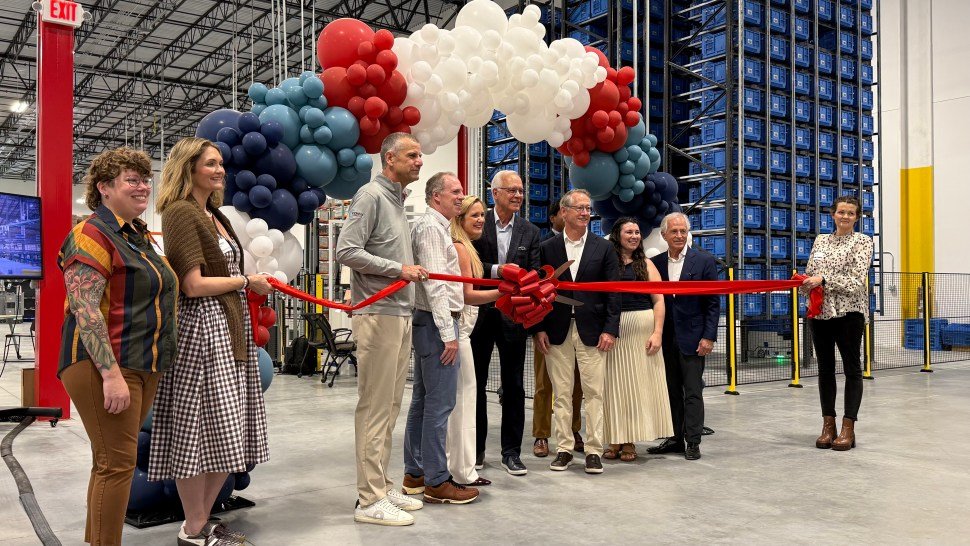
CHATTANOOGA, Tenn. Kenco has expanded its approach to warehouse automation with the opening of a new 30,000-square-foot Innovation Lab on Sept. 10, tripling the testing footprint of the facility the third-party logistics provider originally established in 2015.
The new space gives Kenco the capacity to test larger and more complex warehouse automation systems, while also allowing multiple technologies to operate side by side. The facility has been designed to replicate real-world warehouse conditions, allowing companies to evaluate how technologies are likely to perform in an operating distribution center rather than in a controlled demonstration environment.
For Kenco, the expanded lab is intended to benefit both technology manufacturers and logistics customers.
“The Innovation Lab has long stood as the convergence point for leading technologies and real-world applications, helping both manufacturers and customers identify and realize what’s possible,” said Ainsley Williams, vice president of automation and innovation at Kenco. “By tripling our innovation footprint, we can further provide a space for OEMs to continue experimenting with their products in a real environment and for customers to explore product and value without having to invest in them.”
From a 10,000-square-foot lab to a 30,000-square-foot testing environment
Kenco’s original innovation center was established to help the company better understand how emerging technologies, particularly automation, could be incorporated into its operations and affect its customers.
The company began that process in 2015 with a 10,000-square-foot facility.
“In 2015 we kind of started this journey. We put together a 10,000-square-foot innovation center because we wanted to understand how emerging technology, automation technologies, would be applied in our operation and how that would affect operation as well as our customers,” said Denis Reilly, president and CEO of Kenco, during the lab’s Sept. 10 ribbon-cutting ceremony.
At the time, many of the technologies under consideration were still developing.
“And back then a lot of things were in play — nothing as solid as it is today — but we were seeing all these emerging initiatives going on out there,” Reilly said.
He credited Kristi Montgomery, Kenco’s vice president of strategic transformation, with launching the initiative roughly a decade ago. As automation technologies matured, however, Kenco’s ambitions and the range of technologies it wanted to examine also expanded.
“As both the industry and Kenco’s automation ambitions continue to grow, that space no longer supported our breadth of technologies that we wanted to evaluate, demonstrate, and develop,” Reilly said.
Kenco operated 140 locations across North America and employed more than 7,500 people as of August 2025. Approximately 800 of those employees were based at the company’s Chattanooga headquarters.
The Innovation Lab’s opening brought together former U.S. Sen. Bob Corker and Tennessee state Sen. Bo Watson, as well as representatives from the Chattanooga Area Chamber of Commerce, Hamilton County Schools and the University of Tennessee campuses in Chattanooga and Knoxville.
Kenco is also already working on a major automation project with Thomas Goldsby, the Dee and Jimmy Haslam Chair in Logistics at the University of Tennessee Knoxville’s Haslam College of Business, according to Reilly.
A vendor-neutral environment for testing and evaluation
One of the defining features of Kenco’s new facility is its vendor-neutral structure.
For original equipment manufacturers, the lab provides an operational building where they can test and develop their equipment under realistic conditions. Customers, meanwhile, can examine and evaluate those technologies without being required to make a purchase.
Kenco is able to collect evaluation data from both sides of the process.
That neutrality is particularly important for a third-party logistics provider. Unlike a manufacturer operating its own demonstration center, Kenco does not have a product line to defend when a technology fails to perform as expected on its warehouse floor.
“This facility actually serves as more than a lab. It’s a working environment where we can validate technologies, we can develop solutions, and we can explore what is next for our customers and our operations,” Reilly said.
The approach gives Kenco a space to move beyond demonstrations and assess how automation performs when integrated into conditions that more closely resemble an actual warehouse operation.
Automation remains focused on the warehouse workforce
As automation becomes more deeply integrated into warehouse operations, one of the central questions remains its impact on employees.
For Reilly, the objective is not to remove people from the operation, but to make their work more efficient and less physically demanding.
“Automation is not about replacing people. It’s about enabling them,” Reilly said.
According to Reilly, automation solutions can reduce excessive walking, remove tedious and repetitive tasks, limit physically demanding work and contribute to safer and more sustainable working environments.
That approach still keeps people at the center of the operation. Employees remain involved, but with emerging technologies designed to make their work more efficient.
This human-centered perspective is also reflected in the way visitors are encouraged to experience the new Innovation Lab.
“Now, as you tour the facility today, we encourage you to view these technologies through the lens of a warehouse associate, because that’s where it’s geared towards,” Reilly told attendees.
He urged warehouse professionals to consider the technologies from the perspective of employees who perform picking and other warehouse activities every day.
“The senior warehousemen you’re having to do picking and you’re having to do warehouse activities try to take it from that perspective so you can understand how it’s going to impact their lives as well as the day-to-day operations out there,” Reilly said.