



For years, autonomous trucking has been presented as a promise for the future. Driverless trucks would eventually add capacity, reduce the impact of freight demand swings and help shippers navigate persistent driver shortages and hours-of-service restrictions.
On Sept. 29, FreightWaves and Waabi will examine what happens when that future begins becoming part of real-world freight planning.
That is the focus of “The Autonomous Freight Blueprint: Unlocking Predictable Capacity and the Early Mover Advantage,” a free webinar scheduled for 2 p.m. EDT. The session will explore how AI-powered trucks are progressing beyond pilot projects toward dependable, scalable capacity that shippers and carriers can incorporate into their network planning.
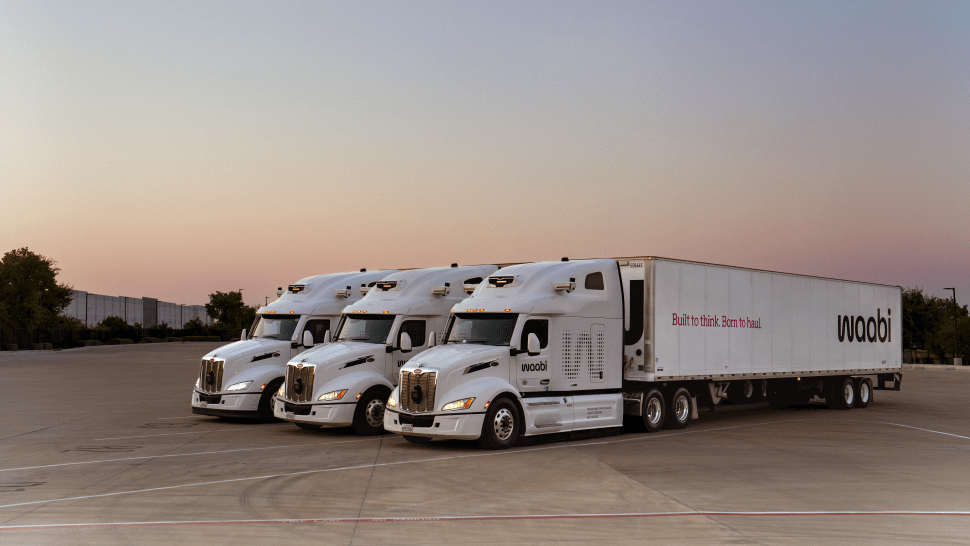
Waabi, the Toronto-based Physical AI company founded by longtime autonomous-vehicle researcher Raquel Urtasun, has taken a different approach to autonomous trucking during 2026.
Instead of adding machine learning to a conventional rules-based driving system, Waabi has developed what it describes as a verifiable, end-to-end AI model designed to reason and generalize. The technology works alongside a neural simulator that is used to train, test and validate the system. That allows the company to examine rare and potentially dangerous edge cases without requiring a truck to encounter those situations on public roads.
“The beauty of this technology is it is end-to-end trainable, meaning it can learn to deal with the complexity of the real world,” Urtasun has said of the approach. She has also argued that the technology could change the world once it is demonstrated at scale.
Investors are backing that potential, betting that Waabi’s Physical AI platform could ultimately support both freight-hauling trucks and passenger robotaxis using the same underlying technology.
For freight, the ability to generalize across different environments is directly connected to the central issue of predictable capacity that the webinar will address.
Waabi COO Lior Ron, who founded Uber Freight before joining Waabi last year, has been outspoken about the limitations of the highway-only, hub-to-hub model that became an early focus for much of the autonomous trucking sector.
His argument is that combining autonomous highway operations with expensive human-driven first- and last-mile segments simply preserves much of the cost structure the technology is supposed to eliminate. Those transfers can add hundreds of dollars in costs that shippers ultimately may not be willing to absorb.
Waabi is instead pursuing door-to-door, facility-to-facility autonomy.
The company has said that the vast majority of freight will ultimately be transported door-to-door. Waabi is also working with Volvo Autonomous Solutions, with the two companies integrating the Waabi Driver into the Volvo VNL Autonomous. The partnership is intended to provide a safe and redundant autonomous solution capable of broader commercial deployment.
For companies serious about removing the driver from the cab, that capability is essential.
The argument for autonomous capacity is unlikely to be unfamiliar to an industry that has spent years dealing with changing capacity levels, driver shortages and rate volatility. But moving from a broad promise to an operational reality requires much more specific answers.
Among the questions facing shippers, carriers and brokers are how autonomous capacity can actually be incorporated into network planning, what advantages an early commitment could provide compared with waiting for the technology to mature further, and how quickly the industry can realistically move from today’s pilot programs to fully driverless freight lanes.
The free webinar will include an audience Q&A and is aimed at professionals responsible for capacity planning, network design and long-term freight strategy, including shippers, carriers and brokers.