




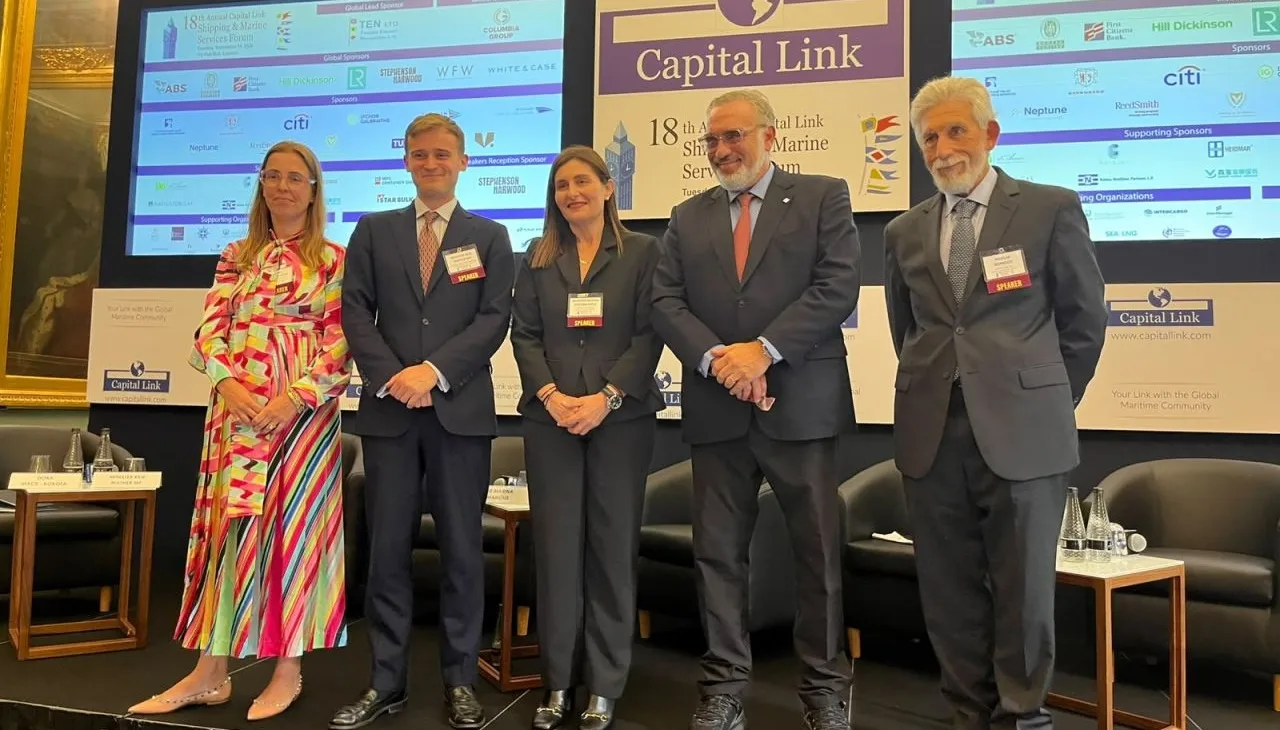
The UK and Cyprus may share a belief that pragmatism will be essential to decarbonising shipping, but comments made by their respective ministers at the Capital Link Conference in London revealed markedly different priorities.
Cypriot Deputy Shipping Minister Marina Hadjimanolis and UK Transport Minister Keir Mather agreed that governments and the maritime industry need to work together to develop practical solutions for a sector that remains particularly difficult to decarbonise.
Speaking on stage at Tuesday’s conference, both ministers stressed the importance of establishing the right regulatory framework to give companies the confidence and freedom to innovate. Yet beneath the apparent agreement, their approaches highlighted different visions of what the transition should look like.
Mather placed considerable emphasis on technological autonomy and nuclear power. He even singled out Ocean Infinity, a technology company involved in autonomous shipping and seabed mapping, as an example of the type of innovation the UK wants to encourage.
Hadjimanolis, by contrast, focused strongly on seafarers and the need for pragmatic measures capable of delivering a realistic IMO Net Zero Framework. Cyprus, she said, wants a framework that provides stability for shipowners.
Her position echoes arguments frequently made by Greek shipowners, who maintain that a pragmatic route to decarbonisation involves using fuels that are already available until commercially workable and affordable alternatives become sufficiently developed.
For Greek shipowners, that readily available fuel is LNG, despite its status as a fossil fuel.
The issue also has a particular relevance for Cyprus, which has discovered significant gas reserves relatively recently off its southern coast. Hadjimanolis referred to this when discussing Cyprus’ position ahead of last year’s Extraordinary Session of the International Maritime Organization (IMO).
The UK faces a different energy landscape. Its gas reserves are largely depleted, while its established nuclear expertise could potentially provide an emissions-free source of energy for shipping at the point of use.
Asked by Seatrade Maritime News about the lifecycle emissions and costs associated with uranium as a nuclear fuel, Mather acknowledged that maritime nuclear power remains an emerging technology.
He said the UK already has a strong rules-based system covering many aspects of nuclear power, including waste disposal, but added that new and adapted regulations would be required if nuclear-powered shipping is to become an area in which the UK participates in the future.
Mather also stressed that concerns surrounding nuclear propulsion would have to be thoroughly examined through discussions at the IMO. Any regulatory framework governing nuclear power in shipping, he said, should be global and agreed through the UN body.
“The UK is clear that in order to decarbonise, we need to be exploring a range of decarbonisation measures in shipping, especially in regards to future fuels,” Mather said, adding that Britain wants to participate in that work and capture the opportunities created by the transition.
Yet the discussion also exposed a broader common denominator between the two countries: emissions reduction and clean fuels appear to be considered alongside the need to protect and increase national economic value.
Cypriot officials argued last year that the country could vote against the Net Zero Framework despite a pan-EU agreement. In Britain, meanwhile, the Labour government continues to face questions over its green credentials as it considers approving additional oil and gas drilling in the North Sea.
Mather’s reference to Ocean Infinity also reflected a broader UK strategy rather than an incidental mention. The company specialises in technologies including seabed mapping and autonomous vessels, such as the Needlefish uncrewed surface vessel (USV) developed for the Kuwaiti Coast Guard.
The UK, Mather argued, should be “unashamedly competitive” in pursuing market share in technologies that are expected to shape maritime innovation over the coming decades. He identified autonomous shipping in particular as an area where Britain could seek to establish a stronger position.
Hadjimanolis offered a different perspective, placing Cyprus’ maritime identity firmly around its people.
For the Cypriot minister, the country’s long history as a shipping nation is closely connected to the people who sustain the industry. That emphasis contrasts with Mather’s focus on the development of increasingly autonomous and uncrewed vessels.
Moderator Dora Mace-Kokota, a partner at Stephenson Harwood, picked up on Hadjimanolis’ comments, noting that a maritime nation is also fundamentally about its people. She added that such a nation must understand its maritime history, know how to regulate effectively and know how to act as a maritime nation before asking Mather about more specific government initiatives.
Mather did not directly engage with the workforce issue. Instead, he returned to investment and industrial strategy, arguing that the government must demonstrate that it is prepared to commit financial resources to the direction it wants to encourage.
That, in turn, would allow private-sector companies to work with government and make major investments in technologies expected to determine the future of shipping and maritime transport.
The difference between the two approaches is partly explained by the structure of their respective maritime industries.
The UK’s maritime proposals are heavily oriented towards technological solutions, reflecting London’s broader focus on economic growth and the role of industrial development in generating that growth.
Cyprus, meanwhile, has a maritime economy in which ship management plays a particularly important role. Hadjimanolis described the country as home to the largest ship-management cluster in Europe, making questions surrounding crews and staffing levels especially significant.
The Capital Link discussion therefore provided a brief but revealing view of the complexity involved when liberal democracies attempt to negotiate maritime decarbonisation.
The divergence between the ministers does not necessarily mean that either is acting dishonestly. Rather, they are approaching the same challenge from different positions, with each government naturally attentive to employment, economic activity and national wealth.
Climate scientists approach the problem primarily through the reduction of emissions and the search for the most efficient ways of achieving that objective. Industry, meanwhile, must remain commercially viable and generate returns.
Reconciling these competing perspectives will be central to the success of the maritime energy transition. Governments, industry and scientists will need to find a model of economic growth capable of accommodating technological development, employment and national interests while still delivering meaningful emissions reductions.
Without that balance, the competing priorities surrounding shipping’s green transition could become increasingly difficult to reconcile.