



Low-carbon building design typically looks at two major sources of emissions: embodied carbon, which is linked to the materials and products used in construction, and operational carbon, generated as a building consumes energy throughout its use.
Both are essential considerations. Yet they do not necessarily capture the additional carbon created when a building envelope fails sooner than expected.
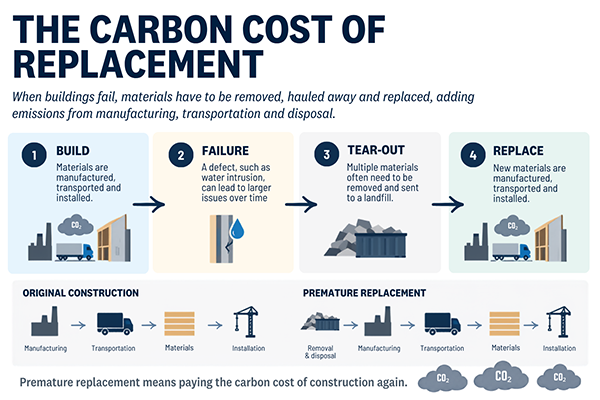
A premature failure can set off a chain of activities that includes investigation, demolition, manufacturing, transportation and reconstruction. At the same time, the building may continue consuming more energy while the underlying deficiency remains unresolved. What initially appears to be a localized performance problem can therefore evolve into an unplanned source of carbon emissions over the building’s lifecycle.
The carbon that follows failure
Embodied-carbon calculations usually include the materials required to build a building and replacements expected over its anticipated life.
Those calculations are based, in part, on the assumption that the building and its components will perform for the period for which they were originally intended. If materials are taken out and replaced earlier than expected, the actual carbon footprint of the building can start to outstrip the original assessment.
The replacement adds to that footprint. New products have to be manufactured, packaged and shipped to the project site. Contractors, labor and equipment have to return to do the work. Materials removed from the building need to be transported, processed or disposed of, adding impacts that may not have been considered in the original design.
The situation can be even worse if the problem is hidden inside the assembly. To investigate the affected area and reach the source, contractors may have to remove finishes, cladding or other functional materials to gain access to a concealed deficiency. In these situations correctly working materials can be wasted if they get caught between the contractor and the part that needs fixing.
Building envelope shortcomings could also heighten operational carbon even before fixes get underway. Insulation damaged by moisture may not perform to the thermal resistance specified in the original design, and uncontrolled air leakage can increase the heating and cooling demand. Since these conditions can be hidden, a building can perform below expectations for months or even years before the root cause is discovered.
How localized problems become larger repairs
Moisture intrusion, air leakage and condensation do not always remain limited to the exact point where a deficiency first occurs. Water can move through materials and assemblies, while air leakage can transport heat and water vapour into areas where they were never intended to travel. As a result, visible evidence of a problem may emerge some distance from its actual source.
Condensation is one example of how damage can develop without a clearly visible exterior leak. Warm, moisture-laden air moving through an unintended opening can reach a cold surface inside a wall or roof. With repeated exposure, insulation, sheathing, fasteners and finishes can all be affected before occupants realize that a problem is developing.
By the time the original source is identified, the required repair may extend well beyond sealing a single opening or replacing one damaged material. Surrounding components may have to be removed to determine the extent of the damage, allow the assembly to dry and restore continuity within the envelope. What began as a limited deficiency can therefore result in a repair project with a significantly larger material requirement and carbon footprint.
Why upfront carbon does not tell the whole story
A product with a lower upfront embodied-carbon value may appear to provide the strongest environmental outcome. That figure remains useful, but it describes the product at the beginning of its service life. It does not, by itself, demonstrate how the product will perform as part of the complete building envelope or whether the overall assembly will remain functional for the period assumed in the design.
When an assembly requires premature or repeated replacement, every intervention can generate another cycle of material production, transportation, removal and construction.
An initial carbon advantage can therefore become less significant when it is followed by additional energy consumption, waste and replacement activity. Lifecycle comparisons need to consider expected service life and real-world performance rather than focusing solely on the carbon associated with manufacturing a product.
At the same time, higher embodied carbon does not automatically mean that a product is more durable or environmentally preferable. Carbon figures need to be considered alongside exposure conditions, material compatibility, assembly design and the service conditions the building is expected to face.
Durability is consequently an important part of the lifecycle carbon equation. A durable building envelope can reduce the likelihood that otherwise functional materials will have to be removed before the end of their intended service life. It can also help preserve the operational performance on which many whole-building carbon assessments rely.
Reducing the carbon risk
Long-term envelope performance depends on more than the durability of individual products. It also depends on continuity between control layers, proper co-ordination at interfaces and the ability of the assembly to manage moisture, temperature variation and movement. Even a high-performing product can fall short when adjoining systems are incompatible or when critical transitions cannot be constructed reliably.
Project teams can work to reduce these risks throughout both design and construction. Constructability reviews, trade co-ordination, mock-ups, inspections and field testing can help identify deficiencies before assemblies are concealed. Clear installation requirements and contractor training can further improve the likelihood that the completed building envelope will perform as intended.
Repairability also deserves consideration. Buildings require maintenance, and some components will inevitably reach the end of their service lives. Designing assemblies so that serviceable elements can be accessed without unnecessarily removing surrounding materials can help reduce waste and limit the carbon associated with future interventions.
Reducing this lifecycle carbon cost requires more than choosing products with favourable upfront figures. It requires durable assemblies that are suited to their exposure conditions, carefully co-ordinated and constructed in accordance with the intended design. The lowest upfront carbon footprint will not necessarily result in the lowest overall impact across a building’s life when durability and long-term performance are excluded from the equation.
Rockford Boyer is a building science leader at Elastochem Specialty Chemicals and brings over 20 years of technical knowledge in sustainable building design. Send Industry Perspectives Op-Ed comments and column ideas to editor@dailycommercialnews.com.