



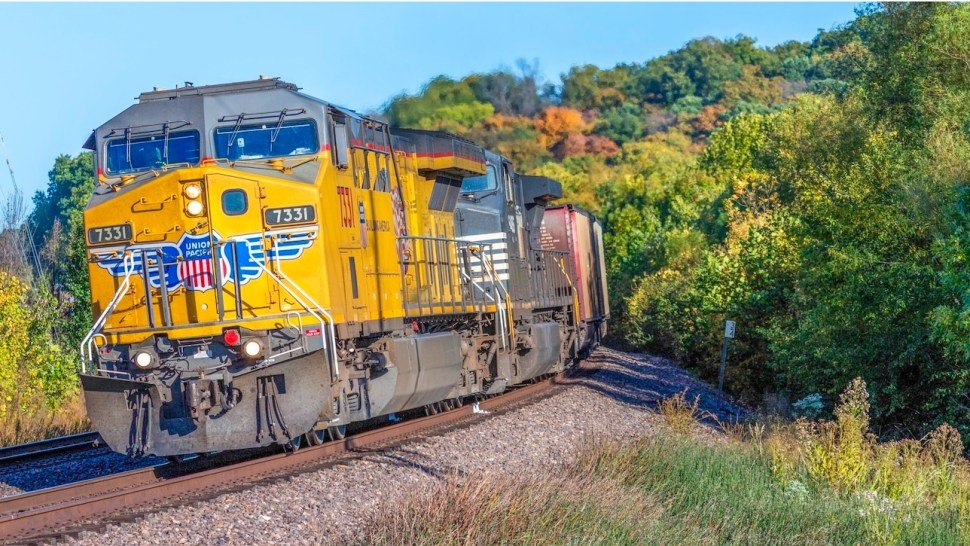
Union Pacific CEO Jim Vena is pushing back against requests from rival railroads seeking broad trackage rights and customer access across a potential combined Union Pacific-Norfolk Southern network.
Speaking at the Morgan Stanley 14th Annual Laguna Conference, Vena criticized the idea of giving competitors access to railroad infrastructure without what he considers a clear business benefit for Union Pacific.
“The idea to give up tracks of your railroad for no reason at all just goes against the fundamental principle of how … business should work,” Vena said.
The comments come after BNSF Railway, CPKC and CSX, along with 11 short-line railroads, told the Surface Transportation Board last week that they intend to seek extensive trackage rights and customer access on a combined UP-Norfolk Southern system if the proposed merger receives regulatory approval.
BNSF has submitted two major proposals. The first calls for 824 miles of trackage rights over Norfolk Southern between Chicago and intermodal terminals in Harrisburg and Bethlehem, Pennsylvania. The second proposes establishing a neutral switching carrier to serve customer facilities along the Gulf Coast that are currently served by BNSF and Union Pacific. The Gulf Coast is the largest chemical-producing region in the United States.
Although he did not specifically name BNSF, Vena questioned the economic logic of the long-distance trackage rights request.
“If we allowed X railroad to run on our railroad for 800 miles, we would charge them a per car-mile charge that actually would make it more expensive for them to get to that destination,” he said.
Vena added that Union Pacific could simply agree to the request and raise the price charged to the competing railroad.
“I thought about just agreeing because guess what: We would just reset the price higher for us,” Vena said. “That doesn’t make a particle of sense in business.”
BNSF has told regulators that the proposed trackage rights would be necessary to preserve service and competition into eastern Pennsylvania, an important distribution hub for consumer goods.
Merger conditions remain a key issue
The proposed $85 billion UP-Norfolk Southern merger includes provisions allowing Union Pacific to walk away from the transaction if the Surface Transportation Board approves the combination but imposes onerous conditions. Under the agreement, UP would face a $2.5 billion breakup fee payable to Norfolk Southern.
Vena emphasized that his opposition is not to making agreements with other railroads in principle. He pointed to the haulage and trackage rights arrangements Union Pacific and Canadian National reached in July as examples of agreements that can benefit both sides.
Under separate agreements, Union Pacific granted CN haulage rights between Memphis and the Eagle Pass, Texas, gateway to reach Ferromex. In return, CN granted UP the right to use its former Elgin, Joliet & Eastern bypass around Chicago.
A separate agreement, contingent on approval of the UP-Norfolk Southern merger, would allow CN to operate over and serve customers on Union Pacific’s line between the St. Louis area and Kansas City. The arrangement would also include use of UP’s Neff Yard in Kansas City.
“Would I make a deal with another railroad? Absolutely. But it would have to be a win-win for Union Pacific and for them,” Vena said.
He also highlighted what Union Pacific expects to gain from the CN arrangement.
“We gave Canadian National access from Canada to Mexico through Memphis. Man, I can hardly wait,” Vena said. “We win by them growing Canadian business to Mexico. Gotta love the competition we just added to Canada against the Canadian Pacific. Love it.”
UP disputes claims over the size of a combined railroad
Vena also welcomed the STB’s decision to accept the merger application and begin the procedural clock last month. The board had initially delayed the proceeding while it reviewed the revised application submitted by the railroads in May.
At the same time, Vena strongly disputed BNSF’s claim that a combined Union Pacific-Norfolk Southern railroad would handle half of U.S. rail traffic if the merger is approved.
“Some railroads are out there saying that we end up with 50% of the business. That’s just a lie. It just is a lie. Burlington Northern Santa Fe, owned by Berkshire, big company, they have more gross ton-miles than us. So we’re No. 2 on gross ton-miles,” Vena said.
BNSF, CPKC and CSX have all urged the STB to reject the merger application. The railroads argue that a transcontinental Union Pacific would create a railroad of unprecedented size and market power, which they say is sufficient reason for regulators to reject the transaction.
Union Pacific, however, views the potential for coast-to-coast single-line service as a competitive advantage. Vena also argued that such a network will become increasingly important as autonomous trucking technology develops.
“We want to move ahead because our competitors are moving ahead,” he said, noting that he has personally ridden in an autonomous truck and believes the technology is ready.
“The competition’s going to get better,” Vena said. “And we need to be able to get better and have a chance to win.”
According to Vena, eliminating interchanges and providing faster, more seamless service would help railroads compete with autonomous trucks. He also noted that single-line rail service generally costs less than interline movements.
“It truly is a great deal for America,” Vena said.
Strong rail volumes amid high fuel prices
Union Pacific is currently benefiting from a shift in freight volumes toward rail as diesel prices reach record highs and trucking capacity becomes tighter.
The railroad’s traffic is up 5% for the quarter to date, while domestic intermodal is on pace for a fifth consecutive quarter of record volume.
For the first time since 2018, Union Pacific has also deployed all of its domestic intermodal containers, Chief Financial Officer Jennifer Hamann said.
The concern, however, is that persistently high fuel prices could eventually weigh on consumer spending and overall freight demand.
“Fundamentally a higher fuel price is never good for the economy in the long run,” Vena said.
So far, however, Union Pacific has not seen a broad-based downturn in freight volumes.
Vena and Hamann made their comments during the Morgan Stanley 14th Annual Laguna Conference.