



A unique partnership between Yinka Dene Economic Development Limited Partnership (YLP), the business arm of Wet’suwet’en First Nation in north-central British Columbia, and the University of British Columbia (UBC) is turning forestry waste into biodegradable foam packaging.
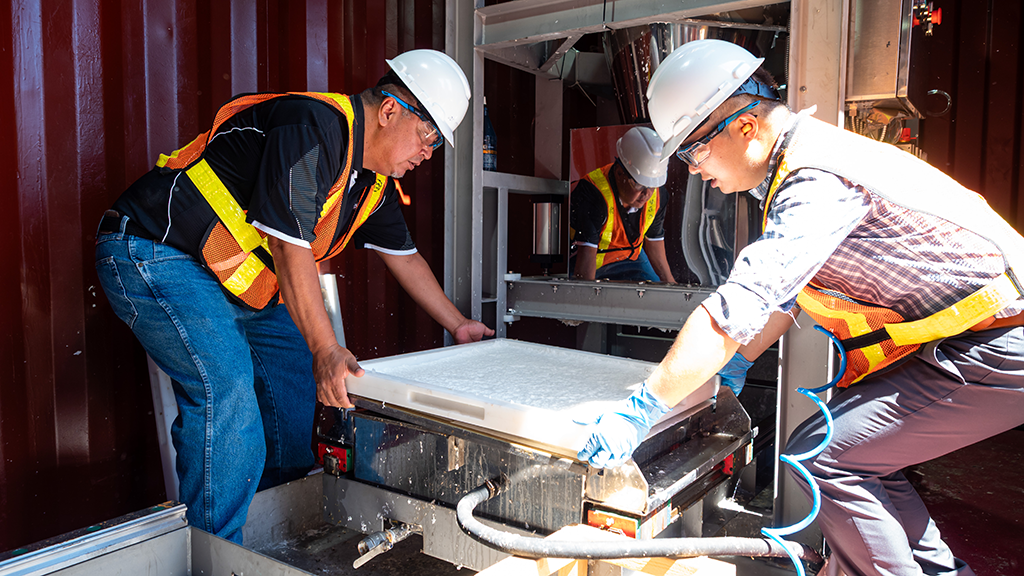
The project is being developed through a pilot plant in East Vancouver operated by DicinFoam, a majority-owned subsidiary of YLP. The technology produces what is known as wood foam, an environmentally friendly alternative to conventional plastic foam packaging.
Plastic foam products such as Styrofoam remain widely used because of their practical properties, but millions of tonnes end up in landfills every year, where they can persist for more than 500 years. Wood foam offers a significantly different end-of-life profile, breaking down in soil within only a few weeks.
The wood waste used in the process comes from B.C. sawmills, municipal solid waste streams and paper recycling sources, according to Reg Ogen, president and CEO of YLP.
The project grew out of YLP’s partnership with Dr. Feng Jiang of UBC’s Department of Wood Science.
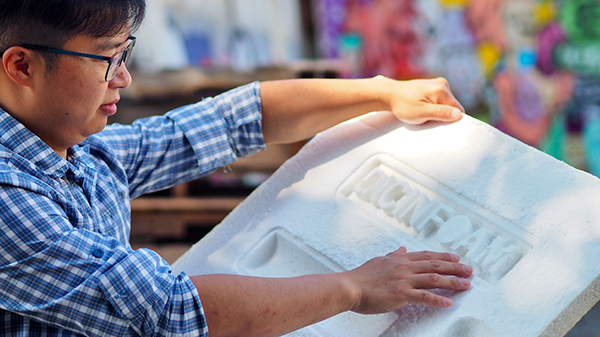
The name Dicin, pronounced DIH-chun, comes from the Wet’suwet’en word for wood.
Dr. Yale Zhu, co-founder of the technology and chief technology officer at YLP, explains that the manufacturing process begins by cleaning and processing wood waste residuals into fibres. Those fibres are then mixed with water and non-toxic substances to create a slurry.
The mixture is subsequently shaped in a mold, de-watered and oven-dried, resulting in a lightweight foam made from wood.
“The wood foam is designed to be an alternative to Styrofoam, with several applications,” says Zhu. “We’re focused on protective packaging and thermal insulation.”
Beyond packaging, the material could also have applications in construction. Zhu says wood foam could be used as a thermal insulation panel or as loose batting.
At the Vancouver pilot plant, the team is also evaluating which additives provide the most effective organic waterproofing, insecticide-proofing and fireproofing properties for the intended applications.
Commercialization still ahead
Wood foam packaging is not yet commercially available.
The immediate objective is to complete the proof of concept over the next 12 months. If regulatory agencies are satisfied with the results, Zhu says the company hopes to have products on the market within two years.
The initial price is expected to be approximately 20 per cent higher than that of an equivalent plastic foam product.
However, Zhu believes the cost gap can narrow as manufacturing volumes increase and production is scaled up.
The project’s longer-term plans are considerably more ambitious.
The next stage calls for a larger facility in Burns Lake, B.C., located within Wet’suwet’en territory. The proposed plant would have the capacity to produce 1,000 tonnes of biodegradable foam annually.
The facility would also serve as the foundation for a forest-based innovation hub and is expected to create as many as 15 jobs.
YLP has applied for government funding for the expansion but has not yet received a response.
Zhu says the project’s schedule will also depend on completion of the proof of concept, which the team currently expects to achieve in 2027.
Building a forest-based bio-economy
The vision for Burns Lake extends beyond the production of packaging.
The proposed facility is intended to help build a stronger forest bio-economy while ensuring significant participation from First Nations.
“It would be a collaborative hub that supports research and development of innovative sustainable uses for lumber and forest products,” says Zhu.
YLP believes Indigenous perspectives and knowledge can play an important role in developing new uses for forestry resources and strengthening the traditional forest industry, particularly in value-added manufacturing.
That approach is rooted in the origins of the project itself.
YLP was established in 2012 with a mandate to improve the well-being of Wet’suwet’en First Nation members today and for future generations.
According to Zhu, the idea for making better use of forestry residuals was influenced by Wet’suwet’en First Nation Elders.
“Six years ago, this was a unique relationship between a First Nation business entity and UBC where ideas came together in a lab,” says Zhu. “Our idea came from the Wet’suwet’en First Nation Elders, who asked why we are so disrespectful to each tree we harvested, even after it had nourished us, only to leave 30 per cent to be piled up and burned. Why can’t we find a use for the portion that we burn?”
Plans for further expansion
The Burns Lake project would not be the final stage of the initiative.
YLP also hopes to eventually develop a 15,000-tonne facility on Vancouver Island. That operation is projected to create between 35 and 60 new jobs.
The partnership has also established an unusual intellectual property arrangement between the First Nation business entity and UBC.
The intellectual property behind the wood foam technology is jointly owned by YLP and UBC. Zhu says the arrangement is among the first in UBC’s history in which the university has shared ownership of intellectual property for a technology developed entirely or partly through its research.
YLP holds the exclusive license for distribution rights to the technology.
The partnership also aligns with UBC’s Indigenous Strategic Plan, which supports research initiatives described as reciprocal and community-led, while recognizing Indigenous ways of knowing and promoting Indigenous peoples’ self-determination.
For Ogen, the partnership with UBC has been essential to moving the project forward.
“Without UBC’s assistance and willingness to partner we would not have had the opportunity to access critical resources in business development, IP registration and management, engineering, wood science and forest management.”
The project now sits at the intersection of forestry, packaging innovation, waste reduction and Indigenous economic development, with the proof-of-concept phase expected to determine the next step toward commercial production.