



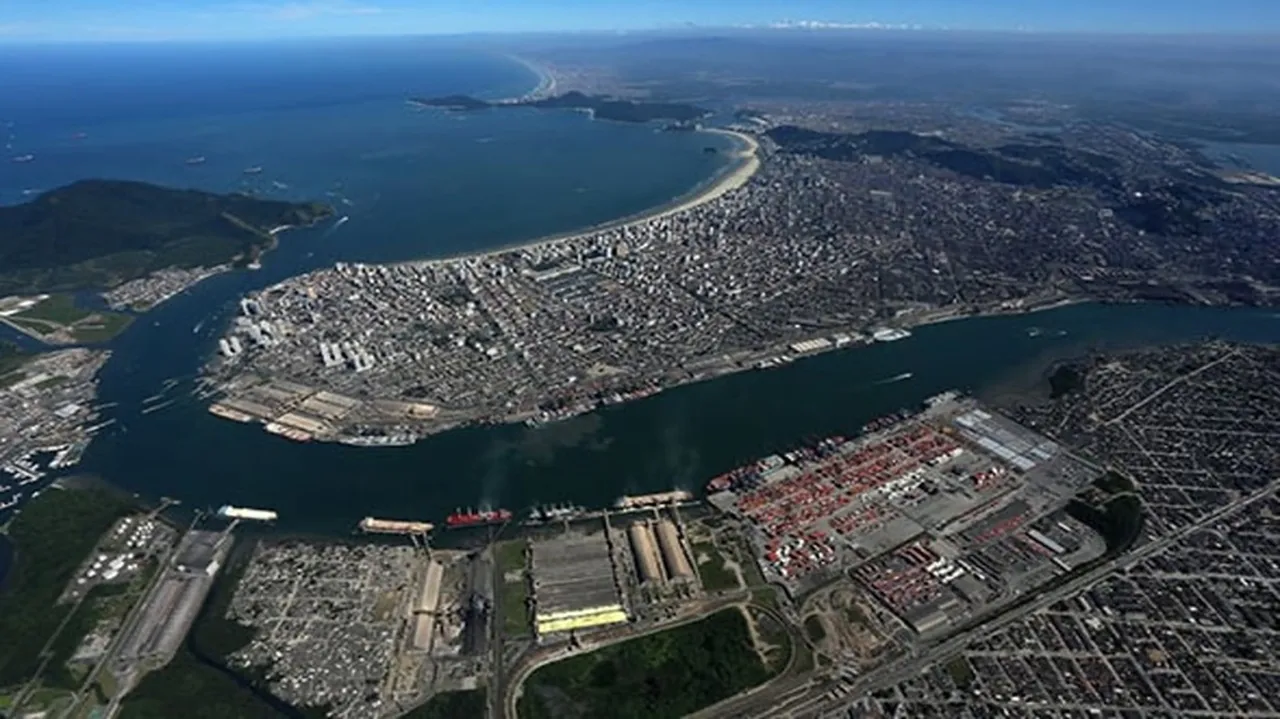
The long-awaited auction of Tecon Santos 10, the major new container terminal planned for Brazil’s Port of Santos, could finally move closer to a resolution.
A technical working group (GTT), established by the Brazilian federal government in July to examine possible changes to the auction model, is expected to deliver its conclusions this month, according to National Ports Secretary Alex Sandro de Ávila.
Once the report is completed, the National Ports Secretariat is expected to review its findings and forward the process to Brazil’s National Waterway Transportation Agency (ANTAQ) during the same month.
Even so, there is still no official date for the auction, a process that has already been delayed for several years.
The GTT has been working on the issue for around two months and has held between four and six meetings, in addition to discussions involving the Secretary and his own team.
“It is an issue that has been extensively debated,” de Ávila said during the Porto & Mar Meeting conference in Rio de Janeiro.
The creation of the working group in July represents another stage in an ongoing disagreement over which companies should be eligible to compete for the mega-terminal.
A dispute over who can bid
The controversy dates back to December 2025, when Brazil’s Federal Audit Court (TCU) approved a two-stage auction model.
Under that framework, companies already controlling container terminals in Santos, as well as shipping lines and shipowners, would be excluded from the first phase. They would only be allowed to participate in a second round if the initial stage failed to produce a valid bid.
ANTAQ, which had previously reviewed the process, had also recommended restrictions on companies already operating in the port.
The issue was subsequently reopened after differences emerged within Brazil’s executive branch.
The Chief of Staff’s Office has supported a tender open to all interested parties, while the Ministry of Ports and Airports (MPor) has backed the restricted model.
The process was suspended in April to allow further discussions, leading to the creation of the GTT in July.
The government is also under pressure from major European and Chinese shipping companies seeking access to the auction. Those companies would be excluded under the restrictions currently being considered.
Santos expansion under pressure
While the rules surrounding the auction remain disputed, the need for additional container capacity at Santos is becoming increasingly difficult to overlook.
The expansion of the port is regarded as unavoidable as throughput approaches full capacity.
During the first seven months of the year, deepsea container movements at the Port of Santos reached 1.73 million teu. That total included 793,347 teu of exports and 934,259 teu of imports.
For ANTAQ Director Alber Vasconcelos, changing the agency’s existing position would not be straightforward.
“It is possible to change [ANTAQ decision], but I think it is difficult,” he said. “I’m speaking as an agency director. Changing an agency’s decisions weakens the very sector it regulates.”
A $1.3 billion project
Tecon Santos 10 is widely regarded as the most anticipated project in Brazil’s port sector.
The $1.3 billion terminal is expected to increase the Port of Santos’ container handling capacity by approximately 50%.
The project would initially be awarded under a 25-year contract, with the possibility of renewal for up to 70 years.
Tecon Santos 10 is planned to occupy 621,900 sq metres on the Saboó quay in Santos.
The terminal is expected to have a static capacity of 3.5 million teu more than half of the total volume handled across the Santos waterfront last year.
With demand continuing to put pressure on existing infrastructure, the conclusions of the government’s technical working group could become a key step in determining how Brazil ultimately proceeds with one of its largest and most closely watched port projects.