



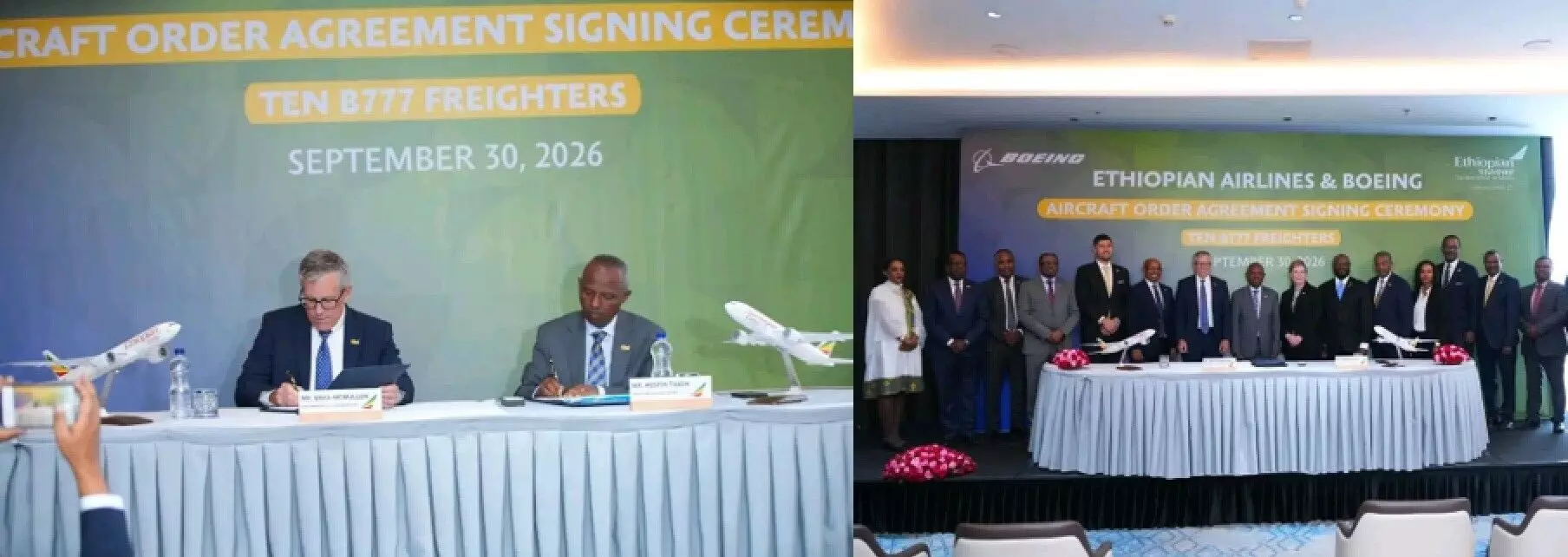
Ethiopian Airlines has placed a major new bet on air cargo, signing an agreement with Boeing on Wednesday (30 September) for 10 factory-built freighters.
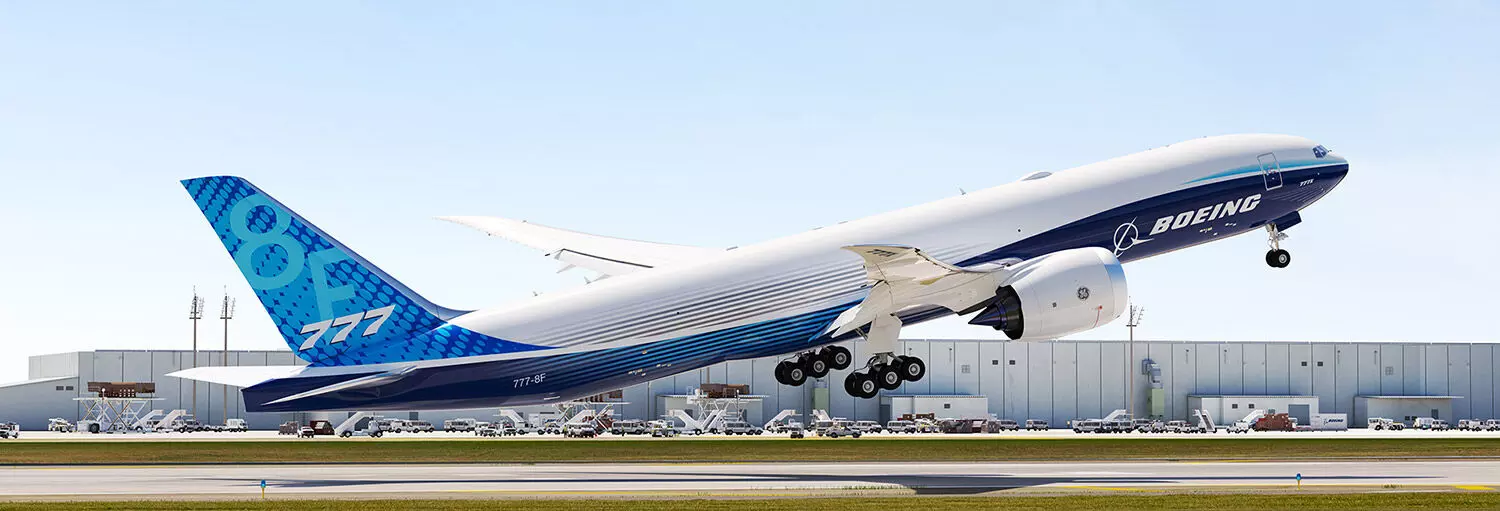
The order comprises eight of Boeing’s next-generation B777-8F, which has yet to receive certification, alongside two B777-200Fs from the current generation. The B777-200F remains the most widely operated twin-engine widebody freighter in service. Ethiopian has also secured options for eight additional B777-8Fs.
Ethiopian Airlines CEO Mesfin Tasew announced the deal during a signing ceremony in Addis Ababa. He said the aircraft have a combined catalogue value of $5 billion, although the actual purchase price agreed between the two companies remains confidential.
The order had been anticipated earlier this month. Reuters, citing industry sources, reported on 2 September that Ethiopian Airlines was nearing a Boeing freighter agreement.
The state-owned airline already has one of Africa’s largest freighter fleets. It operates 12 B777Fs, three Boeing 767 freighters and four converted 737s on medium-haul routes, within an overall fleet of more than 140 aircraft.
At the same time, Ethiopian Airlines is helping finance a $12.5 billion airport development programme that officials describe as Africa’s largest airport. The first phase of the project is scheduled to open in 2030.
Why the 777-200F is still being built
Ethiopian’s decision to add two more B777Fs comes at a time when Boeing is facing a regulatory deadline for the aircraft.
Under emissions rules adopted by ICAO in 2017 and subsequently incorporated in the United States, Boeing would have been required to end B777-200F production by the end of 2027.
The regulations prohibit newly built aircraft that exceed specified fuel-efficiency and CO2 limits from receiving their first airworthiness certificate after 1 January 2028. Because the GE90-powered B777F does not meet those limits, production would otherwise have ended on 31 December 2027.
Boeing petitioned the FAA in December 2025 for regulatory relief, pointing to delays affecting the 777-8F. The FAA has since approved an exemption covering up to 35 newly built 777Fs receiving their first airworthiness certificates from 1 January 2028 through the end of 2030.
The exemption is intended to provide a bridge until the 777-8F becomes available.
That extension reflects continued market demand for the aircraft. Boeing delivered 35 B777Fs in 2025 and another 18 by 31 August 2026. The manufacturer still had 38 aircraft remaining to deliver at that point.
FedEx accounts for eight of those aircraft, Saudia for four and Emirates for three. China Airlines, China Southern Cargo and Silk Way West Airlines each have two.
The remaining 17 aircraft are not allocated to active airlines. Six are listed under Volga-Dnepr UK Limited, the UK subsidiary of Russian cargo carrier Volga-Dnepr, which is insolvent and in administration and is therefore effectively defunct as an operating airline.
Boeing lists the other 11 aircraft against “unidentified customer(s)”. It remains unclear whether Ethiopian Airlines’ two additional B777Fs are included within the existing 38-aircraft backlog or are being added on top of it from this group of 17.
777-8F still some way off
The aircraft Ethiopian is buying for the future is not yet ready to enter service.
The 777-8F, which is designed to comply with the new emissions standards, is currently targeted for entry into service in 2029. Some customers, however, already expect the programme to slip to 2030.
The broader 777X programme is also running behind its original schedule. Certification is now targeted for 2026, while the passenger 777-9 is planned to enter service in 2027.
The 777-9 was originally expected to enter service in early 2020.
Airbus A350F takes to the air
Ethiopian’s Boeing agreement comes just as Airbus puts its own new-generation freighter into the air, giving the long-established Boeing freighter franchise its first serious challenger.
Airbus’s A350F completed its maiden flight from Toulouse on Tuesday (29 September). The first flight-test aircraft, MSN700, remained airborne for four hours and 10 minutes, reaching 25,000 feet and an indicated airspeed of 340 knots.
The aircraft is powered by Rolls-Royce Trent XWB-97 engines and is designed to carry as much as 111 tonnes over distances of up to 8,700 km.
Airbus says the A350F can deliver up to 40% lower fuel burn and CO2 emissions than competing aircraft in the same payload-range class. The company also describes it as the first new freighter specifically designed to fully comply with ICAO’s latest CO2 standards.
Sarah McLaren, Airbus head of widebody and freighter marketing, described the aircraft as “built by Airbus, but really it is designed by the market”.
Airbus had secured 115 A350F orders from 14 customers by the end of August, which it says represents up to 59% of the large freighter market.
Etihad Airways alone has 10 A350Fs on order.
The A350F is positioned directly against both the B777-200F and Boeing’s future 777-8F. With Boeing’s successor still awaiting certification, Airbus now has something its rival does not: a new large freighter that has already taken to the skies.