



U.S. Customs and Border Protection said an empty semi-trailer headed for Canada had an estimated 450 pounds of cocaine hidden under the floor. Officers seized the shipment Sept. 22 at the Lewiston Bridge crossing in New York, where the narcotics had an estimated street value of about $6 million.
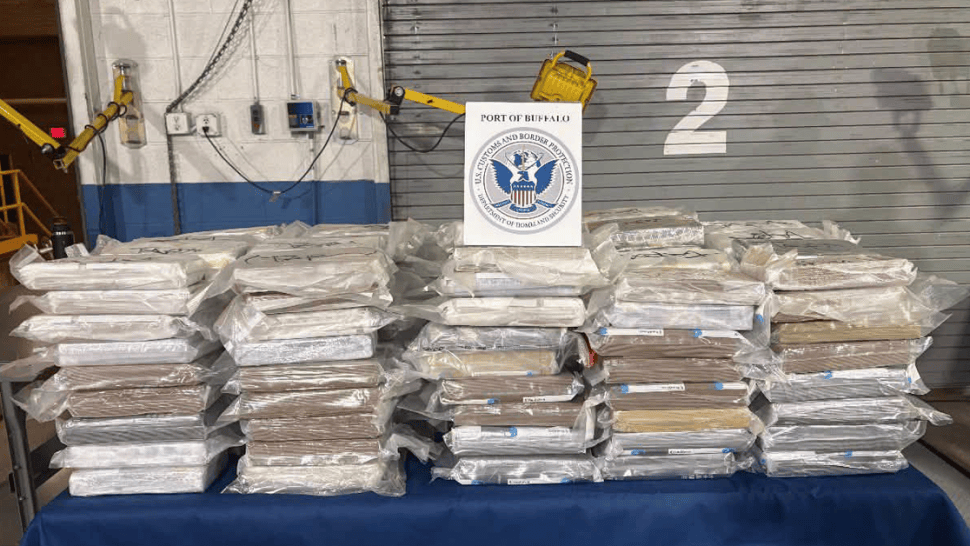
The investigation eventually discovered 174 vacuum-sealed packages hidden in a modified section of the trailer.
The incident occurred in an outbound lane at the Port of Buffalo crossing. The commercial truck and trailer was operated by a 21-year-old male Canadian citizen who was en route to the Canadian border when CBP officers performed a primary physical inspection.
During that inspection, officers observed suspicious alterations to the trailer floor. A CBP canine was then brought in to search the empty equipment and alerted to the presence of narcotics.
Officials took the truck and trailer to secondary inspection for a closer look. Officers used non-intrusive inspection technology to inspect the equipment and discovered anomalies on the floor of the trailer. Hidden packages were later found in a physical search.
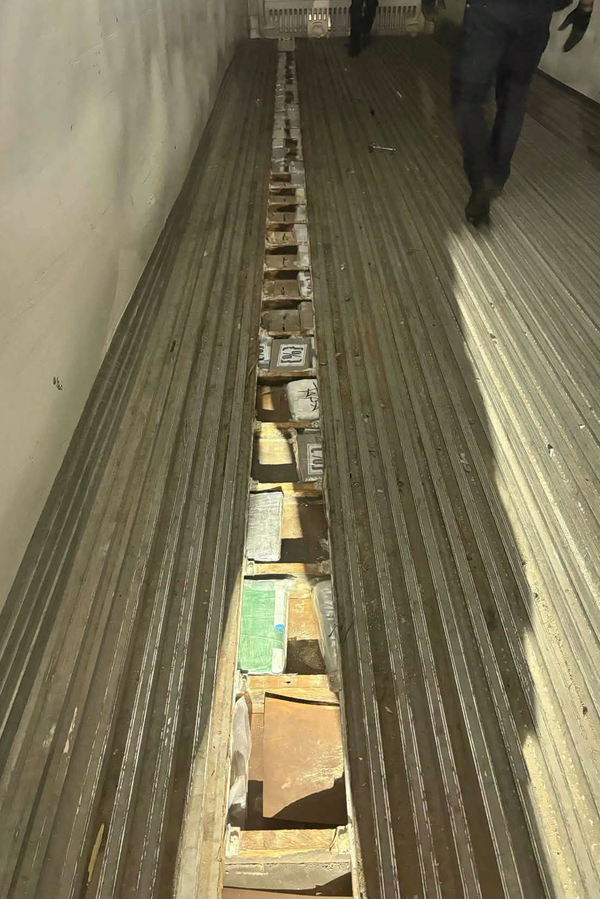
174 Packages of Cocaine Hidden Under the Floor
Investigators field tested the suspected substance after removing the vacuum sealed bundles. The test came back positive for cocaine.
The combined weight was estimated at approximately 450 pounds and the street value of the narcotics was estimated at approximately $6 million, CBP said.
The case was forwarded to Homeland Security Investigations Buffalo for further investigational review. CBP did not identify the driver in an announcement Sept. 29. Officials also declined to say more about who owns the equipment or where the shipment originated.
Sharon Swiatek, acting port director, Area Port of Buffalo, said, “The officers and canine teams involved in this seizure should be commended.
“This large seizure highlights the high level of vigilance, sophisticated training and tireless dedication of our CBP officers and canine teams,” Swiatek said, noting specifically personnel working at the Lewiston Bridge border crossing.
Her comments also highlighted the agency’s outbound enforcement mission.
CBP Stresses Importance of Outbound Inspections
Although much of our border security mission is focused on inbound threats, “CBP personnel are no less sharp on outbound operations,” Swiatek said.
Those outbound efforts target transborder criminal networks, the movement of dangerous narcotics and protecting communities on both sides of the US-Canada border, her statement said.
CBP inspects international travelers and cargo arriving through U.S. ports of entry. Its work involves inbound and outbound movements, with officers on the lookout for narcotics, undeclared currency, weapons and counterfeit consumer products.
The agency’s enforcement responsibilities include banned farm products, invasive pests and other illegal items.
The Lewiston seizure is not the first recent case of contraband concealed under commercial transportation equipment.
In August, CBP officers in California found more than $20 million in cocaine concealed under the floorboards of a commercial trailer.
The earlier seizure involved 1,002 pounds of cocaine discovered during a search at the Otay Mesa Port of Entry. Authorities found irregularities in the structure of the trailer before the discovery of the narcotics.
Why this seizure matters for commercial vehicle inspections
The trailer that was headed to Canada was officially empty, so there was no cargo to check. But the equipment itself had been modified to hide about 450 pounds of cocaine under the floor.
The case highlights the need to inspect commercial vehicles’ structure as well as their visible cargo. At the border, enforcement personnel can use physical checks, canine teams and nonintrusive inspection technology together to identify key indicators of changes that might otherwise go undetected.