




Long Beach, California – The Federal Motor Carrier Safety Administration (FMCSA) expects to improve the user-facing experience of its troubled Motus registration system within “hopefully” the next few weeks, according to deputy administrator Jesse Elison.
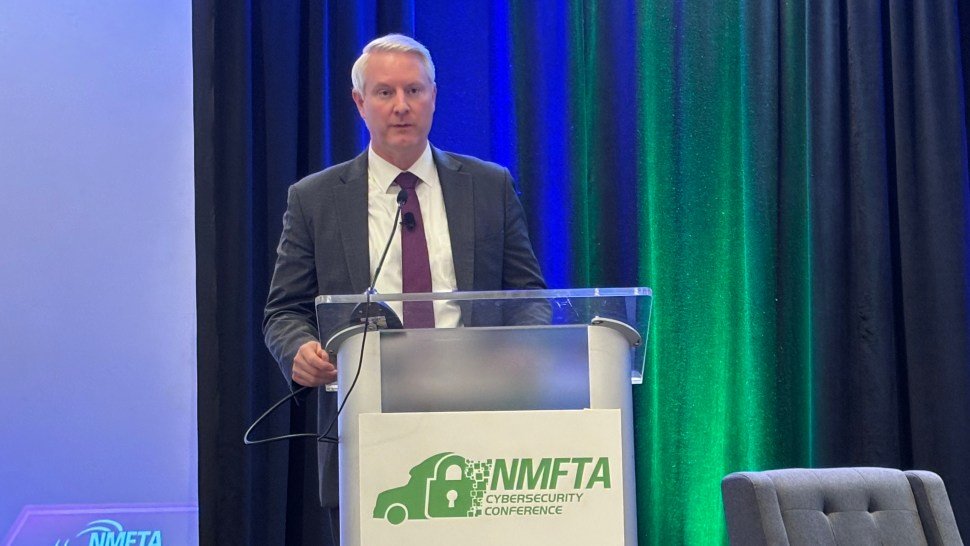
Speaking at the cybersecurity conference of the National Motor Freight Traffic Association, Elison said the agency is closely tracking the timelines and schedules associated with efforts to address the problems that have affected Motus since its rollout earlier this year.
Asked specifically about when users could expect a more functional experience, Elison said the improvements should be measured in an unspecified number of weeks. The federal registration system, operated by FMCSA, has faced widespread difficulties since its launch, with the rollout broadly viewed across the industry as highly problematic.
The timeline is less certain for the system’s backend. Elison said that while the agency is working to make the user interface smoother, improving the underlying backend capabilities “will be ongoing for some time.”
A responsibility FMCSA could no longer defer
Elison defended the agency’s decision to push ahead with Motus under FMCSA administrator Derek Barrs, arguing that the current administration moved more aggressively than its predecessors to bring the system online.
He noted that the modernization was not a new requirement. Rather, he described it as a “decade-long statutory obligation of FMCSA.”
“It’s a huge challenge, but we were not going to punt that responsibility,” Elison said. “The industry deserved that FMCSA followthrough, and so we went after it.”
FMCSA launched Motus on May 14 with what Elison described as a “high level of confidence” that the implementation would succeed. The reality after launch was considerably different.
“Those following weeks were really really tough,” he said, explaining that the system the agency had built was not working as expected. Attempts to correct the problems sometimes made the situation worse.
Elison said FMCSA has nevertheless made “really great strides” over the past couple of months toward stabilizing Motus.
But he acknowledged that the system remains short of the standard the agency needs to achieve.
Reliability remains a central issue
For Elison, one of the most important requirements is ensuring that Motus provides data that the trucking industry can depend on.
The user-facing side of the system must also become seamless, allowing carriers and other users to enter and navigate the platform without the difficulties experienced during the initial rollout.
“We’re going to get there,” Elison said.
In the meantime, FMCSA has taken temporary policy measures in response to the continuing problems.
The agency most recently suspended enforcement of the biennial registration update requirement and the associated deactivation of Department of Transportation numbers for carriers that had not completed the update.
FMCSA announced the temporary suspension on September 10. It applies to carriers whose biennial registration requirement came due after June 1.
Motus and the fight against freight fraud
Despite the system’s continuing shortcomings, Elison maintained that FMCSA is in a better position today than it was immediately after the rollout.
“We’re much better off today than we were yesterday,” he said.
One of the anticipated benefits of Motus is a stronger barrier around access to FMCSA records. The agency sees that as particularly important because those records can be exploited by perpetrators involved in freight fraud.
Elison said the registration system represents a critical point of entry that FMCSA must secure if it is to limit the activities of fraudulent actors.
“We know that it is a point of entry that we have to get right in order to combat the bad actors, and we’re going to do that,” he said.