




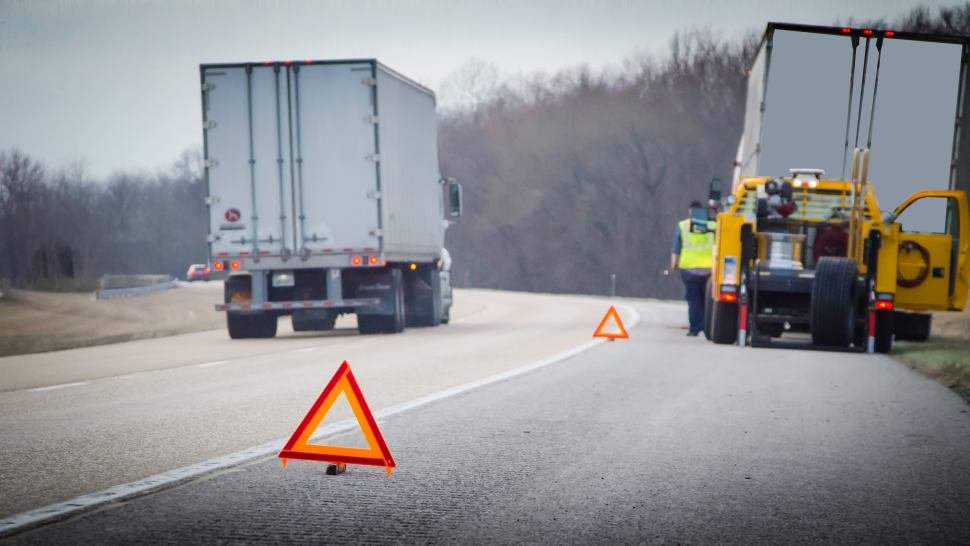
The dispute over whether autonomous trucks should be allowed to use cab-mounted warning beacons instead of reflective triangles or flares is moving toward another key deadline, with the Federal Motor Carrier Safety Administration’s latest waiver set to expire at 11:59 p.m. on Oct. 9.
Under the waiver’s terms and conditions, the authorization will be reissued unless there is a violation of its requirements, a carrier reports a safety concern or FMCSA identifies a safety deficiency. That reissuance language has appeared in each of the four three-month waivers the agency has granted to Aurora since October 2025. In every case, the next waiver took effect the day after the previous one expired.
An Illinois cargo van operator is now asking the 7th U.S. Circuit Court of Appeals to stop that cycle.
Kostas Giannoulias wants the court to stay the current waiver and prevent FMCSA from issuing a successor while his legal challenge proceeds. In a Sept. 21 filing, Justice Department attorneys representing FMCSA argued that the waiver would expire in less than 18 days and that Giannoulias had not demonstrated that he would suffer harm before then. The government’s response did not address the waiver’s reissuance provision.
Giannoulias, who is representing himself, returned to that issue in a Sept. 22 reply.
“The order’s promised reissuance also defeats FMCSA’s suggestion that only eighteen days matter,” he wrote.
As of Oct. 2, the court had not ruled on his request.
The waiver applies to Aurora and to any carrier operating Level 4 automated trucks that notifies FMCSA and certifies compliance with the waiver’s terms.
The dispute follows FMCSA’s December 2024 rejection of a five-year exemption sought by Aurora and Waymo. Aurora subsequently sued the agency in the D.C. Circuit in January 2025. When FMCSA issued its first waiver that October, Aurora described the beacons as “a step forward for road safety” and said it would seek dismissal of its challenge.
FMCSA published another five-year exemption request from Aurora in April. The public comment period ended May 15, and the request remains pending, according to the government’s court filing.
As summarized by FMCSA, Aurora argues in that request that warning beacons “eliminate the need for a human to exit the CMV onto the shoulder or traffic lane of a road.”
In his Sept. 8 petition, Giannoulias argues that the July waiver the latest in the series exceeds FMCSA’s statutory authority and is arbitrary and capricious. He also argues that the agency should have used either the exemption or pilot-program process, both of which require public notice and an opportunity for comment.
FMCSA argues exposure is limited
FMCSA’s response portrays the likelihood of Giannoulias encountering a truck covered by the waiver as extremely low.
Including Aurora and Kodiak, the government said, only about 45 self-driving trucks would be operating under the waiver, compared with more than 3,000 miles of interstate highway in Texas.
“Giannoulias’s chances of actually encountering a truck covered by the waiver are vanishingly small,” DOJ attorneys wrote. “The odds of his encountering such a truck when it was disabled are even smaller.”
Three carriers besides Aurora have opted into the waiver: Kodiak Robotics, Waabi Logistics and Stack AV, which joined after the July waiver was issued.
According to the government, Kodiak had deployed 20 driverless trucks as of March 10. Waabi and Stack AV had deployed none as of July 31. Aurora, meanwhile, told FMCSA in its exemption request that it expects to have more than 200 Level 4 trucks operating by the end of 2026.
Giannoulias operates a 2024 Ram ProMaster 2500 and hauls spot-market freight. In a declaration, he said he made at least six trips in July and August involving Dallas, Houston, Austin, Laredo and El Paso. Several of those cities are located along Aurora’s driverless routes.
The Justice Department also argues that Giannoulias cannot bring his challenge under the Hobbs Act because he did not participate in the waiver process. It further says that his Sept. 3 request asking FMCSA to reconsider the waiver remains pending, meaning the waiver is not yet final as to him.
On the substance of the challenge, the government maintains that federal law does not prohibit successive waivers. It pointed to two FMCSA waivers issued during the COVID-19 pandemic that were each renewed seven consecutive times.
The government also argued that regulations governing waiver requests do not prevent FMCSA from issuing a waiver on its own initiative. It identified the unusual circumstance underlying the current waiver as “the operation of a CMV without a driver who can place warning devices on the roadway.”
FMCSA also relied on findings in the July waiver concerning Aurora’s study of how motorists respond to warning devices. At straight roadway locations, the difference in driver response between beacons and warning triangles was “less than four-tenths of one percent,” according to the agency.
The government further said that no crashes involving a truck operating with an activated beacon had been reported since the waivers began.
“If the mere fact that Giannoulias occasionally takes his cargo van to Texas means that he faces irreparable harm, then literally anyone who occasionally drives in Texas does too,” the filing said. “To state that proposition is to refute it.”
Reply challenges study and points to Aledo crash
Giannoulias disputes the government’s estimate of 45 trucks. He argues that the figure reflects publicly announced driverless deployments, while the waiver covers Level 4 trucks regardless of whether a human is physically aboard.
Aurora told FMCSA that it had 109 Class 8 trucks, and Giannoulias’s reply says most were equipped with the Aurora Driver system and warning beacons.
He also challenged the government’s interpretation of Aurora’s naturalistic driving study. According to his filing, the study found a 44.48% response rate to beacons compared with 44.06% for triangles.
“A failure to reject equality is not