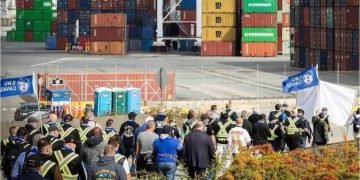




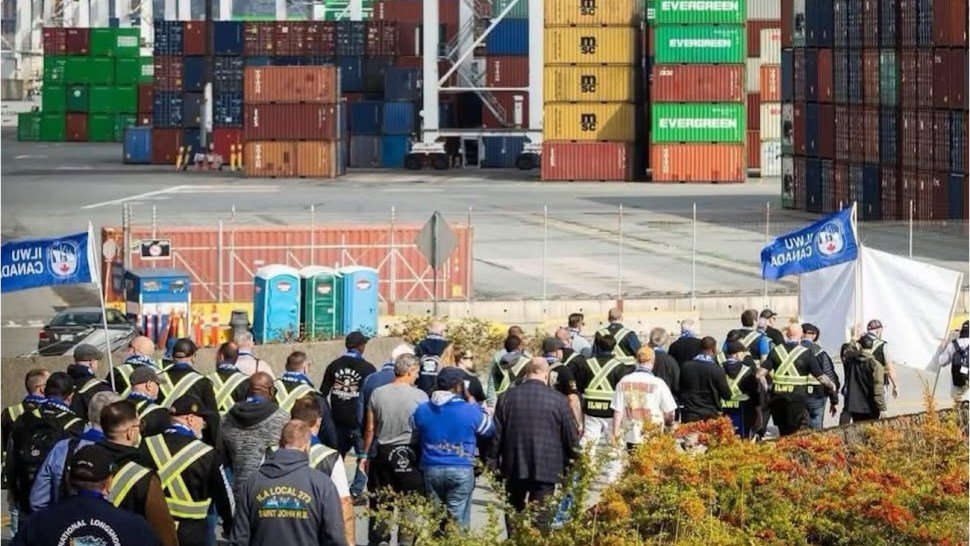
About 100 dockworker union delegates from Canada, the United States, Australia and New Zealand gathered outside DP World’s Centerm container terminal at the Port of Vancouver last week, launching an international campaign against what they see as the growing threat of automation and artificial intelligence to port jobs.
The demonstration came after the International Dockworkers Anti-Automation Summit, held at Vancouver’s Maritime Labour Centre in late September. On Sept. 23, delegates marched to the DP World terminal after agreeing on a common position: they support technology when it improves safety and benefits port communities, but oppose its use to eliminate jobs, outsource work, increase surveillance, weaken unions or lower safety standards.
The issue is likely to become increasingly important in British Columbia, where the current longshore agreement is scheduled to expire in March 2027. How automation affects employment, work rules and collective bargaining rights is expected to feature prominently in negotiations.
Tom Doran, president of the International Longshore and Warehouse Union Canada, said the participating unions had come together around what he described as a shared threat posed by employers adopting automation and AI.
He specifically pointed to Dubai-based DP World, whose operations include Vancouver’s Centerm terminal, as a company at the heart of longshore workers’ concerns.
“Dock workers are united and determined to hold the line on destructive automation in our ports, no matter where those ports are,” Doran said in the union’s announcement.
DP World is also supporting a major container project at the Port of Montreal, as well as an expansion at Port Saint John on Canada’s east coast.
A global labor campaign
The Vancouver summit brought together representatives from ILWU Canada and the U.S.-based International Longshore and Warehouse Union; the International Longshoremen’s Association in Canada and the United States; the Maritime Union of Australia; the Maritime Union of New Zealand; New Zealand’s Rail and Maritime Transport Union; Montreal’s CUPE Local 375; the International Transport Workers’ Federation; and the International Dockworkers Council.
Together, the unions are calling for technological changes to be negotiated with workers before they are introduced. Their joint principles reject:
-
Automation used as a tool to undermine or break unions
-
New technology introduced without a “social dividend” for workers
-
Technology-driven job cuts or reductions in wages and benefits
-
Automation that weakens safety protections or replaces secure waterfront employment without negotiated safeguards
Dennis Daggett, president of the ILA Atlantic Coast District and general coordinator of the International Dockworkers Council, said the consequences of waterfront job losses go well beyond the terminals themselves. According to Daggett, reduced employment can also affect the businesses and communities that depend on the incomes generated by port workers.
Vancouver’s Centerm dispute
The demonstration put renewed attention on DP World’s Centerm facility, one of the Port of Vancouver’s major container gateways and a key connection between Asian trade lanes and inland markets in Canada and the United States.
DP World’s major modernization program at Centerm has significantly expanded the terminal’s capacity. Once completed, the project increased annual container-handling capacity from 900,000 to 1.5 million TEUs, while also adding rail capacity, electrifying equipment and enabling larger vessels to call at the terminal.
The facility has two berths, 15,000 feet of on-dock rail, 19 rubber-tired gantry cranes and five electrically powered semi-autonomous rail-mounted gantry cranes.
Vancouver’s strategic importance has also grown as U.S. trade policies have reshaped container flows. The Trump administration’s tariff and trade policies have encouraged a shift in containerized import traffic away from U.S. West Coast hubs and toward Vancouver and the Port of Prince Rupert, also in British Columbia. From there, cargo can enter the U.S. market through intermodal rail connections.
Those modernization investments have consequently made Centerm a prominent symbol in the broader debate over automation at ports.
In 2024, ILWU Local 514, which represents ship and dock forepersons, accused DP World of planning to introduce automation in Centerm’s rail intermodal yard without first bargaining with the union over the technological changes.
The dispute was one of the factors behind a strike notice issued against DP World. The Canada Industrial Relations Board subsequently ruled that the union’s strike vote was unlawful and ordered the notice withdrawn.
The union’s wider concern is that new terminal technology can change staffing levels, dispatching practices and job classifications even when it increases capacity or improves equipment performance.
Employers, on the other hand, have argued that investment in digital systems, automated gates, rail operations and remotely operated equipment can increase throughput, improve safety and help maintain the competitiveness of Canada’s Pacific gateway.
Competing views of modernization
DP World and the B.C. Maritime Employers Association have presented the Centerm modernization as an example of how terminal investment can expand cargo capacity while also supporting waterfront employment.
A KPMG report released Oct. 1 for the BCMEA found that Centerm’s capacity had increased 65%, from 900,000 to 1.5 million TEUs. At the same time, waterfront payroll hours increased 59%, rising from 835,000 in 2019 to 1.328 million in 2025.
The report attributed those gains to a combination of investment in terminal infrastructure, technology, process improvements and workforce skills.
The unions, however, emphasize that their position is not a blanket rejection of technology. Their argument is that the benefits generated by automation should be shared with workers and the communities that depend on port activity.
They also insist that operational changes resulting from new technology must be subject to meaningful collective bargaining before implementation.