



European armed forces are looking for military trucks in quantities and on delivery schedules that have become difficult to ignore since Russia launched its full-scale invasion of Ukraine. Daimler Truck Defence believes that environment could work in its favor, particularly because its military vehicles rely heavily on the same production facilities, components and industrial infrastructure already used for commercial trucks.
Daimler Truck brought its military activities together under the single Daimler Truck Defence brand in June. The company plans to invest a mid-three-digit million-euro amount over the coming years and has set itself a target of reaching €1 billion in defense revenue by 2028, according to an announcement earlier in June.
The defense organization currently employs around 1,000 people, with further growth expected, particularly at Daimler Truck’s Wörth am Rhein plant in Germany.
“Scaling is one of the key challenges in the defense industry these days,” said Dennis Kinzelmann, CEO of Daimler Truck Defence and head of Mercedes-Benz Special Trucks, during a media roundtable at IAA Transportation in Hanover, Germany.
Kinzelmann linked the urgency directly to the war in Ukraine and the broader security outlook in Europe.
“Unfortunately, with the, I would say, full-scale invasion of Russia into Ukraine, it has shown, especially in Europe, that Western societies and governments have to be prepared for widespread and longer-lasting conflicts,” he said. “This means that we also have to have the ability to provide the right equipment at the right time and also at the scale that is needed.”
Two major programs currently form the backbone of the business’s order book.
In January, France’s Ministry of the Armed Forces selected Daimler Truck and French defense company Arquus for the country’s PL6T truck program. Deliveries are expected to extend for more than 10 years, Daimler Truck said in its announcement at the time.
Daimler Truck will manufacture the chassis at Wörth and at its Molsheim facility in France. Arquus is responsible for militarization, protected cabs and vehicle integration at its French sites. According to Kinzelmann, the framework agreement covers up to 7,000 Zetros-based trucks.
“This will basically be the new platform for the land forces of France, with very different applications,” Kinzelmann said.
Canada represents the other major pillar. Daimler is supplying more than 1,500 Zetros logistics trucks under the country’s Logistics Vehicle Modernization program. General Dynamics Land Systems-Canada is the prime contractor, while Marshall Canada is responsible for mission modules, according to Daimler Truck’s 2024 award announcement.
The chassis are built at Wörth and shipped to Canada. There, local partners install the vehicle bodies and, Kinzelmann said, contribute a “substantial” share of the local content.
Germany’s Bundeswehr has also ordered military logistics vehicles in the three-digit unit range, according to Daimler Truck’s June release. Kinzelmann expects France to become the company’s biggest defense customer on the back of the PL6T contract, “closely followed by Canada,” while Germany remains “still on a very important level.”
Civil components underpin the military range
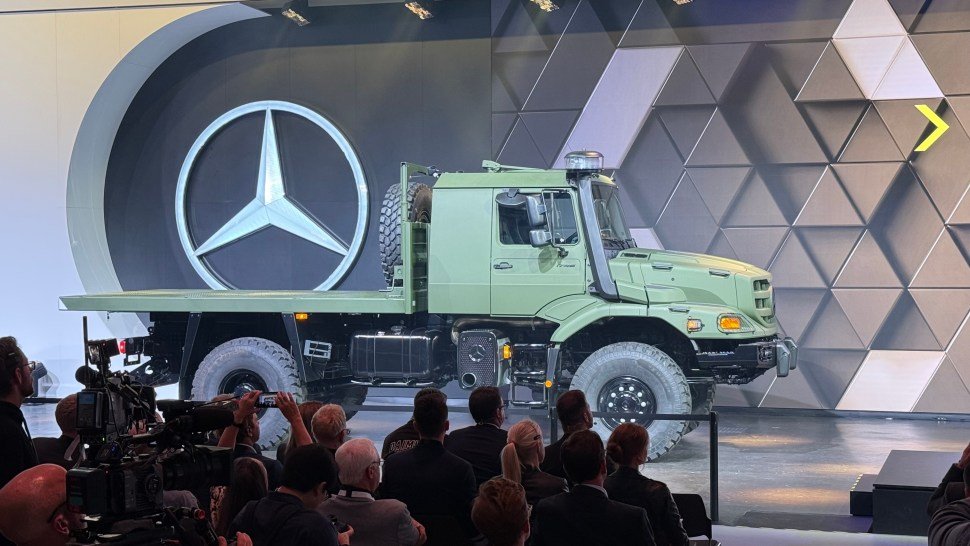
Daimler Truck Defence’s portfolio stretches from the Unimog at the lighter end of the market to the Zetros and the Arocs, the heavy-duty vocational truck sold by Daimler in Europe.
The Arocs can be configured for applications exceeding 100 tons of gross combination weight, Kinzelmann said, while the overall defense lineup spans vehicles “from 10 tons to 100 tons.”
One of Daimler’s main arguments is the amount of commonality between military and commercial trucks.
On a military Arocs, the company can use the same axles, certain transmissions, the engine and the basic cab design found on the civil model. Kinzelmann estimated that shared content could exceed 70% to 80%, although he stressed that he had not formally calculated the exact figure.
The remainder consists of equipment specifically adapted to military requirements.
“Those vehicles and the components that we use typically have been deployed a hundred thousand times already, so well established in the field,” Kinzelmann said.
For Daimler, that established industrial base is also a way to reduce the complexity of scaling output. The company already operates one of the world’s largest truck plants at Wörth and says production volumes can be adjusted relatively quickly.
“Once you’re going to see the Wörth plant, it’s one of the largest truck plants in the world,” Kinzelmann said. “We can switch quite flexibly the volumes depending on the situation.”
A global service network for fleets expected to last decades
Military vehicles are not short-term assets. Kinzelmann said defense customers commonly keep trucks in service for 20 to 30 years, making long-term maintenance and spare-parts availability almost as important as the initial delivery.
Daimler Truck’s aftersales organization operates across more than 160 countries. The defense business can use that existing civil network and parts infrastructure to support military fleets and move spares with the same logistics backbone as the commercial operation.
Kinzelmann pointed to the Unimog as an illustration of that long lifecycle. The vehicle turns 80 this year, and Argentina has recently placed new Unimog orders. During a visit by Argentina’s defense minister to Wörth, Daimler showed the delegation photographs of Unimogs dating from the 1960s and 1970s that are still operating in the country.
“I asked my engineers, how long does a Unimog last?” Kinzelmann said. “And they say, we don’t know because we’ve only been building it for 80 years.”
European procurement remains largely national
Despite the growing pressure to strengthen European defense capacity, military vehicle procurement is still primarily handled country by country.
“It’s still very much a national procurement effort in Europe,” Kinzelmann said.
He said he would like to see greater European alignment develop over time, particularly because closer coordination could help governments close capability gaps more quickly.
Daimler is also relying on partnerships where its own portfolio does not cover a specific capability. Its cooperation with Arquus in France and General Dynamics Land Systems-Canada in Canada are examples of that approach.
Kinzelmann cited Rheinmetall as one of the established defense players in Europe and noted that Scandinavian truck manufacturers also have a role in military vehicle supply.
“To us it’s probably less about competition, but more also about team sport, especially in Europe,” he said. “We need the capabilities now.”
The procurement model is somewhat different in the United States, where Kinzelmann said military buyers are increasingly looking toward what is known as commercial off-the-shelf procurement.
For Daimler, that means starting with a truck already being produced at scale and then modifying it as necessary, while integrating additional equipment supplied by partners.
“It’s always easier to start with what you have available and what might be requested on top of it, instead of just sending a 600-page spec book and then try to meet each and everything,” Kinzelmann said.
The logic is straightforward: every specification removed from a highly customized military design can potentially mean another component sourced directly from an existing civil production line.
Unmanned vehicles are being developed before tenders arrive
Daimler Truck Defence is not waiting for formal procurement competitions in every case. When the company considers a capability strategically important, it can begin development before a tender has even been issued.
Unmanned military trucks are currently the clearest example.
The company is working with partners and already offers its first remote-controlled vehicles. The next steps are expected to involve teleoperation and, eventually, full autonomy. Kinzelmann described that progression as a mid-term development but did not provide a specific target year.
“We’re convinced that unmanned definitely is one of the fields, especially on the defense side, to protect lives where we want to contribute,” he said.
Ukraine and the U.S. remain important markets
Daimler is already selling military vehicles into Ukraine, with Kinzelmann saying that most of those vehicles are Zetros trucks.
The United States is also among the markets being assessed by Daimler Truck Defence. Kinzelmann said the company does not comment on tenders or potential deals that have not yet been officially announced.
For Daimler, the strategy ultimately goes beyond the truck itself.
“A product is not just the new vehicle,” Kinzelmann said. “It’s the whole ecosystem around it, including the after-sales, spare parts, partner ecosystem, technology development that we do globally.”