



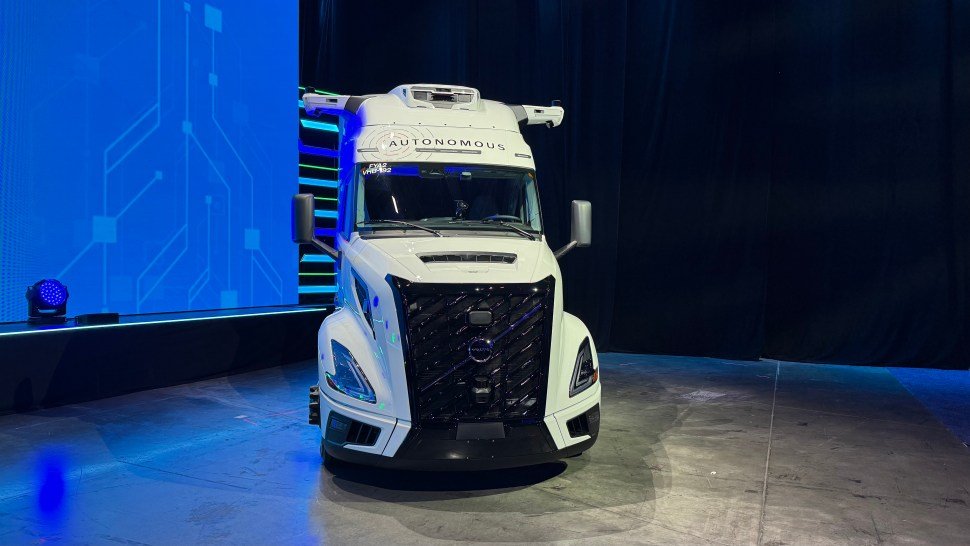
Volvo Autonomous Solutions and Waabi have begun hauling freight for Warp, marking the first customer operation under their partnership. Volvo VNL Autonomous trucks equipped with the Waabi Driver are currently transporting Warp freight directly to third-party facilities along the Dallas-Houston corridor, with a human observer still occupying the driver’s seat.
Warp operates both less-than-truckload (LTL) and full-truckload (FTL) freight through a single network. Its customer base includes Walmart, DoorDash and Gopuff. The company was founded by CEO Daniel Sokolovsky, who previously created AxleHire, before Warp emerged from stealth in 2022.
For Waabi, the partnership offers an opportunity to demonstrate how autonomous driving can improve the efficiency of LTL networks, rather than being limited to conventional truckload operations.
“Warp is a fantastic example where we can demonstrate the value of driving next-level efficiency for LTL consolidation, and remind people that hours-of-service benefits do not necessarily need to translate into a coast-to-coast, team-driving unlock,” said Lior Ron, COO of Waabi, in an interview with FreightWaves.
According to Ron, autonomous technology could also improve efficiency on individual corridors such as Dallas-Houston while enabling continuous consolidation and better utilization across an LTL network.
LTL linehaul operations frequently rely on a slip-seat model, in which one driver operates a tractor for a shift before another driver takes over. Under federal regulations, each driver is limited to 11 hours of driving after 10 consecutive hours off duty.
Ron believes autonomy could eventually remove that operational constraint.
“Imagine a future where you can run those networks and consolidate on a continuous basis without hours of service, and just drive efficiency and utilization,” he said.
The ability to schedule and balance freight networks has become increasingly challenging, Ron added, particularly as capacity leaves the market and fuel costs remain a concern. He also said demand for autonomous transportation has increased since his previous conversations with FreightWaves.
Sokolovsky said the benefits of autonomy become more significant when freight can be coordinated around the technology.
“The value of autonomy grows when you can coordinate the freight around it,” Sokolovsky said in the announcement. “Warp brings together shipments from multiple customers and aligns routes, capacity, and timing, so advances on a single lane can benefit the broader network.”
Driverless Operations Await Volvo’s Purpose-Built Truck
Waabi initially trained its autonomous driving software on a fleet of Peterbilt 579 trucks. This summer, the company transferred the system to the Volvo VNL Autonomous without retraining it.
The Volvo platform is equipped with redundancies covering six safety-critical systems, according to the companies’ announcement.
For Ron, that level of factory-built redundancy is essential to reaching fully driverless operations. Waabi believes autonomous trucks should come directly from an OEM factory, with the necessary redundancy and validation completed by the manufacturer.
“Although we are ready, we are choosing not to retrofit our way into driverless, and to wait until Volvo is ready,” Ron said. “The good news is Volvo is on track. You see their public commitments, and we are fully on track for driverless next year, with Volvo as the first OEM platform.”
Volvo is expected to begin installing Waabi’s system during the first quarter of 2027, according to a Forbes report published last month.
New Lanes Without Additional Retraining
Waabi is also advancing its approach to expanding autonomous operations onto new freight corridors.
Last month, one of the company’s trucks completed the Dallas-San Antonio route for the first time with zero disengagements. Ron said Waabi can map a new lane with a single truck pass, creating a lightweight map that the autonomous system uses as another safety sensor.
Importantly, the truck does not undergo additional autonomy training specifically for that lane, according to Ron.
Waabi has reduced the time required to open a new autonomous lane from three months to three weeks. In the case of the San Antonio route, Ron said, that process effectively reached zero.
“What changes is the ask,” Ron said.
Instead of asking a shipper whether it has freight moving between two particular cities, Waabi can now focus on identifying the customer’s most pressing operational challenge. Ron compared the approach with the conversations he had with customers during his time at Uber Freight, which he founded and led as CEO.
“Let’s solve those pain points with autonomy now, versus waiting for autonomy to catch up,” he said.
The changing perception of autonomous transportation was also evident during a supply chain executive conference in Las Vegas last month. During a keynote, Ron asked attendees how many had ridden in a Waymo vehicle. Around three-quarters of the audience raised their hands.
When asked how many wanted to deploy autonomous technology across their networks within the next three years, roughly half raised their hands.
“We’re on track, and we’re seeing massive customer demand,” Ron said. “It’s crazy, because we’re beyond the early adopters now.”