



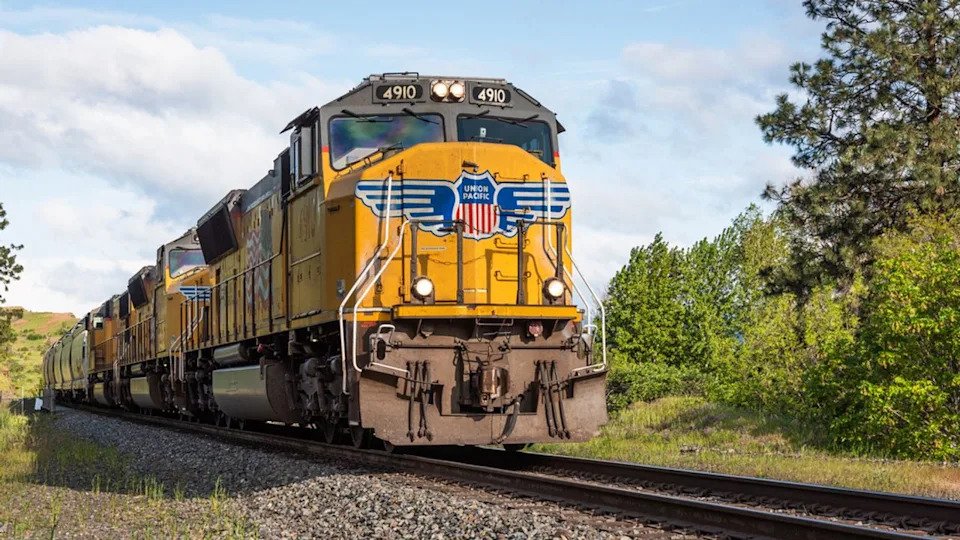
Union Pacific reported strong financial results in the third quarter, with net profit up 16 percent from a year ago, helped by higher freight volumes, pricing gains and fuel surcharges that pushed up revenues. Intermodal traffic was the main growth driver, reflecting stronger demand for container and trailer transport.
Omaha railroad which is traded on the New York Stock Exchange under the ticker symbol UNP, said it earned $2.08 billion, or $3.49 a diluted share. That compares with $1.79 billion, or $3.01 per diluted share, for the same quarter last year. Adjusted earnings were $3.53 per share, versus a consensus estimate of $3.47.
Operating revenue increased 15 percent to $7.2 billion and freight revenue (excluding fuel surcharges) increased 6 percent. Total revenue carloads were up 6% to 2.29 million, reflecting increased traffic volumes across the network.
Intermodal operations showed the biggest gains. Intermodal revenue climbed 27% to $1.52 billion and volumes rose 11% to 956,000 containers and trailers. Industrial volumes also grew 6%, while bulk traffic was broadly flat.
“Union Pacific delivered on the promises we made to our customers and managed a 6% increase in volumes efficiently,” Chief Executive Jim Vena said in a statement on its quarterly results.
Operating income gained 15% to $2.94 billion. The reported operating ratio decreased to 59.1% from 59.2% in the prior year. But the adjusted operating ratio went the other direction, deteriorating 30 basis points to 58.8%.
Fuel prices added 140 basis points to the operating ratio, putting pressure on operating efficiency, the company said. Elsewhere, operational productivity improved, with workforce productivity up 5% and average terminal dwell time down 2% to 19.9 hours.
Looking ahead, Union Pacific reaffirmed its guidance for high single-digit growth in reported EPS in 2026. The railroad also boosted its planned capital spending to $3.5 billion.
Vena also pointed to future milestones in the Surface Transportation Board’s review of Union Pacific’s proposed merger with Norfolk Southern, which trades on the New York Stock Exchange under the ticker NSC. The regulatory review is a key step in the proposed combination of the two railroads.
Why it matters: Union Pacific’s results show how intermodal transportation and improved pricing can improve railroad profitability. Higher sales are helping revenue and earnings increase, but higher fuel prices are still hurting the company. So if the company wants to do well in 2026, it’s going to have to find ways to be more productive and control costs.