



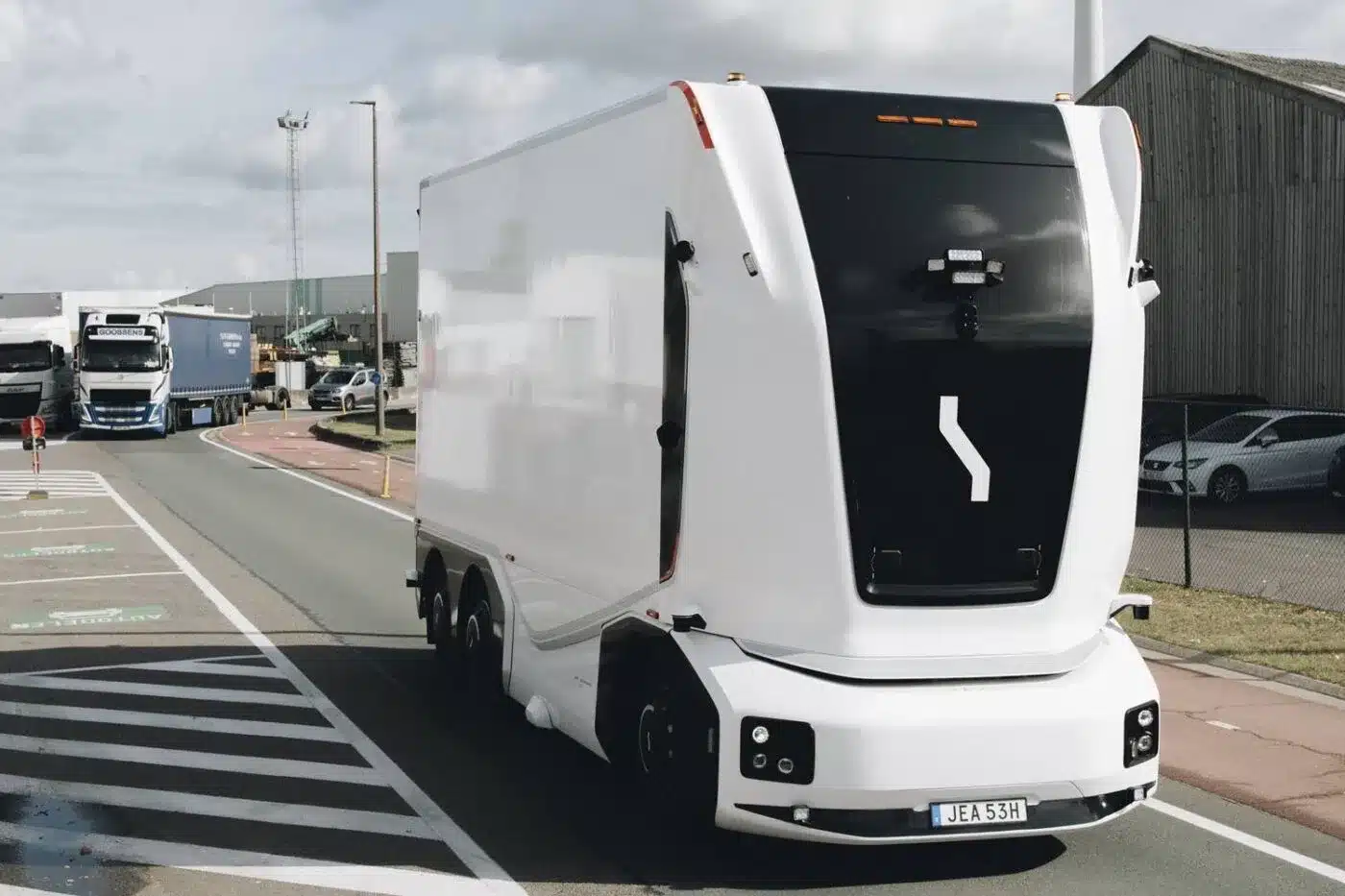
Einride plans to integrate Nvidia’s Alpamayo reasoning-based artificial intelligence driving model into its autonomous driving system, known as Einride Driver, as it seeks to expand its driverless freight operations to additional vehicle types and routes. The Swedish company announced Wednesday that it will adapt the model using its own vehicles, routes and operational data, with a live road evaluation targeted for the second half of 2027.
The initiative builds on the collaboration between Einride and Nvidia announced on September 21, which aims to develop the next generation of Einride Driver using Nvidia’s Hyperion platform. By adapting Alpamayo to its freight operations, Einride expects to shorten development cycles and lower the cost of extending its autonomous technology to new truck configurations and operating environments. Neither company has disclosed the financial terms of the agreement.
The expansion comes as Einride prepares to integrate its autonomous driving technology into additional vehicle platforms. The company is working with DAF and TNO to define and test the integration of its autonomous system into DAF’s electric truck platform throughout 2026. Software integration and commissioning are scheduled for 2027.
Einride’s existing operational experience is central to its decision to adopt Alpamayo. According to its first-half 2026 results, the company had accumulated more than 5,400 driverless operating hours in contracted customer operations across six autonomous deployments in the United States and Europe as of June 30.
“Our advantage has always been running autonomous freight in the real world, for real customers,” said Henrik Green, Einride’s chief technology officer.
Adapting Nvidia’s reasoning-based AI to freight operations
Nvidia introduced its Alpamayo family of models and tools at CES in January, presenting the technology as a way to accelerate the development of safer autonomous vehicles capable of reasoning through complex driving situations.
Alpamayo 1 is a vision-language-action model with 10 billion parameters. It processes video input and generates driving trajectories accompanied by reasoning traces, allowing developers to examine how the model approaches driving decisions.
According to Nvidia, Alpamayo models are designed to function as large-scale teacher models that developers can fine-tune and distill into smaller models tailored to their own autonomous driving systems.
In May, Nvidia introduced Alpamayo 2 Super, a 34-billion-parameter teacher model intended to be distilled into more compact models capable of running on DRIVE AGX Thor, the in-vehicle computer used by the Hyperion platform. Einride has not specified which Alpamayo model it intends to adopt.
The Swedish company will post-train and distill the model using its proprietary operational data, with the goal of tailoring its capabilities to the demands of freight transportation.
Initial testing will take place in shadow mode. Under this approach, Alpamayo will process live driving conditions without controlling the vehicle. Its outputs will be compared with decisions produced by Einride’s existing driving planner and with human driver performance. Throughout the process, established safety systems will retain full control of the vehicle.
This testing framework will allow Einride to assess the model’s performance in real operating conditions before considering any role in vehicle control.
PlusAI is also developing an Alpamayo-based trucking system
Einride intends to become the first trucking company to deploy Alpamayo on Nvidia’s Hyperion platform. However, PlusAI has also announced plans to adapt the technology for heavy-duty autonomous trucks.
In March, PlusAI said it was adapting Alpamayo for Level 4 autonomous trucking on vehicles built using Nvidia’s DRIVE AGX Hyperion platform. The company expects fully driverless commercial operations with these factory-built trucks to begin in 2027.
The two companies’ announcements raise questions about how the term “deployment” is defined, particularly when distinguishing model development and testing from commercial operations. Einride’s claim concerns its engagement with Nvidia, and Green described the company’s position in terms of its opportunity to influence the technology’s development for freight applications.
“Being the first trucking company in this engagement gives us the opportunity to help shape the model for freight,” he said.
Nvidia, meanwhile, characterized the project as an exploratory effort to assess how reasoning-based AI could improve autonomous trucking.
“By combining Nvidia Alpamayo and Nvidia Halos safety system with Einride’s real-world freight data and safety engineering on Hyperion, we’re exploring how reasoning-based AI can help trucks navigate complex driving conditions and accelerate development for new routes and vehicle types,” said Rishi Dhall, Nvidia’s vice president of automotive.
Reducing the cost of expanding autonomous freight
For Einride, the main objective is to make its autonomous driving system easier and less expensive to adapt to different trucks and routes. Training Alpamayo on proprietary freight data could help the company accelerate development while drawing on its experience operating autonomous vehicles for customers in the United States and Europe.
The approach remains at the evaluation stage, however. Alpamayo will initially operate in shadow mode, with existing safety systems retaining control, and Einride’s planned live road evaluation is not expected until the second half of 2027.
The project therefore represents a step toward expanding Einride Driver across a broader range of freight operations, rather than an immediate change to how its autonomous trucks operate commercially.