



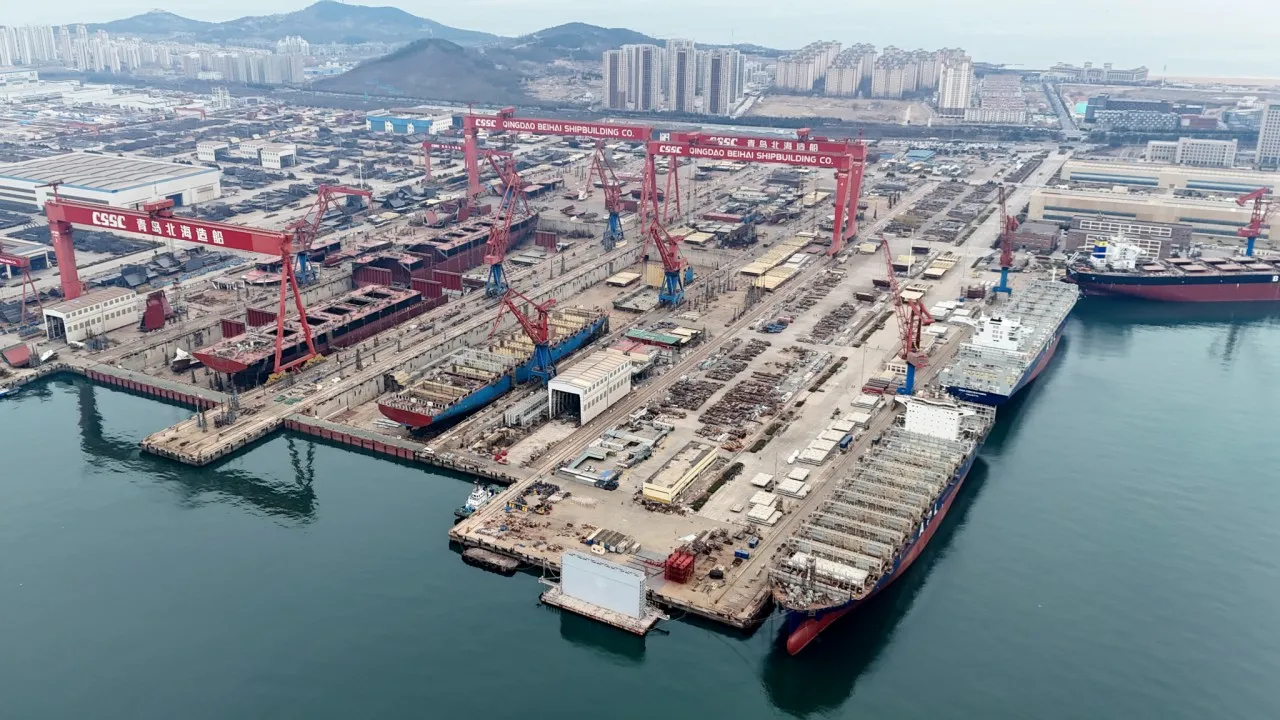
China’s growing dominance of the global shipbuilding market will come under a significant operational test as yards prepare for a sharp increase in vessel deliveries in the coming years. BIMCO’s analysis shows that Chinese shipbuilders have 64 per cent of the orderbook in the world, but the size of the commitments they have scheduled will require a significant increase in production capacity.
The global shipbuilding orderbook stood at 203.2 million compensated gross tons (cgt) as of 1 September 2026, an increase of 13% over the previous year when the total was at 180 million cgt. While the backlog is still below an all-time high of 210.4 million cgt in May, it is above a previous record of 195.4 million cgt set in 2008.
Over the last 12 months Chinese shipyards have further strengthened their dominance, accounting for 74% of the newly contracted cgt. They control 64% of the global orderbook, far ahead of South Korea with 19% and Japan with 6%.
China leads in all vessel categories
China dominates all six main vessel types, with its yards accounting for at least 72% of the orderbook in tankers, gas carriers, dry bulk carriers, ro-ro vessels and other dry cargo ships. In the containership sector, Chinese shipyards are also the leading builders with 81% of the orders.
Containerships have also been the main driver for the recent market expansion. “These vessels constitute 30% of total cgt on order and represent 68% of the increase seen this past year,” said BIMCO chief shipping analyst Niels Rasmussen.
But winning contracts is only half the war. The shipyards are faced today with the challenge of balancing the growing number of ships to be delivered with the production capacity.
Record delivery commitments
The three major shipbuilding countries delivered a record 40.1 million cgt in 2025. They are forecast to reach 55.9 million cgt in 2026 and 60 million cgt in 2028. This will add to the further pressure on production facilities.
The biggest adjustment is happening at Chinese shipyards. BIMCO is forecast to deliver a record 44 million cgt in 2028, up from 22.7 million cgt in 2025.
Clarksons earlier this month predicted global shipyard output could hit new records of 64 million cgt in 2027 and 69 million cgt in 2028. These figures show how much output is expected to increase as shipyards clear their backlog of orders.
Rasmussen said China had established itself as the world’s leading shipbuilder, but said its yards would have to reach record annual output to meet their delivery commitments. He cautioned that adding capacity to meet current demand could result in underutilized facilities if future contracting activity slows.
Lessons from the last shipbuilding cycle
The industry is now growing after a boom before the global financial crisis in 2008. The upsurge in orders over the period led to an estimated 54.4 million cgt of ship deliveries worldwide during 2010 and 2011 as shipyards worked their way through their backlogs.
Thereafter production fell, with annual deliveries dropping to around 31.2 million cgt in 2020 before beginning to recover.
The fall in new orders that affected China’s shipbuilding sector particularly hard led to a cut in deliveries and a general worsening of global economic conditions. From 379 in 2010, the number of active Chinese shipyards fell to 117 in 2019. The number of active yards in the global industry declined by 60% between 2009 and 2017.
This history highlights the risks of overextending shipbuilding capacity in times of high demand, especially when the level of contracting in the future is not clear.
China has a better orderbook coverage than its peers
BIMCO’s assessment also compares orderbook coverage for the three leading ship building nations based on their highest annual output in the last five years.
On this basis, the average workload of Chinese shipyards is 4.2 years of production. The coverage in South Korean yards is 1.9 years, in Japanese shipyards 1.7 years.
When capacity is measured against the highest annual cgt volume scheduled for delivery in the 2021–2030 period, the picture is different. This alternate calculation lowers the average yard coverage in China to 2.1 years, and in Japan and South Korea to 1.6 years.
The figures show China’s large share in the global shipbuilding market, but also highlight the significance of balancing the production capacity and the pace of new orders. Scheduled deliveries are continuing their upward trend toward record levels, and the industry’s ability to manage capacity efficiently will be critical to avoid a repeat of the overcapacity pressures seen after the last shipbuilding boom.