



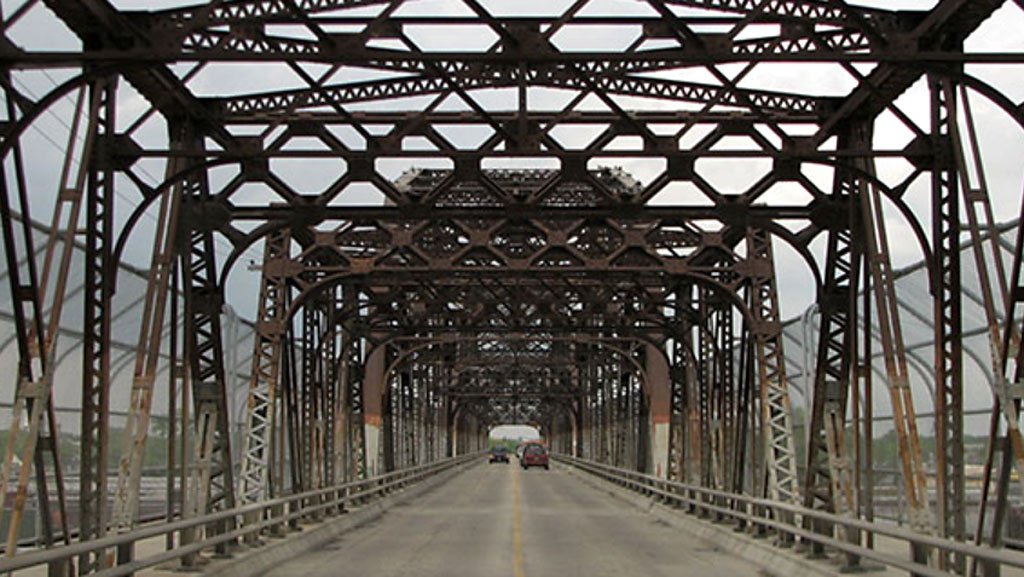
For more than 100 years, the Arlington Bridge has been part of Winnipeg’s skyline and a familiar route for thousands of commuters. Now, after years of uncertainty and mounting safety concerns, its final chapter has officially begun.
Demolition work started in June, marking the beginning of the bridge’s long-awaited removal after years of engineering studies, public discussions and project delays.
Built in 1912, the Arlington Bridge stretches 2,155 feet across the sprawling 1,149-acre Canadian Pacific Kansas City (CPKC) rail yard, making it the longest of Winnipeg’s more than 100 bridges and overpasses. For generations, it has served as a vital connection between the city’s north end and west end.
Mayor Scott Gillingham said taking down the aging structure is an important step toward building a modern replacement that will better serve the community.
“This is the next step toward building a new Arlington Bridge for the north end,” Gillingham said. “We’re removing the old bridge and designing its replacement. The next bridge will be safer, more accessible, and built to serve Winnipeg for generations.”
The bridge’s decline has been years in the making.
An engineering assessment released in 2016 concluded that the structure was nearing the end of its useful life, leading the city to launch the Better Bridge for Arlington Study and develop a preliminary design for a replacement in 2019.
Its fate was effectively sealed in November 2023, when another structural review found the bridge had deteriorated beyond the point where it could be repaired or rebuilt on its existing foundations. The bridge was permanently closed soon afterward.
Winnipeg City Council approved $17 million in January 2025 to fund the bridge’s decommissioning and demolition.
According to the city’s bridge projects engineer, Damir Muhurdarevic, the first stage of the project focuses on dismantling the southern end of the bridge. Crews are removing the south access ramp along with the five southern trusses that extend over the active CPKC rail yard.
The south ramp is expected to be removed within four to six weeks. Demolition above the rail yard is scheduled to begin on July 13 and continue for another six to eight weeks, with crews dismantling the bridge span by span from south to north.
Kiewit Construction Services ULC is leading the demolition, supported by four subcontractors, three of them based in Manitoba.
Because the bridge crosses one of the country’s busiest freight yards, the work requires constant coordination with CPKC to ensure rail operations continue safely throughout the demolition.
Councillor Ross Eadie, who represents the Mynarski ward, said removing the bridge is a complicated but necessary operation.
“The bridge is ready to fail and the city is liable for damages if it does,” he said.
Eadie noted that only a handful of companies across North America have the expertise to safely dismantle a bridge of this size over an active rail yard. Throughout the demolition, CPKC receives project updates every 15 minutes so train movements can continue without compromising safety.
The Arlington Bridge is just one of several major infrastructure projects Winnipeg is undertaking this year.
Public Works is also carrying out improvements to 175 kilometres of roads, 50 sidewalks and 15 kilometres of cycling and active transportation routes. Other major projects include upgrades to St. Mary’s Road, the reconstruction of Lagimodiere Boulevard and repairs to Edmonton, Kennedy and St. Mary streets in the downtown core.
Even with that workload, Manitoba Heavy Construction Association President Chris Lorenc believes there is room for more investment.
He said provincial infrastructure funding has failed to keep pace with inflation, pointing out that Manitoba’s highway capital budget has dropped from $640 million in 2016 to $525 million this year. To match inflation, he said, that budget would need to be closer to $1.2 billion.
Lorenc praised Winnipeg’s commitment to infrastructure, noting the city has allocated $156.8 million this year to improve roads and sidewalks.
“The city is setting a good example,” he said, adding that he hopes the province will eventually follow suit.
For Lorenc, however, the Arlington Bridge is more than just another infrastructure project.
Having grown up in Winnipeg’s north end, he crossed the bridge countless times over the years and says watching it disappear is bittersweet.
“It’s an iconic Winnipeg structure,” he said. “Although it was structurally unsound, it would have been nice to keep it in some form, like the High Line in New York. The Arlington Bridge has wonderful character. To lose it is sad.”