



The air cargo industry, which is often overshadowed by passenger aviation, is once again arguing the case for its strategic importance to the global economy. Speaking at the 82nd International Air Transport Association (IATA) Annual General Meeting and World Air Transport Summit 2026 in Rio de Janeiro, industry leaders highlighted a sector that remains highly profitable and essential to global trade, yet increasingly challenged by capacity constraints, regulatory complexity and geopolitical uncertainty.
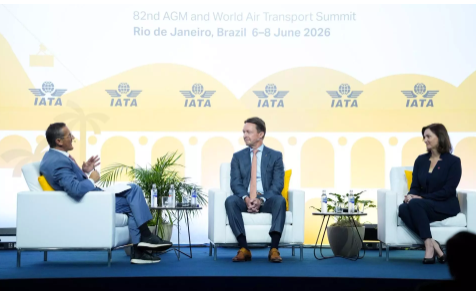
During a panel moderated by CNN’s Richard Quest, Michael Steen, CEO of Atlas Air, and Janet Wallace, Managing Director of Cargo Operations and Transformation at Air Canada, pushed back against the perception of air freight as aviation’s “Cinderella story.”
“When people talk about cargo as the less glamorous side of aviation, they often forget one thing,” said Steen. “It’s profitable.”
A silent giant behind the global economy
The scale of the industry is substantial. Atlas Air currently operates 113 wide-body freighters serving more than 300 destinations across 90 countries, representing approximately 13% of the world’s wide-body freighter fleet.
Meanwhile, Air Canada remains North America’s only combination carrier operating a dedicated freighter fleet alongside a passenger network, with eight Boeing 767 freighters connecting destinations across Asia, Europe, Latin America and Canada.
Steen explained that air cargo supports three major economic pillars.
The first is industrial production, transporting critical goods ranging from pharmaceuticals and electronics to high-value manufacturing products. The second is defence logistics, with military organisations around the world relying heavily on dedicated freighter fleets to move equipment and supplies.
The third, often overlooked, is the entertainment industry.
“Formula 1 required ten dedicated Boeing 747 freighters to support the Monaco Grand Prix this week,” Steen noted. “When Taylor Swift goes on tour, she needs five. Air cargo supports both scheduled global supply chains and highly specialised projects alike.”
Tariffs and trade uncertainty create operational disruption
One of the dominant themes at the summit was the impact of shifting trade policies and tariffs, particularly following recent U.S. measures that created significant uncertainty across supply chains.
As a major carrier serving global e-commerce platforms, Atlas Air experienced the effects almost immediately.
“All the e-commerce shipments heading into the United States were affected,” Steen explained. “Some platforms stopped sales overnight, not necessarily because of the tariffs themselves, but because there were no clear procedures.”
Frequent policy changes created confusion for customs authorities, freight forwarders and shippers, leading to shipment delays, border congestion and widespread booking cancellations.
Atlas Air responded by reallocating aircraft capacity to other markets as e-commerce operators redirected activity outside the United States.
Wallace said Air Canada is seeing similar market fragmentation, with supply chains shifting toward secondary suppliers and requiring constant scenario planning.
Both executives stressed that unpredictability, rather than tariffs themselves, remains the biggest challenge.
“The tariff is not necessarily the issue,” Steen said. “The issue is the absence of clear processes that prevent cargo from becoming stuck at customs.”
A capacity crunch looms over the industry
Beyond trade policy concerns, the industry is facing a longer-term structural challenge: a shortage of future air cargo capacity.
According to Steen, more than 100 of the approximately 620 dedicated freighters currently operating worldwide are over 30 years old and approaching retirement.
At the same time, cargo demand is forecast to grow between 3.5% and 5% annually over the next decade, while fleet growth is expected to remain around 1%.
Traditionally, airlines converted retired passenger aircraft into freighters. However, record aircraft order backlogs have drastically reduced the availability of suitable aircraft.
“We heard yesterday that there are around 18,000 commercial aircraft currently on backlog,” Steen said. “Many aircraft that would have become freighters will remain in passenger service much longer.”
To address future demand, Atlas Air recently expanded its fleet by nine aircraft over the last two years and placed an order for 20 Airbus A350 Freighters, with options for another 20. The agreement makes Atlas Air the largest customer for the new-generation A350F programme, scheduled to enter service in 2027.
Air Canada faces similar challenges.
“There’s simply no capacity available in the market for additional aircraft,” Wallace acknowledged. “But we remain committed to dedicated freighters and would expand if suitable aircraft became available.”
Digitalisation remains air cargo’s biggest internal challenge
While aircraft shortages threaten future growth, Wallace argued that one of the industry’s greatest weaknesses remains its lack of digital maturity.
“People assume we’re modern. We’re not,” she said candidly. “Every shipment still moves with a huge amount of paperwork. Around 30 documents are required for a typical shipment.”
Despite ongoing discussions around artificial intelligence and digital transformation, Wallace believes the industry remains far behind where it needs to be.
A major obstacle is the lack of global standardisation. Regulatory requirements vary from country to country, creating complexity and slowing automation efforts.
Of the dozens of documents accompanying a shipment, only the air waybill has been significantly digitised.
Wallace pointed to IATA’s ONE Record initiative — a blockchain-based data-sharing platform — as one of the most important projects for the sector’s future.
“It will accelerate customs clearance, improve data sharing and speed up revenue recognition,” she explained. “The technology exists. We know it can work.”
The future depends on stability, infrastructure and investment
Both executives agreed that air cargo’s future success depends on greater harmonisation, predictability and infrastructure investment.
Steen called for stronger collaboration between industry stakeholders and policymakers to reduce regulatory uncertainty and support global trade flows.
Wallace concluded by highlighting the industry’s strategic significance.
“Air cargo represents approximately 35% of the value of global trade,” she said. “It is truly the backbone of international commerce. What we need now is continued investment in infrastructure, capacity and throughput to support future growth.”
The discussions took place during the 82nd IATA Annual General Meeting and World Air Transport Summit, held in Rio de Janeiro from 6 to 8 June 2026, where industry leaders gathered to address the future challenges and opportunities facing global aviation and air freight.
- Latest
- Trending
ADVERTISEMENT