



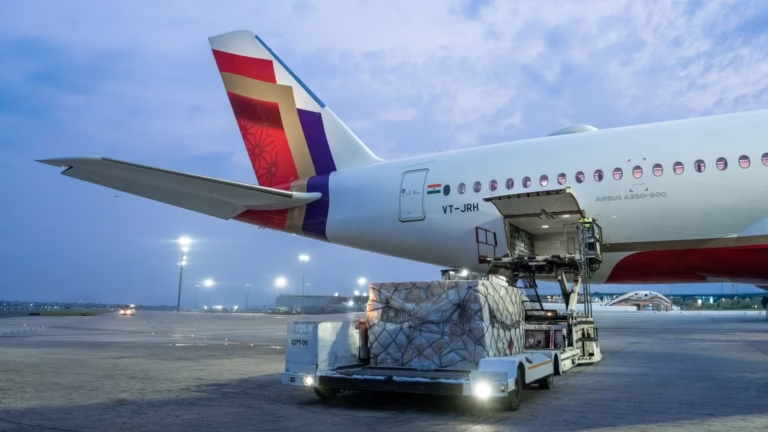
Air India has successfully operationalised India’s new cargo transshipment framework, with an ongoing Proof of Concept (PoC) on the Chennai–Delhi–Frankfurt route demonstrating significant improvements in cargo handling and transit times.
Launched on 20 June 2026 and approved by the Bureau of Civil Aviation Security (BCAS), the initiative allows eligible shipments to remain securely packed in the same Unit Load Device (ULD) while transiting through Delhi. Cargo no longer needs to be unpacked for piece-level security re-screening before being loaded onto its onward flight.
The streamlined process has significantly reduced handling requirements and connection times. On the Chennai–Delhi–Frankfurt corridor, average cargo connection times at Delhi Airport have fallen from 36–48 hours to between five and eight hours.
Cargo volumes more than double
The initial results have also highlighted strong growth in cargo volumes. Between 20 June and 20 August, average daily cargo volumes on the corridor increased from 2.2 tonnes to 4.5 tonnes, while a total of 300 tonnes of cargo was transported during the two-month period.
Air India’s Flown-as-Booked (FAB) performance also improved from 76% to 100%, with no cargo loss or damage recorded during the trial.
Major logistics and freight companies, including DHL, Dachser, DVS and Kuehne+Nagel, have also provided positive feedback on their experience with the new process.
Pilot expands to more international connections
Following government approval to expand the pilot, Air India will extend eligible cargo transshipment operations through Delhi to a wider network.
The expanded framework will cover cargo originating from Ahmedabad, Bengaluru, Chennai, Hyderabad and Mumbai, with onward connections to Copenhagen, Frankfurt and London Heathrow.
Subject to further regulatory approvals, the framework is expected to progressively cover domestic-to-international cargo, international-to-domestic shipments and international-to-international transshipment through Indian airports.
Delhi targets a larger share of global cargo flows
For Air India, the initiative is about more than reducing transit times. The airline estimates that Delhi could attract more than 2 million tonnes of additional annual transshipment cargo across more than 95 international cargo corridors.
The new system could help India capture cargo flows that currently move through established overseas transit hubs, while strengthening the role of Indian airports in global supply chains.
The benefits could also extend to the wider logistics ecosystem such as freight forwarders, warehousing providers, ground handlers and e-commerce operators.
The new framework can help make Indian airports competitive in international air cargo, and turn Delhi into a major global transshipment hub by reducing handling, improving predictability of cargo and speeding up connections.