



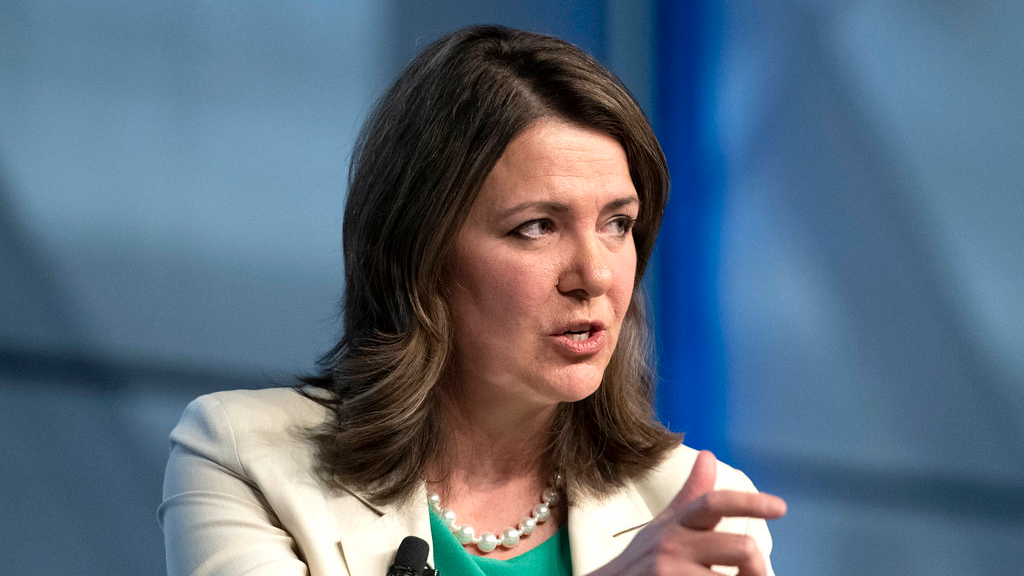
EDMONTON – Alberta Premier Danielle Smith says the province will suspend its fuel tax for three months beginning Oct. 1, providing drivers with a 13-cent-per-litre reduction on gasoline and diesel as the government responds to rising costs at the pump.
“Every fill-up will cost Alberta families and businesses less,” Smith said during a speech to the Calgary Chamber of Commerce. Alberta’s government has confirmed that collection of the provincial fuel tax on gasoline and diesel will be suspended starting Oct. 1, with the measure remaining in place through at least Dec. 31.
The decision marks a change from the province’s approach earlier this year.
In June, the government opted not to reduce the fuel tax at the pump and instead introduced $100 affordability cheques for most Albertans. Smith had argued at the time that a tax reduction would not necessarily be fully passed on to consumers.
But speaking to reporters Tuesday, Smith acknowledged that Albertans were unhappy with the rebate approach.
“We have to be willing to take criticism and adjust and change course,” she said.
Under the new plan, Alberta says it will monitor retail fuel prices to ensure the benefit reaches consumers. Businesses convicted of price gouging could face court-imposed fines of up to $300,000 or as much as two years in prison.
The rebate program had also encountered practical difficulties. Its online application system was criticized by some users as invasive and burdensome.
According to the finance ministry, roughly 1.4 million Albertans had either applied for or received the $100 rebate, less than half of the estimated 3.4 million people eligible. Applications remain open online until Sept. 30.
Finance Minister Jason Nixon said he remains concerned that a fuel-tax reduction may not be passed through to consumers in full. However, he said the limited uptake of the rebate program demonstrated that the government was not able to distribute the payments as efficiently as intended.
“Our main goal is to get every dime that we can into Albertans’ pockets to help with this time of tight affordability,” Nixon said.
Nixon also said provincial law is designed to prevent a sudden return of the full fuel tax between January and the end of March next year. Should global oil prices decline, part of the tax could be reinstated during that period.
The government’s latest move follows months of calls from Alberta’s Opposition NDP for the United Conservative Party government to eliminate the fuel tax.
NDP Leader Naheed Nenshi said he welcomed the change in direction but described the UCP’s rebate program as “an absolute failure.” He also said the timing of the announcement appeared connected to the party’s recent political difficulties following a byelection loss in Calgary.
“I wish this government had motives beyond political survival, but they don’t,” Nenshi said. His comments were presented as a political criticism of the government’s timing and motives.
Fuel prices have risen sharply amid disruptions linked to the United States’ war on Iran, which began in late February and affected traffic through the Strait of Hormuz, a crucial shipping route at the entrance to the Persian Gulf.
For Alberta, the higher oil prices have produced a significant change in the province’s fiscal outlook. Alberta is heavily dependent on oil exports, and in February Smith’s government had projected a $9.4-billion deficit for the current fiscal year.
That forecast has since shifted to a projected $2-billion surplus.
Oil-price assumptions have also changed substantially. Seven months ago, the province expected West Texas Intermediate, the North American benchmark, to average US$60.50 a barrel during 2026.
Between Aug. 18 and Sept. 15, however, WTI averaged US$90.54 a barrel. For the quarter, Smith told the Calgary Chamber, the benchmark had averaged US$83 per barrel.
Alberta’s fuel-tax system is linked to WTI prices and is adjusted quarterly. Under the current framework, the provincial tax can be reduced or suspended when oil prices reach specified thresholds; Alberta’s official tax table shows the gasoline and diesel rate at zero cents per litre beginning Oct. 1, 2026.
The change in Alberta comes as governments across Canada seek ways to ease pressure on household and business budgets.
The federal government has also extended its fuel excise tax until the end of January, a measure expected to reduce gasoline costs for drivers by as much as 10 cents per litre.