




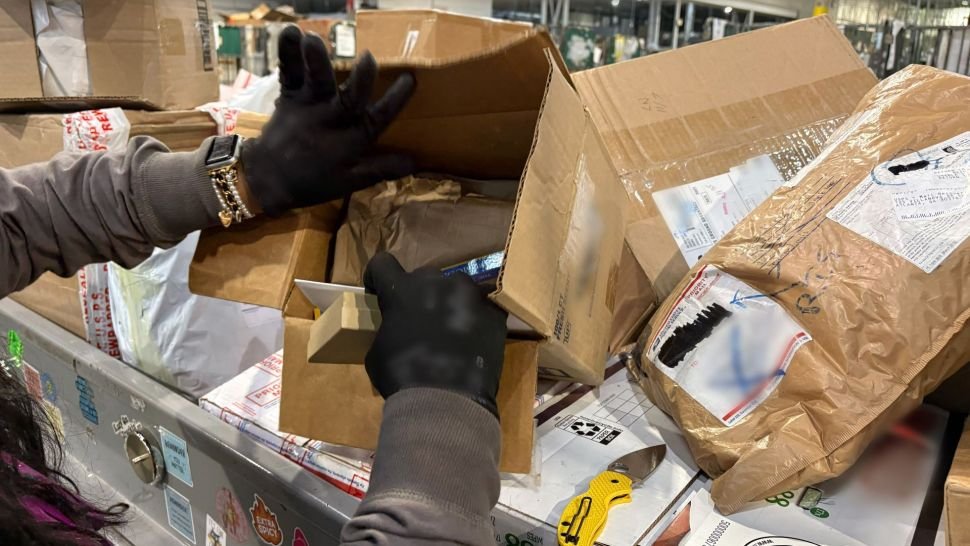
The U.S. Postal Service lost $163 million in revenue over a 12-month period after it failed to adequately track a sharp increase in undeliverable e-commerce packages, with fulfillment centers in many cases effectively using the carrier as a disposal service, according to a report released Thursday by the agency’s inspector general.
The Postal Service’s Mail Recovery Center (MRC) saw the number of packages entering its “lost & found” operation rise 45% during the 12 months ending in February. The increase was driven in large part by fulfillment centers refusing packages that could not be delivered or returned to their original senders, the USPS watchdog found.
When e-commerce companies reject undeliverable return-to-sender packages many of which arrive with postage due the cost of disposing of those parcels shifts to the Postal Service.
The inspector general estimated that USPS could generate nearly $20 million in additional revenue over the following 13 months by collecting postage due from direct shippers and introducing a fee for refusing packages.
The audit also found that the Mail Recovery Center received four times more “dead mail” than USPS reported over a three-year period. At the same time, the center returned less than 1% of missing packages to customers, rather than the 39% return rate cited by management. Inspectors attributed the discrepancy to flawed methods used to measure both package volumes and recovery rates.
In fiscal year 2025, customers filed more than 5 million complaints concerning missing packages. At the Mail Recovery Center, clerks attempt to match recovered items with packages reported missing and recorded in a database.
Packages containing items valued at more than $25, or meeting several other criteria, are held for at least 30 days. Most of the remaining packages, however, are sold in lots through public auctions, discarded, recycled or donated.
USPS estimates that about 19 million packages were sent to the MRC by post offices during the 12 months ending in February. Commercial shippers accounted for 75% of that volume.
Return-to-sender packages that could not be delivered because an address was invalid or because the sender refused the shipment represented 62% of the incoming volume, according to the inspector general’s report.
Many of those return-to-sender shipments were sent through Parcel Select, a heavily discounted USPS service in which shippers presort packages and drop them near their eventual delivery locations for the Postal Service to handle the final mile.
Parcel Select does not include return service. As a result, packages sent back to their origin are subject to postage due at the USPS Ground Advantage rate. The fee must be paid before the recipient — often a fulfillment center — can take possession of the returned package.
Return postage costs at least $12.63 per package, while processing a return can cost a fulfillment center between 20% and 65% of an item’s value.
That combination creates a strong financial incentive for fulfillment centers to reject returns and avoid both the postage charge and the processing expense, the report said.
“`html
“`
The inspector general said USPS management should identify alternatives for collecting postage due on Parcel Select shipments and introduce a charge for disposal services.
The underlying problem was partly a lack of tracking. USPS did not monitor sender-refused packages separately or determine how extensively commercial shippers were relying on the Mail Recovery Center to dispose of undeliverable parcels.
Adding a “sender refused” scan option for packages routed to the MRC would allow postal officials to measure the scale of the practice and determine how much revenue is being lost, the report said.
Another proposed solution would have USPS automatically collect return postage from the postal consolidator handling shipments for a fulfillment center. That would ensure the Postal Service is compensated for the return-to-sender portion of the shipment.
It could also make fulfillment centers more likely to accept returned parcels, since the packages would arrive through the normal mailstream alongside the rest of the center’s daily deliveries.
The inspector general had already recommended automating the postage-due collection process in a 2025 audit. USPS is still working to implement that recommendation.
Volume mix-up
The audit found that the Mail Recovery Center also significantly undercounted inbound package volumes.
Rather than scanning individual packages, the center calculated the number of packages based on bulk weight and an assumed “typical package weight.” Inspectors found that the method mixed containers holding packages with bundles of non-package mailpieces and loose items, which were then counted as single, unusually heavy packages.
As a result, approximately 27 million packages were omitted from the facility’s operational records.
The MRC also overstated the proportion of packages returned to customers because it used a different baseline for its calculations. Its measurement focused only on packages considered eligible for return, excluding 98% of the total package volume from the calculation.
Inspectors also discovered a long-standing formula problem in the Excel spreadsheet used by the center to track its internal performance. The error double-counted some packages returned to customers, artificially increasing the reported recovery rate.
The spreadsheet had been developed in 2016, and the problem remained undetected until the inspector general conducted its audit.
Postal officials said they would modify the way inbound package volume is measured by April 30, 2027. However, they disagreed with the inspector general over how the return rate should be calculated, arguing that including every package in the denominator would distort the results.
A new system for evaluating the Mail Recovery Center’s overall performance is scheduled to be implemented by Nov. 30, 2028.
Operational practices at post offices are also contributing to the low recovery rate.
The audit found that post offices frequently fail to scan and label packages being routed to the MRC. They also do not always mark MRC shipments as “dead mail,” a step intended to prevent those packages from being returned to the regular mailstream.
A separate problem involved the staging facility responsible for organizing and dispatching trailers carrying dead mail directly to the Mail Recovery Center.
That facility did not follow the required first-in-first-out, or FIFO, system. According to the report, the supervisor mistakenly prioritized trailers he believed were generating the highest daily rental charges rather than dispatching them according to how long they had been waiting.
Auditors were unable to determine which of the 22 trailers in the yard had been there the longest. They could establish the storage duration of only four trailers, including two that had already been there for 30 days.
By failing to follow the FIFO policy, the staging facility delayed the arrival of some packages at the MRC, reducing the center’s ability to attempt returns to customers as quickly as possible.
Management has since reinstated the FIFO policy at the staging site, which the inspector general’s office said should prevent the problem from recurring.