Tech Nov 11, 2026
ASICS Cuts Misplaced Inventory Recovery Time by Nearly 60% With Autonomous Warehouse Drones
Corvus Robotics drones scan nearly 3 million products every night at ASICS' Mississippi distribution center, increasing inventory counting frequency sixfold and saving approximately 200 labor hours per month.
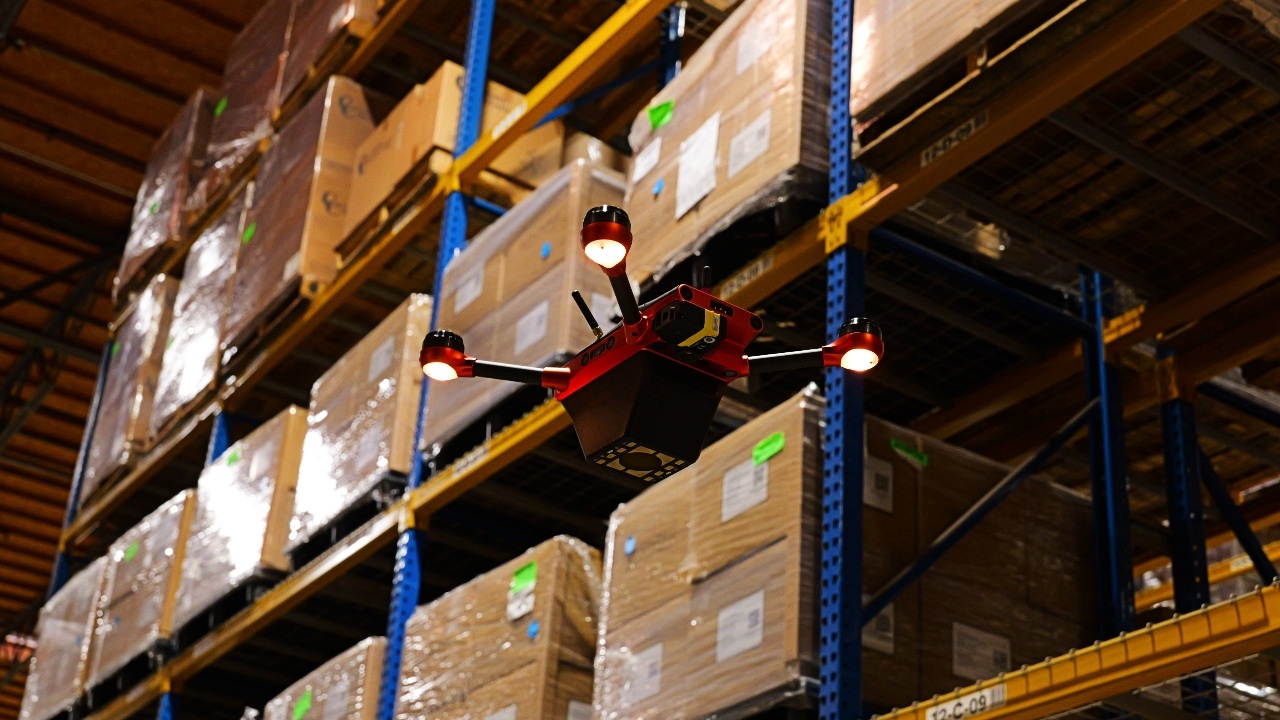
At its Byhalia, Mississippi distribution centre, ASICS is deploying autonomous drones to enhance inventory accuracy and warehouse efficiency. Since the company started to do nightly inspections of the storage areas most prone to inventory mismatches, the sportswear maker has been able to find misplaced items almost 60% faster.
Corvus Robotics’ system has made a huge difference in how the facility manages its inventory. Today, ASICS has a counting frequency six times higher than before, instead of physical counts twice a year. Data gathered from nightly flights is consolidated and analysed on a monthly basis, allowing the company to identify stock discrepancies sooner and maintain reliable product availability for customer orders.
The companies say the technology has also cut out around 200 hours of manual inventory-counting work per month. Instead ASICS is spending that time on inventory investigations, exception management and other operational priorities.
Monitoring 44,000 SKUs comprising millions of products
ASICS’ The Byhalia distribution centre ships nearly 3 million items, including 2.3 million pairs of shoes and 700,000 pieces of apparel and accessories. The inventory is about 44,000 stock keeping units (SKUs), all managed through a Manhattan Associates warehouse management system.
The facility serves e-commerce orders, wholesale shipments and replenishment for ASICS full-price retail and outlet locations.
To inspect these, Corvus drones have two areas of interest that are prone to inventory discrepancies: the singles area, where returned products and individual shoes are stored and picked separately, and the case reserve area.
Under ASICS’ former cycle counting policy, both sites were physically counted only twice a year. The longer time between inspections meant misplaced products could go undetected for months.
The results of the new approach were immediate. Within three months, the drones spotted 26 misplaced cases that contained more than 200 pairs of shoes. Without automated inspections, the products would likely have been unavailable to customers until the next scheduled physical inventory count.
Preventing out-of-stock products from impacting customer orders
For ASICS, misplaced inventory is not just a warehouse management problem. It can directly impact order fulfilment and customer satisfaction.
“We could have a unit out for as long as six months,” said Kyle Koestler, senior director of distribution and transportation at ASICS America Corp., in a company announcement.
Sometimes the missing item might be the last pair of shoes in the building for an order that had already been accepted. If the warehouse people couldn't locate it, the company would have to cancel the customer’s purchase, maybe.
Now with Corvus One, ASICS is able to do monthly cycle counts in the targeted areas, surfacing discrepancies much earlier and decreasing the likelihood of delayed or cancelled orders due to inaccurate inventory records.
The roughly 200 hours saved each month are spent conducting additional inventory reconciliation in packing operations, investigating root causes of discrepancies and working on special projects to support the wholesale business.
Drones combine physical carton counts and barcode scanning
The Corvus system offers two inventory control functions on a single flight. Each drone simultaneously reads the Universal Product Codes, or UPCs, of products and tallies the boxes in each storage location.
This dual process is particularly relevant in the singles section where customer returns could cause multiple products of the same SKU to be stored in one place. In these situations, a UPC scan might be incorrectly associated with a box.
The system also tallies the physical cartons, providing ASICS another reference point to double check the barcode readings.
Corvus is a simple illustration of this process. If a drone sees 10 boxes in a storage location, it should also have 10 UPC reads. Any difference between the two amounts could indicate a potential inventory discrepancy.
Seven independent flights each night, no additional infrastructure
ASICS has seven planned drone flights per night, starting around 7 p.m. The aircraft can manoeuvre through warehouse aisles that are less than six feet wide.
Corvus One uses onboard computer vision and spatial reasoning to navigate the facility and check out individual storage locations. Crucially, the system can function without the need to install extra infrastructure throughout the building.
Human supervision is still involved, but a good deal of the verification can be done remotely. “Each morning an inventory associate reviews the results of each flight based on the videos and images taken by the drones.
Most discrepancies can therefore be investigated and resolved from a desk rather than requiring employees to go back to each location inspected overnight.
More accurate inventory helps ASICS protect full-price sales
In addition to operational improvements, more reliable stock information is also yielding commercial benefits.
ASICS provides product availability feeds to online marketplaces. But before the rollout of the drone-based inventory management, the company intentionally held back 12 to 15 units for every 100 so that the products advertized online could actually be delivered.
This protection lessened the likelihood of selling items that weren’t available to customers, but also restricted the company’s ability to sell the items that were available.
Products located in less accessible areas of the warehouse may not appear on marketplace listings if their availability cannot be reliably confirmed. Some of these goods would eventually have to be liquidated by ASICS at deep discounts.
The announcement said inventory accuracy has improved to the point that the company now is able to publish its complete availability feed and sell those products at full price instead of liquidating them heavily discounted.
The company also highlights energy savings. Employees need to operate lifting equipment through warehouse aisles less often, since drones do more of the inventory counting work, reducing the energy associated with those activities.
Corvus boosts reach in warehouse automation
Mountain View, California-based Corvus Robotics has customers in a range of industries. Its clients include Southern Glazer’s Wine & Spirits, GNC, Dermalogica and MSI Surfaces.
The company is not the only one developing autonomous inventory solutions for distribution centres. Other providers of drone-based warehouse inventory technology include Gather AI and Verity.
This deployment by ASICS shows how automated aerial inspections can do more than just replace manual counting. The technology is increasingly becoming an essential tool for warehouse operations and supply chain management by providing better stock visibility, finding misplaced products sooner and making more inventory available for full-price sales.
END OF REPORT