Tech Nov 9, 2026
Motive bets on proprietary hardware and edge AI to strengthen its position in physical operations
President Thomas Hansen explains how Motive’s in-house AI models, camera technology and newly launched Agents give the company a competitive advantage in fleet safety and operational efficiency.

When Thomas Hansen began searching for his next professional opportunity, he approached several frontier AI companies and businesses developing specialized artificial intelligence solutions. His main concern was whether their technology offered a sustainable competitive advantage and whether those companies would still be relevant a year or two later.
His decision ultimately led him to Motive, an AI platform designed to help companies managing physical operations improve workplace safety, productivity and profitability. Hansen joined the company in May as president of go-to-market, taking responsibility for sales, marketing, customer success and partnerships.
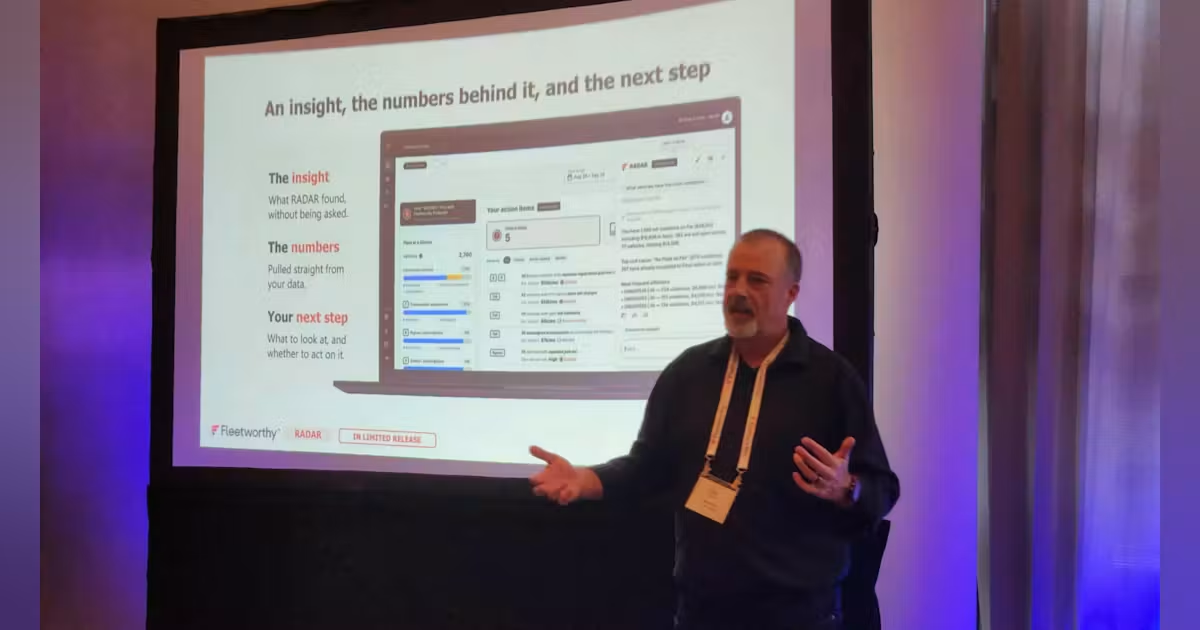
Speaking with FreightWaves on October 19 during the American Trucking Associations’ Management Conference & Exhibition in Charlotte, North Carolina, Hansen explained why he believes Motive has a distinctive position in the rapidly evolving AI market.
The discussion took place on the same day Motive announced the launch of its Agents platform, a new AI capability designed to identify potential problems and automatically initiate appropriate responses. The technology transforms operational and safety information already collected by fleets into actionable decisions.
For Hansen, Motive's competitive advantage starts with something that many software-focused AI companies do not possess: its own hardware.
Hardware as the foundation of Motive's competitive advantage
Hansen believes that owning the hardware deployed inside commercial vehicles gives Motive a significant advantage over competitors relying exclusively on software.
The company's technology includes camera systems installed in vehicles, ranging from 360-degree camera configurations to individual dashboard cameras positioned inside the cab. Once the equipment is installed, Motive can deliver additional value through the software and artificial intelligence operating on the devices.
He compares this business model to Gillette's traditional razor-and-blades strategy. The hardware establishes the initial relationship with the customer, while recurring revenue comes from the software and AI services built around it.
According to Hansen, this combination creates a stronger commercial relationship with fleets because Motive is not simply providing an AI application. It is supplying the equipment through which operational data is captured, analyzed and converted into useful information.
Proprietary cameras and AI models developed internally
Motive's technological investments are concentrated in two main areas, Hansen explained.
The first concerns its camera systems, which use two forward-facing lenses and another camera directed toward the driver. The second involves the artificial intelligence models operating directly on the device, an approach commonly known as edge AI.
These models are trained and refined using extensive data annotation and correction work carried out by large teams based overseas. According to Motive, its AI Dashcam Plus can operate more than 30 AI models simultaneously.
Hansen considers this in-house development strategy essential to differentiating Motive from companies that depend on third-party AI providers.
He argued that the industry cannot simply rely on general-purpose models developed by major technology companies such as Anthropic or OpenAI to address the specific requirements of physical operations.
Instead, Motive has developed its own models, which run directly on its hardware without depending on third-party AI models for their operation.
This approach also gives the company access to operational information generated by its own customer network. While major AI businesses invest billions of dollars in training data sourced from specialized providers such as Scale AI and Snorkel AI, Motive trains its technology using data collected from its customers.
The company says its customer base is approaching 100,000 organizations, providing a substantial pool of information for improving its AI capabilities.
Hansen also highlighted the results of competitive evaluations, claiming that Motive performs better than its rivals in approximately three out of four side-by-side trials.
He attributed this performance to the quality of its camera technology and the relatively low number of false-positive detections produced by its AI models. However, Motive has not published the underlying data supporting this comparison.
AI Agents want to transform fleet data into operational decisions
But Motive wants its AI to do more than just spot risks and send alerts.
The new Agents platform is designed to automate operational processes like opening work orders for maintenance and notifying managers when an alert meets predefined fleet requirements.
Later this year its AI assistant, Atlas, will also begin taking calls from drivers, the company said.
For Hansen, this development addresses one of the biggest drawbacks of current AI solutions: the fact that they tend to generate information without helping organizations figure out what to do next.
“Fleet managers get a lot of reports, alerts and notifications in the morning as it is,” he said. The trick is turning that information into real operational improvements, rather than letting it sit there unused.
Say safety managers who may conduct a dozen or so manual driver coaching sessions each day.
Managers could use the increased automation of routine interactions to review the quality of automated coaching conversations, develop preventative maintenance processes and oversee broader safety initiatives.
However, the automation of the driver coaching calls will be included in the planned Atlas functionality.
Hansen does not see this shift as a replacement for staff. Instead, he believes AI will free workers who are tied up in repetitive administrative duties to focus on tasks that create more value for their organizations.
The change could also help improve relations between fleets and their insurers. Safety managers would have more time to prove improvements in fleet safety performance, which could help companies secure lower insurance costs.
Motive’s growth supported by more than $1.3 billion in financing
A large financial push supports Motive’s tech ambitions.
The company closed $1.3 billion in growth financing led by General Catalyst in September. The announcement was made as it withdrew its initial public offering prospectus.
Its annual recurring revenue has surpassed $600 million, marking year-over-year growth of 30%.
The United States, Canada and Mexico are important markets for the company’s future growth, Hansen said. UK is another strategic priority.
Motive aims to gain further traction in continental Europe off the back of its UK presence, having established itself in the UK market in August 2025.
But Hansen believes that despite the progress AI has made financially, its adoption across the fleet industry is still relatively early.
He noted that many transport operators are still running legacy technologies from established vendors, so there is still plenty of scope for newer AI-based solutions.
Why it’s important
The development of physical AI is becoming increasingly important for transportation and logistics companies, where the main challenge is no longer collecting operational data. The real question is how to react to that information, quickly and effectively.
Motive takes a different approach than traditional monitoring and reporting systems. We use proprietary camera hardware, internally developed edge AI models and automated Agents.
For fleet operators, this could translate to less time spent on processing alerts, conducting repetitive coaching sessions and managing routine follow-ups, freeing up more resources for driver training, preventive maintenance and operational coordination.
If Motive can deliver on its promise of performance and efficiency improvements, its integrated hardware-and-software model could prove an important competitive advantage in a market where fleet safety, collision prevention and operating costs remain top priorities.
END OF REPORT