Land Nov 12, 2026
Austria Moves Closer to Four-Track Westbahn Expansion as Key Section Nears Completion
The first upgraded section between Wels and Marchtrenk is scheduled to open in December 2026, marking a major step towards increasing capacity on one of Austria’s busiest railway corridors and strengthening freight transport connections across Central Europe.
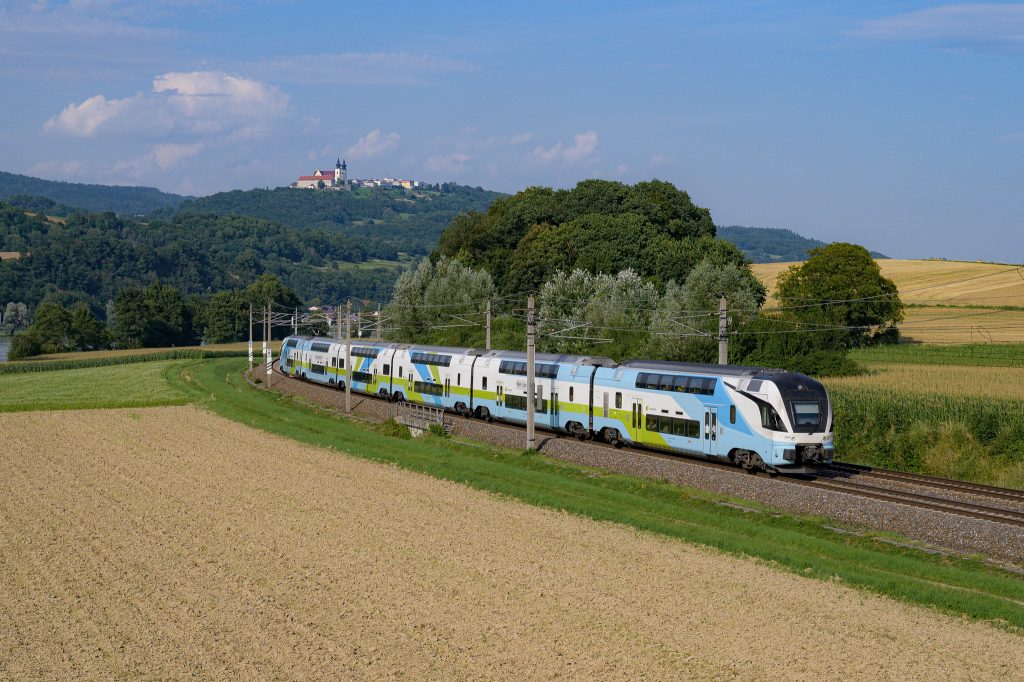
Austria is approaching an important milestone in the modernisation of its western railway network. Construction is progressing towards the completion and commissioning of the first section of the four-track expansion of the Westbahn. The project entails a 24-kilometre section between the cities of Linz and Wels, a growingly important part of the railway corridor between Vienna and Linz and Salzburg.
The Westbahn is just over 300 km long and represents some 10% of the entire Austrian railway network, but it accounts for more than 30% of all train movements in the country. The strategic importance of the airport means that more infrastructure capacity is needed, particularly given the continuing growth in demand for both passenger and freight services.
The first major operational milestone is expected in December 2026, when the approximately five-kilometre section between Wels and Marchtrenk is to be opened to traffic.
A steel arch bridge over the A25 expressway with a span of 93 metres is one of the most important engineering structures on this stretch. Weighing around 3,500 tons, the structure was successfully load tested at the end of October 2026. Six locomotives, weighing almost 500 tons, were used to test the bridge’s structural performance.
The four-track expansion between Linz and Wels is to eliminate a long-standing capacity bottleneck on the western rail corridor. Freight transport will be one of the main winners. With four tracks separating and specialising train routes, the infrastructure will be able to take more traffic and respond better to increasing demand.
A more extensive modernisation programme on the Westbahn
The present construction programme is part of a much larger investment effort, which has progressively transformed the Westbahn in recent years.
The railway already has four tracks along the entire section between Vienna and Linz. In some areas, the additional tracks have been laid alongside the historic railway line, while in other areas, high-capacity alternative routes have been built, many of them through tunnels.
A number of the most technically demanding works have involved major railway junctions. For example, in Linz the four-tracking programme extends over the entire section of the city, where traffic can reach up to 450 trains a day.
Further west, between Wels and Attnang-Puchheim, Austrian Federal Railways (ÖBB) have also made substantial improvements. This section of the corridor incorporates new rail alignments to improve operating conditions and remove current constraints.
These include the Kalvarienberg Tunnel, which bypasses the Lambach railway loop, and the Römerberg Tunnel, which solves the difficult section between Breitenschützing and Schwanenstadt in a similar way.
A new high capacity route to Salzburg
Another major infrastructure project is planned further west to fix one of the most meandering sections of the present railway network, between Köstendorf and the edge of Salzburg, the western end of the Westbahn.
The proposed alternate alignment will be double-track railway, intended to serve as a high-capacity supplement to the historic line. Its key engineering feature will be a twin-tunnel system, comprising two 16.2-kilometre single-track tunnels.
The new infrastructure is expected to reduce journey times compared with the current route, but also to increase overall railway capacity, improve operating conditions and remove current loading-gauge restrictions. These improvements will be of particular benefit to freight operators looking for more efficient and reliable links by rail.
Linz-Wels strengthens its position as a European logistics hub
The Linz-Wels area also holds a strategic position within the European transport network, serving as Austria's western gateway to the Rhine-Danube TEN-T corridor.
The central section of the Westbahn concentrates several of the country's most important logistics and freight facilities. Alongside the major hubs of Linz and Wels, the network includes freight terminals at Sankt Peter, Sankt Valentin and Amstetten.
Wels is particularly important because of its position at the intersection of transport flows linking Austria with Bavaria in Germany and the Czech Republic. Its freight terminal is among the most significant facilities in the Austrian railway network.
Despite handling substantial volumes, the terminal currently operates with just four tracks, each measuring less than 600 metres. This limitation highlights the scale of the infrastructure challenge facing one of the country's most strategically positioned logistics centres.
A new investment programme is now expected to improve its operational capabilities considerably. With financial support from the European Union, works are underway to extend the tracks to 700 metres and establish a direct connection towards Linz and Vienna.
The improvements are intended to reduce shunting requirements and associated operating costs while increasing terminal capacity and overall efficiency.
Taken together, the four-track expansion between Linz and Wels, the wider modernisation of the Westbahn and the planned improvements to freight facilities represent an important step in strengthening Austria's position within the European rail freight network. The investments will provide additional capacity along a corridor that plays a central role in connecting major industrial and logistics markets across Central Europe.
END OF REPORT