



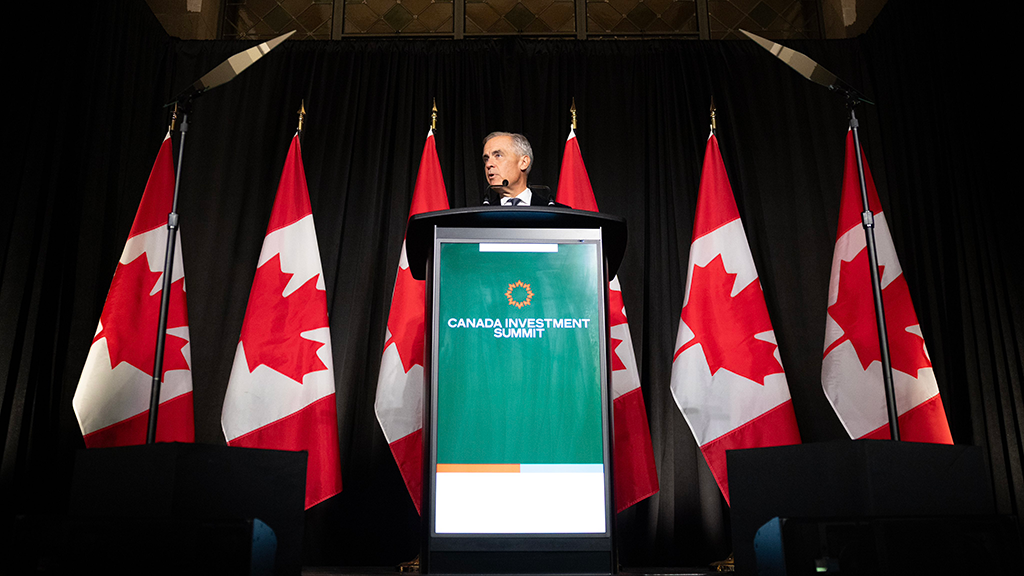
Canada’s inaugural investment summit ended Tuesday with Prime Minister Mark Carney and former prime minister Stephen Harper both making the case for increased investment in the country, though from different perspectives.
Carney spent much of the summit’s final day presenting new incentives designed to attract capital, including preferential tax measures for businesses investing in capital and a plan to allow private investment in Canada’s four major airports.
The two-day event in Toronto brought together hundreds of Canadian and international executives representing trillions of dollars in assets under management. The summit was intended to address both long-standing concerns over Canada’s investment environment and newer challenges facing the economy.
Canadian government officials and business leaders repeatedly sought to challenge the country’s reputation as a difficult place to generate investment returns. Their central message throughout Tuesday was that Canada is “open for business.”
The summit also became a platform to counter concerns that Canada’s recent deterioration in relations with the United States could seriously damage the Canadian economy.
Former prime minister Stephen Harper addressed those U.S. concerns directly in his closing speech.
Harper, who also serves as board chair of the investment arm of Alberta’s pension plan, said Canada’s negotiating team had “no choice” but to leave the negotiating table with the United States several weeks earlier. The two neighbouring countries have since remained caught up in renewed tariff disputes.
At the same time, Harper urged Canada to use the disruption as an opportunity, particularly by accelerating resource development and pursuing its ambition of becoming an “energy superpower.”
He described the current situation as “an opportunity to realize our true potential as a country,” adding that Canada has, in his view, “come nowhere close to achieving” that potential.
Harper also congratulated the federal government for recent efforts to accelerate project approvals, while arguing that additional measures are still necessary.
Carney, who opened Tuesday’s program with a keynote address, said Canada is currently “ahead on incentives” in its competition with the United States for investment, but acknowledged that the country still has significant ground to cover.
The federal government unveiled a major tax reform package aimed at expanding and permanently maintaining immediate expensing. The measure encourages businesses to invest in capital by allowing them to deduct the full cost of an investment during its first year of use.
Ottawa said the reform will reduce Canada’s marginal effective tax rate, or MER, from 13 per cent to 6.4 per cent. The MER is an industry benchmark used to assess how competitive a jurisdiction is for business investment.
The United States has also moved to reduce its own marginal effective tax rate. U.S. President Donald Trump signed the One Big Beautiful Bill Act last year, and Canadian government calculations put the U.S. rate at 16.9 per cent.
Carney defended Canada’s approach when The Canadian Press asked whether the measure could provide only a temporary competitive advantage if other countries subsequently respond by cutting their own tax rates.
“The incentive for companies to invest in Canada is twice as high as it is in the United States,” Carney said, referring specifically to the tax measure.
“If we’re in a race…we’re ahead on the incentives, but we have ground to catch up,” he said. “And what does this mean for Canadians and catching up to that ground? It means more jobs. It means a stronger country. It means more resilience, more independence, more sovereignty.”
Ottawa estimates that expanding the deduction will cost $36 billion over five years.
Carney also announced that the federal government intends to balance the operating side of its budget in 2027, one year earlier than previously planned. The Liberal government is still expected to run deficits related to capital spending.
The prime minister received praise from members of the corporate community during Tuesday’s proceedings for his efforts to encourage investment after a prolonged period of weak business capital spending.
However, the government’s approach also faced opposition.
Some Indigenous leaders, environmental organizations and union leaders have criticized the summit and expressed concerns about the future of public services, pipelines and arms manufacturing in Canada.
A group that organized a protest march outside the Toronto summit on Monday said Tuesday’s announcements reinforced its concerns about what it described as a potential “fire sale” of Canadian assets.
“This is not nation-building; it is a corporate asset grab,” the group said in a statement Tuesday. It argued that the federal government was creating a system in which the public would carry the financial, environmental and operational risks while private capital would receive the profits.
Conservative Leader Pierre Poilievre told reporters at a news conference in Vancouver on Tuesday that he welcomed the decision to hold an investment summit, but said the government needed to deliver tangible results for Canadians.
Carney also announced that the federal government plans to introduce legislation during Parliament’s fall session to broaden Ottawa’s “one project, one review, one year” framework.
The expanded framework would cover infrastructure proposals that fall outside the projects currently classified as major “nation-building” initiatives.
Carney said the government would not lower its standards for project approvals.
“Speed, certainty, predictability themselves are competitive advantages,” he told summit attendees. “Investors should know that when Canada says it wants something built, Canada will get it built.”
Jon Gray, president of Blackstone’s asset management group and a panellist at the event, described Canada as a “sleeping giant” that now appears to be waking up.
“We’re now at a moment where Canada’s really focused on its economic independence, and at the same time, this massive infrastructure is needed for the future,” Gray said.
“I think the potential growth rates here are much higher than most people would expect.”
Several of Canada’s largest banks, insurers and pension funds used the summit to announce billions of dollars in intended investments and financing over the coming years.
Carney has set an ambitious target of attracting $1 trillion in investment to Canada over the next five years.
Whether the summit itself will be enough to alter investor sentiment and increase foreign capital flows into Canada, however, will take time to determine.
During the two-day event, federal officials, premiers and private-sector leaders promoted dozens of projects spanning energy, critical minerals, artificial intelligence and defence. Actual investment decisions are expected to emerge over the months and years ahead rather than immediately following the summit.
B.C. Premier David Eby suggested during a scrum with reporters Tuesday that some investors could prefer Ottawa to establish a new Canadian infrastructure fund that global asset managers could invest in, rather than approaching individual projects separately.
Bombardier CEO Éric Martel, speaking to reporters on the sidelines of the summit, said he regularly works with international investors but believes bringing the investment community directly to Canada sends a stronger message.
“It shows that we’re not just alone,” Martel said. “It shows our country’s behind us, our resources are behind us…it just also explains what Canada is capable of doing.”