Maritime Nov 10, 2026
China completes a 1,000-tonne green ammonia bunkering operation at sea
Jiangsu Andefu Energy Development achieves a major milestone with the transfer of 1,000 tonnes of green ammonia to CMB.Tech’s ammonia-powered bulk carrier Mineral Europa, strengthening prospects for the fuel’s wider adoption in maritime transport.
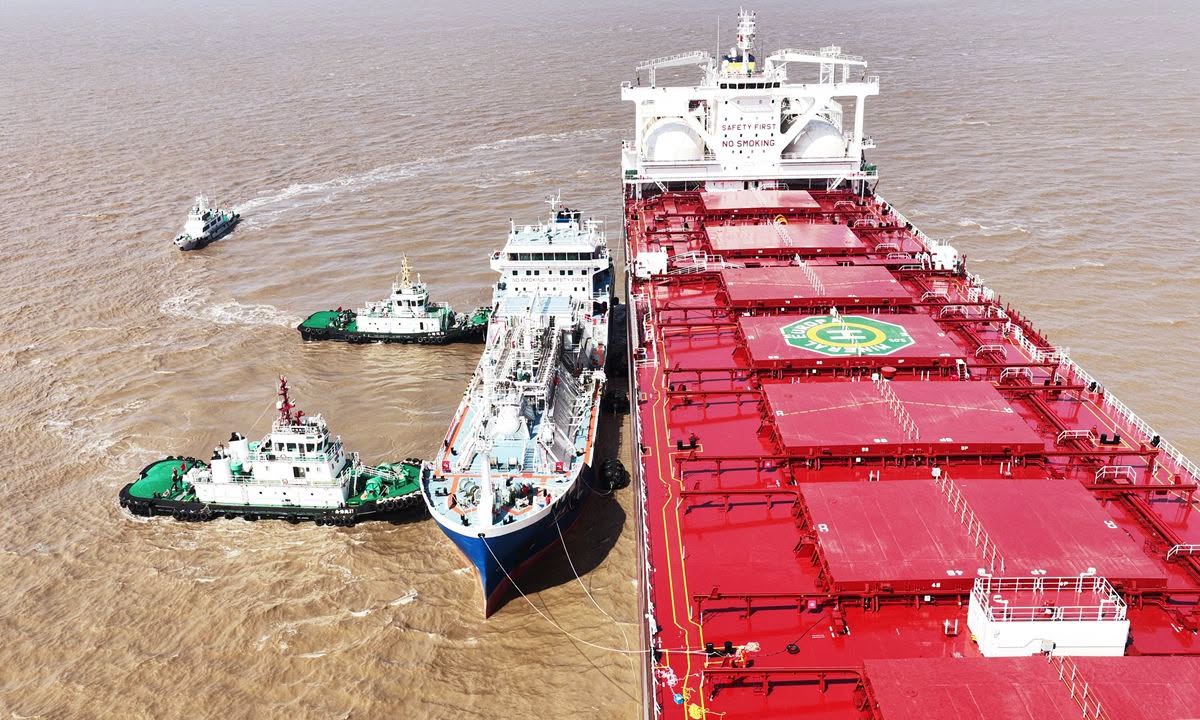
China has taken a big step in the development of alternative marine fuels after the successful ship-to-ship transfer of 1,000 tons of green ammonia to CMB-owned bulk carrier Mineral Europa. Technology.
The operation took place at the Zhoushan anchorage in Zhejiang province, using the Shenghang Yongle, believed to be the world’s first ship built specifically for ammonia bunkering. The 210,000 dwt Newcastlemax bulk carrier is also known as the world’s first ammonia-powered vessel in its class. It is driven by a WinGD dual fuel main engine.
The successful transfer by Jiangsu Andefu Energy Development marks a major step toward making green ammonia a viable marine fuel and establishing the infrastructure needed for its use in commercial shipping.
The Shenghang Yongle was designed by Swedish ship design and marine engineering consultancy FKAB Ship Design and was originally intended as a flexible liquefied gas carrier. The original configuration was capable of carrying out semi-refrigerated and semi-pressurised cargo operations. Subsequently, the vessel was selected for conversion to a dedicated ammonia bunkering vessel. FKAB carried out the conversion project in co-operation with Gloryholder, a specialist in cargo-handling systems.
The China operation follows another green ammonia bunkering trial last week with the Mineral Europa at Port Hedland, Australia. While loading a shipment of iron ore bound for China, the bulk carrier took the alternative fuel.
CMB.Tech’s operation at Port Hedland took two hours, with close coordination with Pilbara Ports and major iron ore producer Fortescue.
The two operations together show a growing progress in the practical use of green ammonia for maritime propulsion. They also emphasize the need for cooperation among shipowners, port authorities, fuel suppliers and industrial partners to build the supply and bunkering capabilities that will be required to support the transition to lower-emission shipping.
END OF REPORT