Maritime Nov 10, 2026
Unions and Maritime Industry Leaders Push for a Revival of British Columbia’s Shipbuilding Sector
With billions of dollars in federal shipbuilding contracts being rolled out and major icebreaker projects underway at Seaspan, labour unions and maritime industry representatives are urging British Columbia to rebuild its domestic shipbuilding capacity. They argue that expanding local construction could generate thousands of jobs, strengthen industrial expertise and bring more ferry and vessel contracts back to the province.
British Columbia may be about to begin a new chapter in its shipbuilding history, with labor unions and maritime industry representatives urging more commitment to building vessels at home. Major icebreaker projects underway at Seaspan Shipyards are evidence of the province’s industrial capacity, but industry stakeholders say the activity is just a fraction of the potential.
The message is simple: British Columbia has the workers, the technical know-how and the industrial base to rebuild an industry that once was a major pillar of the province’s economy.
“We have the skill, we have the ability,” said Boilermakers Lodge 359 assistant business manager Jeremy Kwok.
Kwok noted the pre-1993 period when many vessels were built by B.C. shipyards to run along Canada’s West Coast. But a lot of that business later went overseas, leaving domestic shipyards with less need to build new vessels.
Why does the province continue to send contracts overseas when the capabilities are here especially after the recent BC Ferries contracts went to foreign shipyards, he asked.
“The financial argument should not just be about the price of construction,” says Kwok. While it might be more costly to build ships in British Columbia, the employment, income taxes and wider economic activity that result would bring significant value back to governments and local communities.
Thousands of jobs can be created in local shipbuilding
The economic benefits are illustrated by an assessment by consulting firm QEDinc. Building four new Summit-class ferries in British Columbia would have created about 10,000 job-years and $413 million in tax revenues, the analysis estimated.
The figures support the argument that domestic shipbuilding contracts can provide economic benefits far beyond the shipyards themselves.
Kwok also pointed out the opportunities for workers displaced from other industrial sectors. Boilermakers formerly working in pulp and paper operations and the milling industry are landing new jobs in marine-related work with increasing frequency.
He believes there’s room for the sector to grow even further, creating more jobs and offering more job security to people getting into the industry.
British Columbia already has a large maritime industrial base. Provincial statistics indicate its marine sector is the largest in Canada, employing 34,250 people and generating $7.2 billion in economic output.
Seaspan's icebreaker programme demonstrates the province's capabilities
A significant share of Canada's new vessel construction is being driven by the federal government's National Shipbuilding Strategy (NSS). Under the programme, Vancouver-based Seaspan has secured responsibility for building non-combat vessels.
The previous NDP government had also advocated for British Columbia to receive 35 per cent of federal defence vessel contracts, seeking a larger role for the province in Canada's wider naval and maritime industrial development.
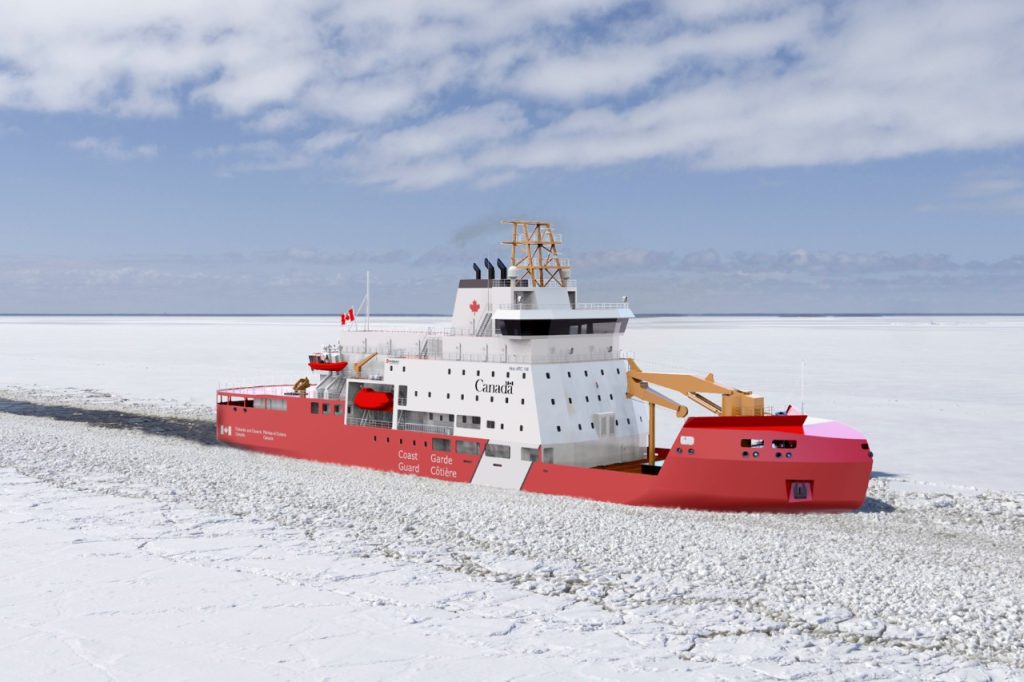
One of the most important projects currently underway at Seaspan's Vancouver shipyard is the Canadian Coast Guard's future heavy polar icebreaker, CCGS Imnaryuaq. A keel-laying ceremony recently marked a major construction milestone for the vessel, which is designed to become the largest icebreaker ever built in Canada.
The ship is being developed to operate throughout the year in Arctic conditions and will be capable of accommodating 100 personnel.
Its sister vessel, CCGS Arpatuuq, is being built through a separate programme involving Quebec's Chantier Davie shipyard and construction activities in Finland.
Once completed, the two Canadian vessels will join an exceptionally limited group of Polar Class 2 ships. The only other vessel of this classification currently in existence is France's Le Commandant Charcot.
The delivery schedules differ: Arpatuuq is expected to enter service in 2030, while Imnaryuaq is scheduled for delivery in 2032. According to the federal procurement website, the contract value for Imnaryuaq is $3.15 million.
A major steel supply agreement supports future icebreaker construction
Seaspan is also strengthening its supply chain for upcoming Coast Guard programmes through a major agreement with Algoma Steel Inc. and Stigterstaal Canada.
The companies have been awarded a contract to act as primary suppliers of steel plate for the construction of up to six multi-purpose icebreakers (MPI). These vessels are intended to operate in Canada's lower Arctic regions and offshore environments.
The agreement is valued at $182 million and covers the supply of approximately 24,000 metric tons of steel. The material will also be used in the construction of CCGS Imnaryuaq.
In its announcement, Seaspan described the order as the largest polar-class steel order in the history of the mill. The company confirmed that Algoma will manufacture structural steel for the MPI programme, one of the Canadian Coast Guard's largest shipbuilding initiatives.
With up to 16 vessels included in Seaspan's order book, the programme represents a substantial industrial opportunity for Canadian suppliers.
The federal procurement website puts the overall estimated value of the relevant shipbuilding programme at just over $14 billion.
Workforce development will be key to expanding production
The growth of domestic shipbuilding will depend on contracts, infrastructure and availability of qualified workers.
“Unions are working with Seaspan to co-ordinate labor supply and organize specialized training courses to meet industry workforce requirements,” said Brynn Bourke, executive director of BC Building Trades.
“The current boom is an opportunity for the federal and provincial governments to build up local construction capacity, especially in the ferry market,” she said.
As ship building activity increases, the unions want public authorities to make sure British Columbia can compete for a greater share of domestic vessel construction – not continue to see projects awarded overseas.
Vessel construction could open a new market for smaller shipyards
The bulk of the major shipbuilding programs are concentrated in Canada's biggest yards, but industry representatives say smaller facilities could play a far greater role in rebuilding the province's industrial capacity.
Alex Rueben, executive director of the Association of BC Marine and Defense Industries, which represents more than 1,000 marine-related businesses, sees huge opportunities for small and medium-sized shipyards.
In particular, he thinks British Columbia could develop a stronger market for vessels under 1,000 tons.
The structure of the National Shipbuilding Strategy permits this kind of activity. The larger vessels have major contracts awarded to the main Canadian shipbuilding facilities, which are not allowed to bid on projects involving vessels below 1,000 tons.
This paves the way for smaller B.C. shipyards to develop niche construction skills and compete for projects that might not have many local options, according to Rueben.
The province's shipbuilding industry started to decline when federal defense spending dropped in the late 1980s, he said. With fewer new construction opportunities, many regional shipyards transitioned to maintenance, repair and overhaul (MRO) activities.
But the change required different facility layouts and a different set of workforce skills, gradually changing the nature of the province’s shipyard operations.
Now, Rueben says, with the federal Liberal government renewing the fleets of the Royal Canadian Navy and the Canadian Coast Guard, there’s another opportunity for the industry to grow. Billions of dollars of contracts are being awarded that will create potential demand for both large vessels and smaller new build projects that have historically gone to overseas shipyards.
“We need to bring these back to B.C.,” he said, suggesting federal grant funding could help smaller facilities update and retrofit their infrastructure to allow for new construction.
Smaller yards are already securing new contracts
There are already examples of smaller British Columbia shipyards successfully competing for new vessel programmes.
Rueben cited the $74.7 million contract awarded to Ocean Pacific Marine in Campbell River to design and construct three next-generation coastal patrol vessels for the Royal Canadian Mounted Police (RCMP).
The project demonstrates that smaller shipyards can participate in public-sector vessel procurement when contracts are appropriately structured and local industrial capabilities are recognised.
For industry representatives, expanding these opportunities could create a more diversified shipbuilding network across British Columbia, reducing dependence on a limited number of major facilities.
The Look West strategy sets out broader ambitions for the marine sector
The previous NDP government had already outlined plans to strengthen British Columbia's maritime industries through its development strategy, Look West – Jobs & Prosperity for a Stronger BC.
The plan advocated securing 35 per cent of federal defence vessel contracts for the province, expanding the maintenance, repair and overhaul sector by 50 per cent, and developing a ship-recycling industry in partnership with First Nations.
These ambitions were subsequently incorporated into an agreement signed in July between Prime Minister Mark Carney and then-premier David Eby, entitled the Canada and BC Cooperative Prosperity Agreement.
Rueben said he remains hopeful that the new Conservative government will follow through on the commitments and support the development of the province's shipbuilding industry.
“The new Conservative leader seems to be pro-industry,” he said.
Labour coalition calls for shipbuilding contracts to return to Canada
The push to strengthen domestic shipbuilding has also been supported by a coalition of 15 labour unions operating under the banner Build Them Here.
The group campaigned strongly against the decision to award contracts for four BC Ferries vessels to shipbuilders in China, arguing that the work should have remained within the province.
Union representatives pointed to British Columbia's own shipbuilding history, particularly the construction of two Spirit-class ferries in local shipyards during the early 1990s. Those vessels became the largest in the BC Ferries fleet.
Sussanne Skidmore, president of the BC Federation of Labour and one of the coalition's signatories, said the province should take advantage of every available opportunity to rebuild and expand its shipbuilding capabilities.
She also called for British Columbia to secure a fair share of federal funding and vessel construction projects.
According to Skidmore, strengthening the sector could create thousands of skilled-trades careers while generating wider economic benefits across the province.
For unions and maritime industry organisations, the combination of federal fleet-renewal programmes, existing industrial expertise and growing demand for new vessels offers a rare opportunity to restore British Columbia's position as a major shipbuilding centre.
Their priority is to ensure that future investments translate into local construction contracts, stronger shipyards and long-term employment rather than allowing another generation of vessel-building opportunities to move overseas.
END OF REPORT