Maritime Nov 13, 2026
China’s Shipyards Ramp Up Capacity as Container Ship Orderbook Reaches New Heights
Chinese shipbuilders are accelerating infrastructure expansion to accommodate an unprecedented wave of container vessel orders. Hengli Heavy Industry has emerged as a major player, ranking second globally by orderbook capacity despite having yet to deliver a single container ship.

China’s shipbuilding industry is rapidly expanding as yards invest heavily in new facilities to meet the growing demand for container vessels. One company set to profit from this momentum is Dalian-based Hengli Heavy Industry, which has grabbed a sizable share of the global market although no container ships have been delivered to date. The shipbuilder has at least 182 vessels on order now.
According to Alphaliner, the rapid growth in shipyard capacity, especially in the Far East and China, allowed for an exceptional surge in global newbuilding orders. In several instances shipbuilders have doubled their annual productive capacity in a relatively short time.
The scale of this development is particularly noteworthy in that shipyards undertook to build vessels in drydocks that were not even built at the time of contract.
China has been the main engine of this growth, with new shipyard infrastructure being added to the continuing building of vessels. This parallel effort to build facilities and ships is a testimony to the country’s ability to ramp up industrial capacity in a big way.
A large part of the global orderbook of container ships depends on these expansion projects being completed on time, Alphaliner warns. The first of the large container vessels are already being floated out of newly built graving docks, an important step in the expansion program.
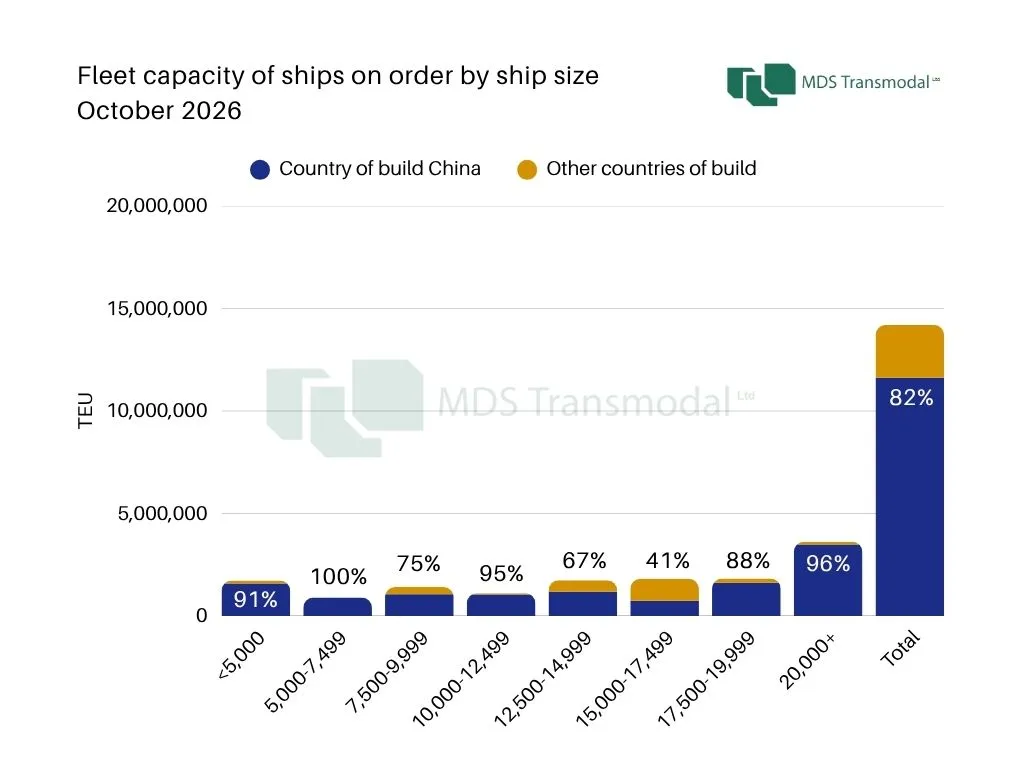
The latest data from MDS Transmodal demonstrates the extent to which China dominates across a range of vessel categories.
Last year’s orderbook for the 5,000-to-7,500 teu space consisted of 27 ships, all of them being built at Chinese yards. This year the number has jumped to 152 units with all orders again going to Chinese builders.
A similar trend can be seen in the 10,000 to 12,500 teu group. All 66 ships ordered last year went to Chinese yards but this year the country's share has slipped to 95% with 93 of the 99 vessels currently on order.
China is below the 50 per cent mark for the mid-sized 15,000 to 17,500 teu segment, which is a different story. It is down from 46% last year when 65 vessels were ordered out of a total of 143 and this year it is 41% with 45 ships out of 114. In terms of capacity this is a drop from just over 1 million teu to just under 740,000 teu.
In the bigger size categories, however, China is in a much stronger position. Chinese yards have boosted their share of orders for vessels between 17,500 and 20,000 teu from 75% in 2025, equivalent to 665,400 teu, to 88% this year, totaling some 1.6 million teu.
The dominance of the country is even more evident in the case of vessels larger than 20,000 teu. Chinese shipyards account for 96% of orders in this category, up two percentage points year-on-year, according to MDS Transmodal.
Chinese shipyards consolidate their world leadership
China's shipbuilding sector has also grown, as shown by the rankings of the world's largest shipyards by container ship orderbook.
According to Alphaliner figures, the orderbook at six shipyards is now over 1 million teu. The only non-Chinese shipbuilder to do so is Hyundai Heavy Industries. This underscores how container shipbuilding capacity worldwide is becoming more and more concentrated in China.
“Hengli Heavy Industry’s position is particularly noteworthy. The company is the second largest shipbuilder in the ranking after CSSC, an impressive feat for a company that has not yet delivered a boxship.
Hengli's transformation began in 2022 when Hengli Group bought the former STX shipyard assets from bankruptcy proceedings. The deal was worth $257 million, it was said.
The group then declared a $2 billion investment program. Cargo vessels started construction in 2023, tankers and bulk carriers.
CSSC and Hengli have 3.86 million teu and 2.47 million teu of container ship orders respectively today. Together, their orderbooks represent more than one third of the current global orderbook of nearly 16 million teu.
The other four yards in the top six in the world are Hyundai Heavy Industries, Yangzijiang, CIS Changhong and NTS New Times Shipyard. Combined, the companies have orders totaling 4.79 million teu.
Alphaliner also implies that its figures may underestimate the real volume of new orders. The consultancy says it is taking a cautious approach and only including vessels where contracts have been confirmed through official means or reliable industry sources.
An increasing orderbook supported by high shipping profits
The rapid rise in shipbuilding capacity is closely related to the development of the container shipping market in recent years.
Freight rates were at historically high levels from 2020 and onward, in part due to a series of disruptions and events that limited the available capacity of vessels. This was followed by very good net profits for shipping companies, who therefore had plenty of money to renew and expand their fleets.
These earnings are now being used to fund the purchase of new vessels, driving the global container ship orderbook to ever higher levels.
But industry analysts have different estimates.
Linerlytica estimates the global orderbook at 48% of the current fleet or 16.78 million teu. Alphaliner’s more conservative estimate is that total will be close to 16 million teu.
MDS Transmodal gives a much lower figure of 14.2 million teu, reflecting differences in how the consultancies collect and register vessel orders.
“The difference is due to the delay in the registration process,” says Antonella Teodoro, an analyst at MDS Transmodal.
A newly ordered vessel is only included in the consultancy’s database once it has been assigned a unique IMO number. Several months can pass between the announcement of a shipbuilding contract, its reporting in the press, and the allocation of an IMO number by the shipyard, Teodoro explains.
The delay in registration accounts for the fact that some recently announced orders are not yet in the consultancy's database.
The Chinese shipyards are building more infrastructure and signing new contracts, so their impact on the global container ship building market is growing. The question now is not just how many orders can be secured but whether the new production facilities can be finished and brought onstream as planned to deliver the growing volume of vessels.
END OF REPORT