Maritime Nov 13, 2026
Hapag-Lloyd posts sharp profit growth as rising freight rates lift 2026 forecast
Strong spot market conditions drive a significant improvement in third-quarter earnings, prompting the German shipping group to raise its full-year EBITDA and EBIT expectations.
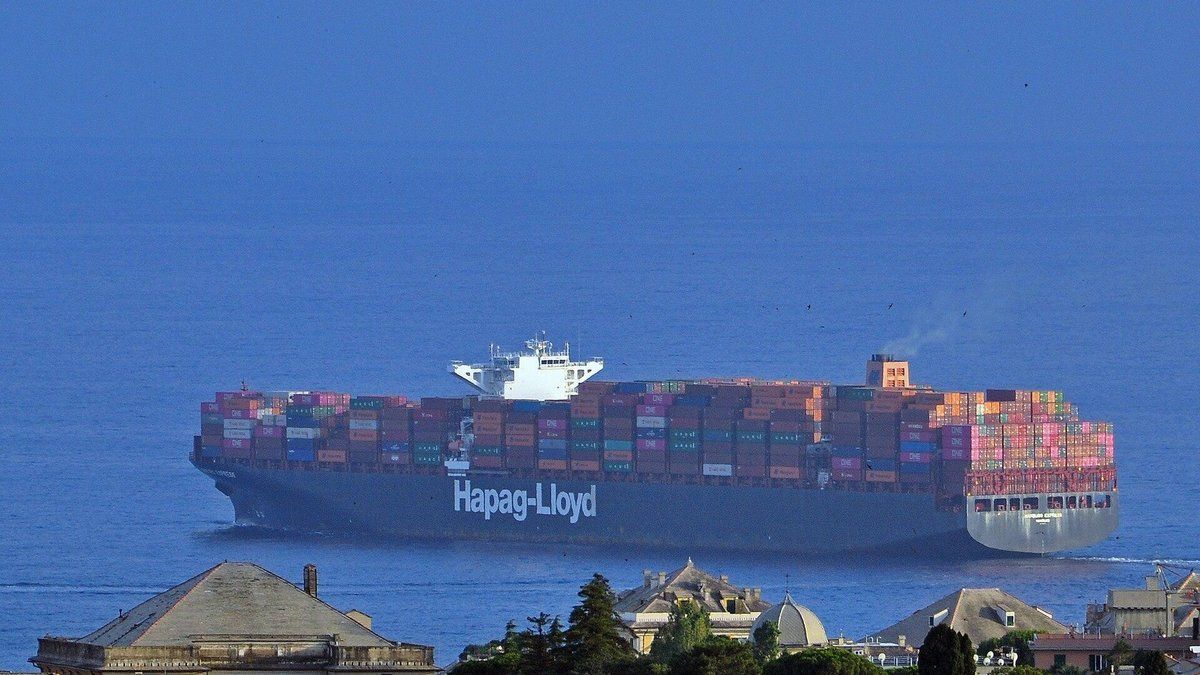
Hapag-] Spot freight rates were stronger and demand in its shipping business remained solid, helping to boost third-quarter earnings, Lloyd said. The improved financial performance also prompts the German container shipping company to raise its profit forecasts for 2026 as it expects favorable market conditions to continue until the end of the year.
The company said group profit was $999m in the third quarter, compared with $172m in the same period last year. EBITDA rose to $1.73 billion from $866 million a year ago, nearly doubling. EBIT also saw impressive growth, rising to $1.09 billion from $228 million. Revenue for the quarter was $6.88 billion, compared with $5.46 billion a year ago.
The new outlook, approved Nov. 11 by Hapag-Lloyd’s executive board, is based on the continued strength of spot freight rates. The company now expects full-year 2026 EBITDA of $4.6 billion to $5.0 billion compared to $3.9 billion to $4.4 billion previously. It also lifted its forecast for EBIT, to a range of $2.0 billion to $2.4 billion from a range of $1.25 billion to $1.75 billion.
The Hapag-Lloyd and Maersk partnership also runs Gemini services and Hapag- Lloyd said it anticipated receiving regulatory approvals for its planned acquisition of Zim in the first quarter of 2027.
Higher freight rates drive earnings, not higher volumes
The key to improvement in 3Q results was improved freight pricing not growth in the volumes of transported cargo. Hapag-Lloyd's average freight rate surged to $1,808 per twenty-foot equivalent unit (TEU) from $1,413 in the same quarter last year.
At the same time, cargo volumes were broadly unchanged. The carrier’s quarterly throughput was 3.38 million TEUs, compared to 3.40 million TEUs a year earlier.
Higher spot rates, continued demand and high capacity utilization helped our results,” Chief Executive Officer Rolf Habben Jansen said.
But he pointed to ongoing geopolitical tensions and operational disruptions that are adding to pressure on unit costs even with a positive commercial backdrop.
Liner shipping was the main contributor
Liner Shipping revenue was $6.72 billion versus $5.36 billion in the third quarter of last year. EBIT jumped to $1.05 billion from $219 million.
Hapag- The conflict in the Middle East and weather disruptions continue to affect operations, Lloyd said. However, these events hurt the operational efficiency and added costs. Total transportation volumes were resilient.
The group's Terminal & Infrastructure division also performed well. Revenue surged to $197 million in the quarter from $131 million, while EBIT increased to $34 million from $9 million a year ago.
The company attributed the improvement to investments in terminal capacity and improved operation of its Latin America terminals.
earnings for the nine-month period still below last year’s
Hapag-Lloyd’s group profit for the first nine months of 2026 was below the previous year’s figures, despite a strong third quarter.
Between January and September the group made a profit of $827m, down from $946m a year earlier.
But revenues rose to $17.64 billion from $16.05 billion and EBIT to $1.10 billion from $905 million.
The company's revised full-year outlook remains subject to a high degree of uncertainty, it said. “Volatility in freight markets and ongoing geopolitical challenges continue to be a material risk to operating performance and costs.
Market Outlook: Earnings Are Helped by Higher Rates, but Uncertainty Persists
Hapag-Lloyd raised its financial outlook for 2026, suggesting that management expects positive freight rate trends to continue supporting earnings through the end of the year.
But the difference between higher freight rates and largely unchanged cargo volumes still matters. Higher prices are helping profitability now but gains could be limited in the future by geopolitical tensions, weather-related disruptions and rising unit costs.
The company’s improved guidance therefore reflects a better earnings outlook but one still very much tied to the development in the global shipping market.
END OF REPORT