



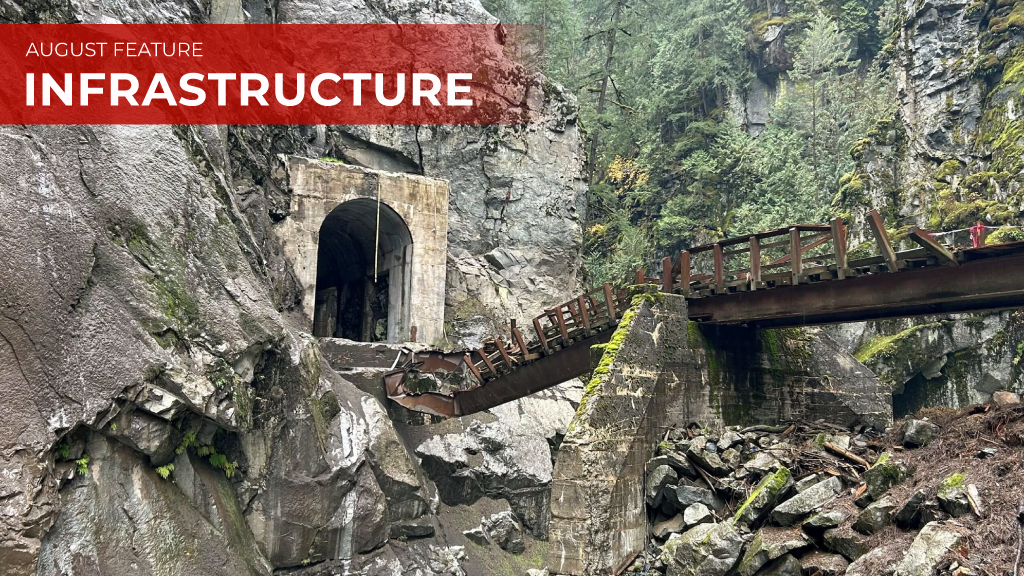
A new climate-resilient pedestrian bridge over the historic Othello Tunnels has been installed, restoring public access to one of British Columbia’s most famous heritage sites. The original bridge sustained heavy damage from the destructive 2021 atmospheric river.
It was set off by a rare three-day rainstorm in November 2021 that dumped months’ worth of rain on southwest British Columbia in just 48 hours. The extreme weather brought widespread flooding and landslides, and cut road and rail links between Metro Vancouver and the B.C. Interior, destroyed major transportation routes including the Coquihalla Highway (Highway 5) and Highway 1, killed five people and led to the death of more than 600,000 farm animals.
One of the sites hit was Coquihalla Canyon Park, home to the Othello Tunnels — a series of historic railroad tunnels built in 1914 and connected by pedestrian bridges that make a continuous trail thru the narrow canyon.
When the engineers inspected the bridges after the storm, they found that Bridge 1 had suffered considerable erosion and loss of material. Its foundations had been eroded by rockfalls, resulting in partial structural failure and rendering the bridge unsafe for public use. The structural risk was so high that the authorities closed the crossing immediately.“The flood compromised the center support of the bridge, leading to the separation of the bridge deck and rendering it unsafe for continued use by the public,” said Damian Liebeknecht, Project Manager, Tetra Tech Canada Inc.
The B.C. Ministry of Environment and Parks contracted Tetra Tech to provide structural and geotechnical engineering design and construction support for the rehabilitation project.
The engineering team considered a number of potential fixes, such as repairing the existing two-span bridge, replacing it with a similar design and taking out the central pier entirely.
The idea of keeping a support pier in the river was eventually rejected because it would leave the bridge vulnerable to future erosion, flooding, and debris build-up. Modular bridge systems were considered but rejected because of the rigid design requirements, the required modifications to existing abutments, and the industrial appearance, which was considered incongruous with the historic character of the site.
Instead, the engineers decided to construct a specially designed 45 meter clear-span bridge that would rest on the existing abutments. The design did away with the need for a central river support, whilst meeting structural safety, preserving the heritage setting and overcoming the difficult terrain of the narrow canyon.
Environmental protection was a major part of the construction. Severe restrictions on in-water work on the Coquihalla River meant crews had to employ a novel installation technique to avoid disturbing the waterway.
The bridge was assembled in sections within Tunnel 2 and then pushed piece-by-piece into position from one side of the canyon, avoiding the need for construction work in the river.
The project also included extensive rockfall mitigation for long term safety. Loose rock was removed from the adjoining slopes and pinned and draped mesh systems were installed to stabilize the rock faces and direct falling debris away from visitor areas.
The exposed timber elements of the new bridge are made from Western Red Cedar, selected for its durability and its close association with local traditions and cultural heritage.
Completed in November 2025, the project successfully restored continuous public access thru the Othello Tunnels while increasing resilience to future extreme weather events and minimizing environmental impacts.
Work was also undertaken on Bridge 2, where the deck and railings were completely replaced and additional rockfall protection measures were added to improve structural safety, durability and the overall visitor experience.
The project was awarded a 2026 Award of Merit in the bridges category from the Association of Consulting Engineering Companies British Columbia (ACEC-BC).
“The best thing about the project is not one engineering innovation, but how the different challenges were solved with one integrated solution,” Liebeknecht said.
“The new bridge offers a durable, long-term solution that incorporates climate resilience, heritage preservation, environmental protection and innovative construction methods, while maintaining one of British Columbia’s most iconic historic landmarks.