Maritime Nov 6, 2026
Container freight rates set to plunge in 2027 as capacity outpaces demand
Xeneta expects to see global spot rates down 30% year-on-year as new vessel capacity comes on stream and more and more shipping services are re-routed through the Red Sea and Suez Canal. However, geopolitical tensions and possible disruptions to major maritime corridors could change the outlook.
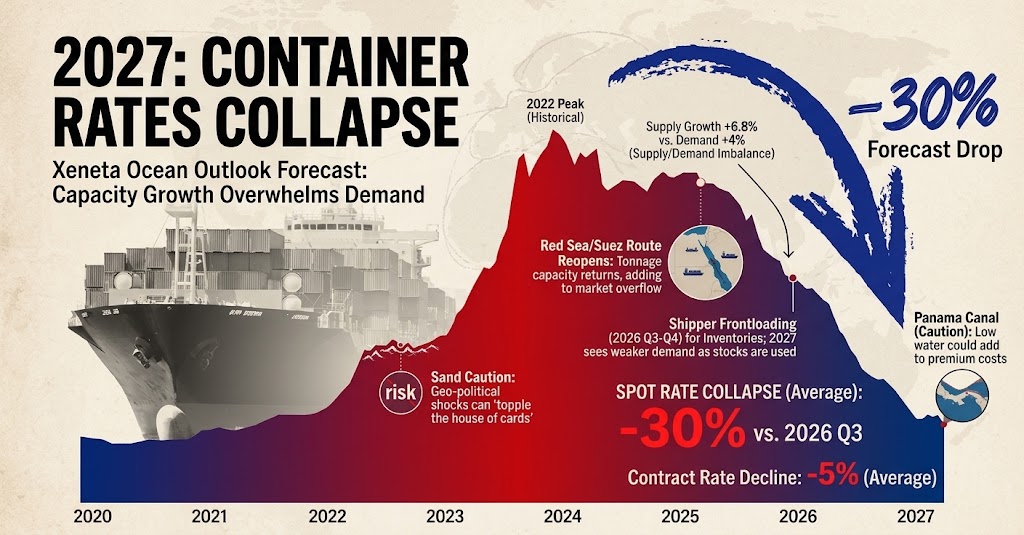
The world’s container shipping industry could face a sharp correction in 2027, as freight rates come under growing pressure as capacity outstrips demand. The latest Ocean Outlook report from freight intelligence platform Xeneta suggests that the addition of more shipping capacity, together with the gradual return of vessels to the shorter Red Sea route, could lead to a significant correction in freight rates.
Xeneta expects global demand for container shipping to rise by up to 4% in 2027, while capacity is expected to increase by some 6.8%. The widening supply/demand gap could push average spot rates down by up to 30% over the course of the year.
Contract rates are also expected to decline, but at a slower pace. Xeneta expects to see a reduction of approximately 5% compared to Q3 2026.
But the company’s chief analyst, Peter Sand, cautioned against taking this forecast as gospel. "The market fundamentals have been pointing to lower freight rates for the last three years, but major geopolitical and trade disruptions have reversed that," he said.
The Red Sea crisis upset expectations for 2024, US tariffs did the same for 2025 and the Hormuz crisis for 2026. Sand cautioned that unexpected supply chain shocks could again reshape the market, even as capacity growth is set to outpace demand in 2027.
The return to the Red Sea could speed the correction
A large part of Xeneta’s outlook is the gradual return of shipping services through the Red Sea and the Suez Canal. The change is already happening with over 50% of vessel tonnage now reverting to the shorter transit routes.
But this upgrading of maritime operations should not be taken as a sign that geopolitical risks have disappeared. Sand warned that the broader Middle East remains fragile and that any new tensions could easily upset the recovery of established shipping networks.
He cautioned that even a small escalation could destabilize the current situation and weaken the assumptions underlying the 2027 market forecast.
Frontloading could dampen demand early in 2027
Global container demand increased 4.7% in the first eight months of 2026. But Xeneta says a good portion of this growth is attributed to frontloading, with shippers moving cargo movements forward to avoid potential disruptions in the Arabian Gulf and the impact of rising fuel costs.
The company expects a slower start to 2027, absent another major disruption. Demand may also soften during the traditional peak season as shippers work off large inventories built up from earlier shipments.
Such inventory adjustment could put further pressure on freight rates, especially if additional vessel capacity continues to hit the market.
Another source of uncertainty is the Panama Canal restrictions
Beyond the Middle East, water shortages in the Panama Canal pose another potential threat to the stability of global container shipping.
Low water levels could trigger renewed transit restrictions that would force shippers to pay higher premiums to guaranty passage within their required schedules.
Sand pointed to the lack of flexibility throughout the worldwide maritime network. With the Suez Canal already exposed to geopolitical risks, any further disruption at another major trade corridor could leave the industry with little room to absorb any more shocks.
Transpacific routes continue to be a high return route
The freight market is likely to soften in 2027, but there are still some major trade lanes that are providing very high returns for carriers.
According to Alphaliner, spot rates for shipments from Asia to New York via the Panama Canal have been above $10,000 per FEU since late August. Meanwhile, the Shanghai–Los Angeles route has become the most lucrative trade, with freight prices hovering around pandemic levels.
Although spot rates to Los Angeles are lower than those to New York, the revenue per nautical mile is much higher on the US West Coast.
Alphaliner data shows the cost is 130 US cents per nautical mile for shipments to the West Coast, compared with 96 cents for cargo to the East Coast.
The difference is even more pronounced in comparison with Asia–Europe headhaul services. For the Mediterranean destinations the revenue per nautical mile is around 50 cents, for Northern Europe 34 cents.
Carrier revenue eroded by longer voyages around Africa
Shipping lines running services from China to Northern Europe via the Cape of Good Hope face a further financial disadvantage because of the much longer sailing distances.
Alphaliner says the route around South Africa adds 3,309 nautical miles to the journey. The revenue per nautical mile for spot cargo on this service is thus around 26 US cents, some 24% lower than the alternative benchmark provided by the analyst.
That is only 1/5th of the revenue per nautical mile earned on spot cargo moving in the Transpacific Southwest trade.
The comparison points to the financial cost of longer sea routes and the uneven profitability of the major global shipping corridors.
Xeneta has a view that 2027 could be a tough year for container carriers in general. “Faster capacity growth, inventory adjustments and the normalization of shipping routes could all work together to push freight rates significantly lower. That said, the market remains sensitive to the risk of sudden changes that could again shake up current expectations, as geopolitical tensions continue to simmer and key maritime passages remain vulnerable.
END OF REPORT