



DoorDash is expanding deeper into e-commerce logistics, moving into reverse logistics while also taking a bigger step into aerial delivery. The delivery platform announced Wednesday the launch of a new retail returns service alongside a custom-built drone delivery system aimed at handling time-sensitive orders.
The announcements were part of a broader series of new products and enhancements unveiled during a major user event, all designed to make shopping and ordering food, groceries and retail products faster and more convenient.
The new returns service, called Dasher Returns, is already available in select cities and is expected to expand nationwide in November. It relies on the same gig-driver network that DoorDash uses to move merchandise from stores to consumers’ homes.
Customers pay a flat $7.99 fee, with no box or shipping label required. DoorDash (NASDAQ: DASH) said drivers can collect return orders in as little as 30 minutes and bring them directly back to the retailer. The store then handles the return and issues the customer’s refund within days.
The move gives DoorDash a foothold in a part of the logistics market that can generate higher margins than traditional store-to-door delivery. It also puts the company into greater competition with parcel carriers such as FedEx and UPS, which have increasingly focused on returns as short-distance B2C e-commerce delivery continues to evolve.
FedEx began offering a lower-cost version of its own no-box, no-label returns service last year in an effort to simplify merchandise returns. The difference is that customers still have to take the items themselves to locations such as FedEx Office and Kohl’s stores.
DoorDash is not the only delivery platform moving into this space. Earlier this year, Uber Eats launched a paid retail returns service allowing customers to send back products ordered through its app.
The larger question, however, is whether customers will consistently pay for a return when the process is less urgent than receiving an inbound order. For many shoppers, waiting and taking an unwanted item back to a store themselves remains a free alternative.
“For retailers, it means turning the stores they already have into a growth channel, not a warehouse three states away,” said Shanna Prevé, DoorDash’s Chief Revenue Officer, in a news release.
At the same time, DoorDash continues to build out the retail side of its marketplace. The platform has added a growing number of retailers whose product catalogs are now available directly through the DoorDash app.
Consumers can now order products from Macy’s, Anthropologie, The North Face, Vans and Timberland, with fast delivery from stores. Earlier this month, Costco and Skims also began delivery partnerships with DoorDash.
DoorDash has branded its broader retail proposition “Mall-in-Your-Pocket,” allowing shoppers to buy apparel, beauty products and home goods from hundreds of stores nationwide through a single platform with fast delivery.
The company has also introduced new tools aimed at retailers and brands. Its Brand Center provides participating companies with real-time visibility into store inventory and shopper substitution patterns. The goal is to show brands how their products are appearing on store shelves and what customers select when their preferred item is unavailable.
DoorDash takes to the skies
DoorDash is also stepping further into drone logistics by investing in its own aerial delivery operation. The company says the system will give customers a faster option for deliveries from local restaurants and convenience stores.
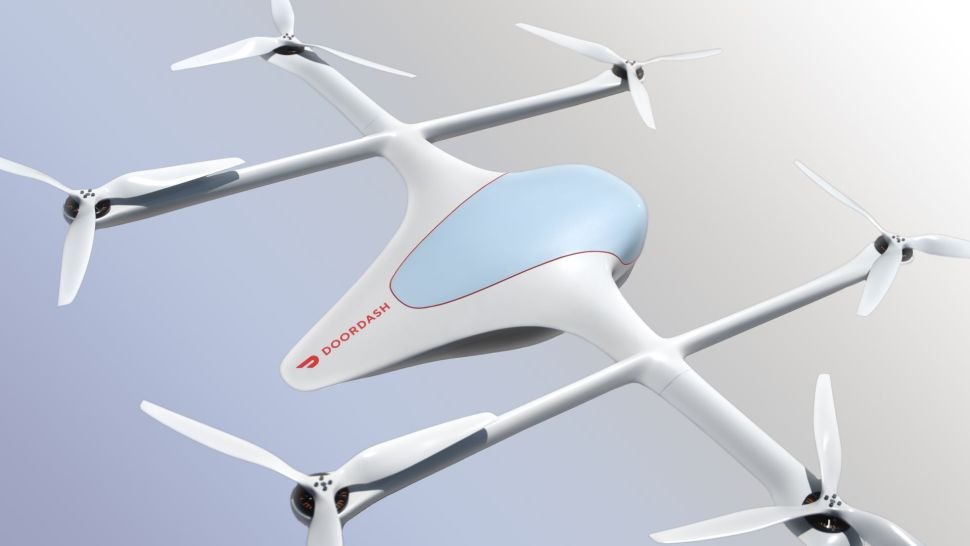
The drones were developed and built internally by DoorDash Labs, the company’s robotics and automation division. The aircraft use a six-rotor design.
Until now, DoorDash has depended on outside drone operators, including Alphabet’s Wing and Flytrex, to carry out aerial deliveries. Lowe’s, for instance, began a pilot program in North Carolina this month using the DoorDash marketplace and Wing’s small unmanned aircraft.
DoorDash said it does not intend to abandon those partnerships. Instead, the company sees its own aircraft as another layer of flexibility for the network.
“We’ll continue our partnership with third parties like Wing and Flytrex, but in the same way we use multiple delivery methods, having multiple drone delivery options adds resilience to our network and helps us better serve merchants and bring the benefits of drone delivery to more communities faster,” said DoorDash spokesman Eli Scheinholtz in an email exchange.
The company said it worked closely with businesses while developing the complete delivery system. That included everything from packaging and loading systems to ground handoffs.
DoorDash is now developing multiple loading configurations intended to fit into existing business operations, with the aim of making drone delivery practical for local businesses of different sizes.
The company estimates that roughly 80% of typical DoorDash restaurant orders are light and small enough for its aircraft to transport safely.
“Any local business should be able to reach consumers by air. We built the whole system so that they can deliver by air without being disruptive to how they run their business,” said Harrison Shih, head of DoorDash Air, in the announcement.
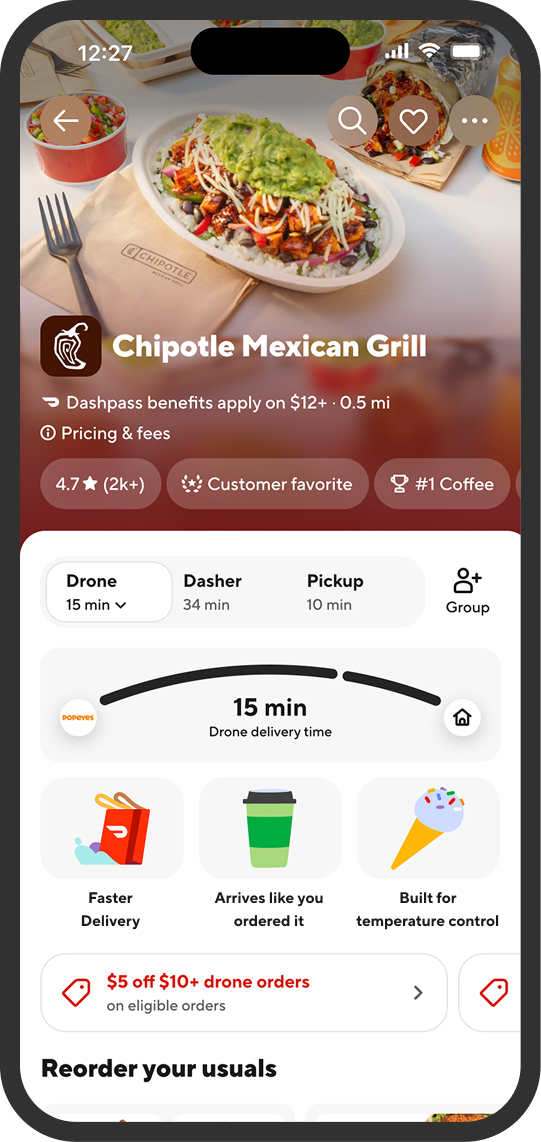
Trial flights are already underway in Northern California, involving national brands Chipotle and Popeyes, as well as local restaurants. DoorDash said delivery times during the trials have averaged less than five minutes.
Customers will be able to choose through the DoorDash app how they want an order delivered by a traditional driver, the company’s self-designed Dot robot, or a drone.
An autonomous system determines which orders are suitable for aerial delivery by using smart routing and considering several factors, including weather conditions, flight range and ground traffic. Based on those calculations, the system narrows down which deliveries make operational sense to send by air.
DoorDash said the drone’s cruising noise is comparable to that of a passing car. Orders are collected and then lowered to the ground using a winch. In rare situations, the aircraft also has a backup mechanism that allows it to be safely lowered to the ground.
That approach differs from Amazon’s drone delivery system, which drops packages at their destination from roughly 13 feet above the ground.
DoorDash’s push into logistics is not limited to physical delivery. The company also announced a text ordering feature, allowing customers to send a simple text message describing what they want from a restaurant or grocery store rather than navigating an app or browser.
DoorDash is therefore extending its role beyond food delivery and into a broader logistics platform spanning retail fulfillment, returns, autonomous ground delivery and drone operations. The combination gives the company additional ways to connect local businesses with consumers while positioning its technology and delivery network further into retail parcel logistics.