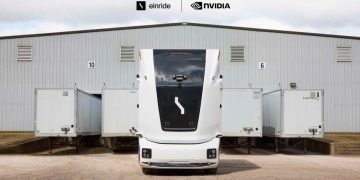




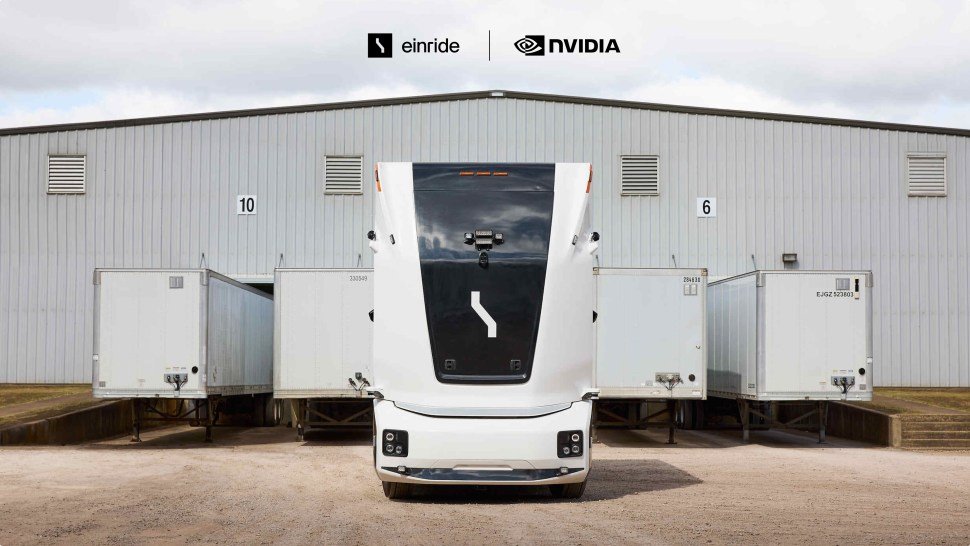
Einride is teaming up with Nvidia to develop the next generation of its autonomous driving technology, with the Swedish freight technology company set to build its next-generation Einride Driver on Nvidia’s Hyperion platform under a collaboration announced Monday.
The agreement will see Einride adapt Hyperion Nvidia’s compute and sensor reference architecture designed for Level 4 autonomy to the specific requirements of heavy-duty trucks as the company moves further into autonomous highway and suburban freight operations.
Einride, listed on Nasdaq as ENRD, already operates hundreds of electric trucks for shippers across the U.S., Europe and the Middle East. Its network also includes autonomous trucks deployed through contracted customer operations.
Based on customer demand already captured through its platform, Einride expects its vehicle footprint to grow to between 1,500 and 2,000 vehicles by 2028. The company estimates that roughly 80% of this demand could be suitable for automation in the medium term.
“We have the customers, the operational experience and the technology,” Henrik Green, chief technology officer at Einride, said. “Building the next generation of the Einride Driver on the Nvidia Hyperion platform will enable us to scale autonomous deployment across a freight network that’s already serving customers today.”
Combining Einride’s driving system with Nvidia’s technology stack
Einride will continue to design, build and operate the driving system itself. The company is also responsible for safety validation, regulatory approvals and customer deployments, while Nvidia will provide the underlying compute platform and AI development tools.
The companies will work directly on extending Hyperion’s compute, sensor, software and safety architecture to meet the demands of heavy-duty freight operations. Hyperion is integrated with Nvidia’s Halos safety system as part of that architecture.
The partnership also extends into AI model training. Einride plans to deploy Nvidia’s Blackwell architecture at scale through an Nvidia Exemplar Cloud partner. Such providers use infrastructure validated by Nvidia for large-scale AI training performance, although the announcement did not identify the partner involved.
Nvidia’s Cosmos technology is already part of Einride’s AI development workflow. The tool allows the company to search and curate camera data to identify complex edge cases, while also augmenting real-world datasets with photorealistic synthetic scenarios.
That combination gives Einride a broader pool of material for both model training and validation, particularly for situations that may be difficult to capture consistently in real-world driving.
“Autonomous trucking represents one of the clearest opportunities to improve the safety and efficiency of global freight,” said Rishi Dhall, vice president of automotive at Nvidia.
The two companies have not disclosed when the first Einride trucks based on the Hyperion platform are expected to enter service.
Why it matters
The collaboration moves Nvidia’s autonomous-driving platform into an operating freight network rather than a purely development-focused environment. Einride is already moving cargo for customers across the U.S., Europe and the Middle East, while its current demand pipeline points to 1,500 to 2,000 vehicles by 2028.
With the company estimating that around 80% of that demand could eventually be automated in the medium term, highways and suburban routes are emerging as the next major proving ground for its autonomous freight strategy.