Maritime Nov 17, 2026
Ethanol gains momentum as a potential alternative fuel for the maritime industry
Backed by substantial US production capacity and an established distribution network, ethanol could emerge as a practical low-carbon option for shipping, although technical, safety and regulatory challenges still need to be addressed.
Ethanol is drawing growing attention as a potential marine fuel, and the United States is in a good position to supply the shipping industry with its large production capacity and existing distribution infrastructure. According to a new report from the Global Center for Green Fuels (GCGF), the conditions are becoming increasingly favorable to link US ethanol producers with demand for marine fuels.
US ethanol production is expected to be 18.5 billion US gallons this year, or about 55 million tons. This is an opportunity for agricultural producers, fuel manufacturers and the maritime sector to develop a new market as the shipping industry diversifies its energy mix in response to decarbonization requirements.
“Shipping’s fuel mix is expected to diversify as decarbonization regulations come into effect. "The GCGF report said, 'A key question for US stakeholders such as farmers, ethanol producers, ports and shipyards is how much ethanol can play a role in this transition.'
The United States has an existing supply chain
American ethanol production is on a scale that gives it a big head start. The country grows over 38.5 million hectares of corn to support the production of 51% of the world's ethanol.
There are already more than 2 billion gallons of ethanol moving through an existing logistics network. Fuel travels by road, rail and barge from agricultural producers to around 200 biorefineries in 24 states. From these facilities, it is shipped to major export terminals along the Gulf of Mexico, most notably the ports of Houston and New Orleans.
With demand growing for maritime, this existing infrastructure could greatly reduce the need for new distribution investments.
The GCGF also believes that any possible increase in consumption would be manageable for the US agricultural sector. In its most ambitious 2031 scenario, maritime ethanol demand would still be only about 14% of projected American corn production. The report therefore suggests that this additional demand could be met within the existing agricultural production capacity of the country.
A fuel compatible with existing methanol infrastructure
Ethanol’s physical characteristics are also an advantage. It is liquid at ambient temperatures and can be handled as methanol with the same regulations applying. It is also higher in calorific value than methanol.
Compatibility, however, does not mean that you can use existing equipment without any modifications. Ethanol can be corrosive to certain materials, which means components such as hoses, seals, gaskets, valve seats and fuel tanks need to be adjusted.
Another thing to consider is the production capacity. The United States could be a major supplier, but the world's ethanol production would not be enough to power the global fleet of ships. Its development must therefore be seen primarily as a drop-in fuel for vessels already in service.
Early commercial examples: Maersk, Brazil
Practical trials are already assessing ethanol’s potential in maritime operations.
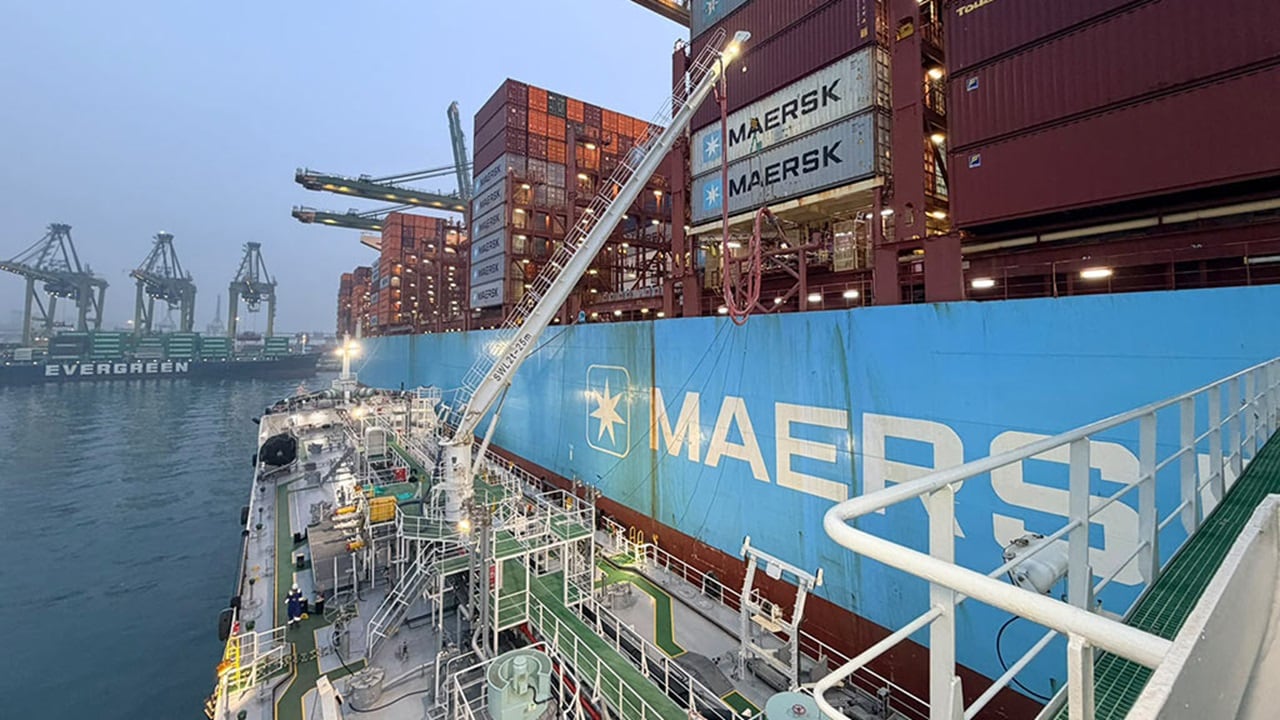
Among the most notable developments is the bunkering operations of Maersk and its methanol dual-fuel vessels. The Maersk Halifax in Singapore in October got 5,000 tons of ISCC-certified bioethanol next to the berth and during container handling operations. The vessel also bunkered a stem of bioethanol in the Port of Houston in late September.
Another key market to watch is Brazil. The country is already a major user of ethanol as a fuel for road transport, and the Port of Santos has now started to provide ethanol bunkering services, another example of the fuel’s move into maritime supply operations.
There is also increasing interest from engine manufacturers and ship owners. The Mærsk Mc-Kinney Møller Center for Zero Carbon Shipping (MMMCZCS) noted in a report published last month that there is growing focus on ethanol as a drop-in for engines designed to run on methanol.
Studies to date indicate that the technical systems and regulatory requirements for methanol are broadly similar to those for ethanol, the center said.
“The other hurdles for this use case of ethanol are largely optimization, validation and certification. “The combined reported findings indicate a clear path for the use of ethanol in methanol-fuelled vessels,” the MMMCZCS report stated.
Flashpoint and fuel stability remain major obstacles
Despite these advantages, several technical issues must be resolved before ethanol can be adopted more widely.
One of the main difficulties concerns the existing fleet, most of which has been designed to operate on conventional diesel. This reinforces the importance of developing ethanol as a drop-in fuel rather than relying exclusively on the introduction of new vessels.
The MMMCZCS has also identified problems associated with blending ethanol and marine gas oil (MGO). Laboratory tests showed that ethanol-MGO blends had a low flashpoint and could separate during prolonged storage. The centre additionally identified a risk of separation as the blended fuel passes through a vessel's onboard fuel preparation system.
The flashpoint issue is particularly important from a maritime safety perspective. Ethanol has a flashpoint of approximately 13°C, considerably below the International Maritime Organization's (IMO) general minimum requirement of 60°C for marine fuels.
Liquefied natural gas (LNG), despite having an ignition point below this regulatory threshold, is managed through dedicated safety frameworks.
The MMMCZCS identified reports suggesting that additives could help address both fuel separation and flashpoint limitations. However, the centre was unable to independently reproduce the reported flashpoint-increasing effects of two such additives, while acknowledging that its tests were not exhaustive.
The report therefore maintains a degree of caution: “We were unable to independently replicate the reported flashpoint-increasing effects of two fuel additives, our tests were not exhaustive. If increasing the flashpoint of ethanol-MGO blends ultimately proves infeasible, ships operating with ethanol must be equipped with dedicated safety systems.”
Six priorities to establish a US maritime ethanol market
To move ethanol from initial trials towards wider commercial adoption, the GCGF has outlined six actions that the United States should undertake to stimulate both supply and demand in the maritime sector.
The first priority is to finalise a marine life-cycle assessment certification framework. Such a system would need to account for emissions throughout the entire production chain, including corn cultivation, transportation, milling, cooking, liquefaction, fermentation, distillation, dehydration, storage and final delivery.
Second, the US Coast Guard should establish regulations governing the domestic use of alcohol-based marine fuels, providing a clearer framework for their handling and operation aboard vessels.
The third recommendation concerns extending the US Renewable Fuel Standard 2 (RFS2) to maritime fuels. This would require a minimum proportion of renewable fuel to be blended with conventional fossil fuels.
The GCGF also recommends launching up to five pilot vessel programmes in US coastal waters to demonstrate the operational feasibility of ethanol as a marine fuel.
A fifth measure would involve designating up to five port hubs for ethanol bunkering, supported by state funding, Department of Transportation resources, port grants and energy agency financing.
Finally, the organisation calls for long-term offtake agreements to provide commercial certainty for the emerging market. These arrangements would connect Midwest ethanol producers with marine bunkering operators, while encouraging low-emission corridor commitments involving cargo owners on priority shipping routes.
IMO climate regulations could accelerate adoption
According to the GCGF, the regulatory foundations for ethanol as a marine fuel are already more developed than those of almost any other low-emission fuel, with methanol representing the main exception.
The centre also sees the IMO's Net Zero Framework as a potential catalyst. By establishing the economic conditions needed to support lower-emission fuels, the framework could improve ethanol's commercial competitiveness and encourage investment across its supply chain.
However, the pace of development will depend heavily on the position adopted by Washington during the upcoming IMO Net Zero discussions, scheduled to begin later this month.
For the American ethanol industry, the opportunity is significant: an existing production base, established transport infrastructure and growing interest from shipowners could provide the foundations for a new maritime fuel market. The decisive question now is whether regulatory support, technical validation and commercial commitments can come together to turn that potential into a viable shipping solution.
END OF REPORT