Tech Nov 11, 2026
Europe’s Hydrogen Truck Technology Advances, but Refuelling Infrastructure Remains a Major Obstacle
Cellcentric’s BZA375 fuel cell is ready for heavy-duty truck applications, delivering up to 375 kW while reducing hydrogen consumption by 20%. However, large-scale production remains dependent on the development of truck-compatible refuelling stations and hydrogen prices falling towards €6 per kilogram.
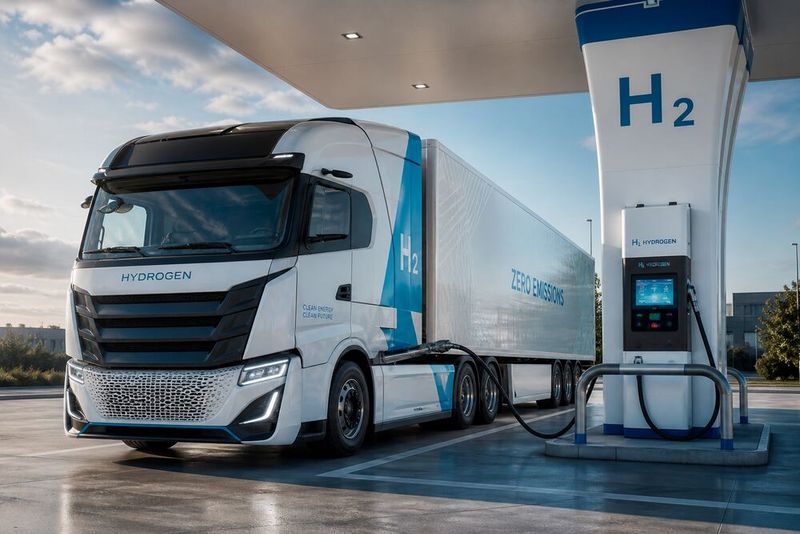
STUTTGART, Germany – Hydrogen fuel cell technology for heavy-duty transport is moving closer to commercial deployment, but Europe's infrastructure is not yet ready to support widespread adoption. For cellcentric, the joint venture between Daimler Truck and Volvo Group, the main challenge is no longer simply developing a suitable fuel cell. It is creating the economic and operational conditions that will allow transport companies to use hydrogen-powered trucks profitably.
The company's latest system, the BZA375, has been designed to fit into the engine compartment of a conventional 13-litre diesel truck. While production currently takes place at cellcentric's facility in Esslingen, near Stuttgart, preparations for a much larger manufacturing site have already begun in Weilheim an der Teck, Germany.
However, construction of the new factory remains conditional. According to Nicholas Loughlan, cellcentric's chief technology officer (CTO), the company needs a European network of hydrogen stations designed specifically for heavy-duty vehicles, alongside hydrogen prices approaching €6 per kilogram (approximately $6.70).
Speaking during a media visit to the company's headquarters in Kirchheim/Teck on September 17, Loughlan stressed that technological readiness alone cannot guarantee market adoption.
“You cannot just put a product out there and expect it to scale,” he said, explaining that successful deployment requires an entire ecosystem of infrastructure and supporting conditions.
His comments came two days after Daimler Truck, Volvo, Toyota, Bosch and four energy companies announced an alliance at IAA Transportation to accelerate hydrogen infrastructure development alongside the deployment of truck fleets, beginning in Germany.
Toyota is also preparing to become an equal shareholder in cellcentric. In July 2026, the Japanese manufacturer signed a binding agreement with Volvo Group and Daimler Truck to acquire a one-third stake in the venture. Completion of the transaction is expected around the end of 2026 or early 2027.
BZA375: One fuel cell replaces two previous units
The BZA375 represents a significant development compared with cellcentric's earlier technology.
Its predecessor, the BZA150, powers a 40-tonne truck using two 150-kilowatt fuel cell units. However, cellcentric decided not to take that system into full series production, instead accelerating development of the more powerful BZA375.
Unveiled in April 2026, the new system delivers up to 375 kW of continuous net power, equivalent to more than 500 horsepower. It weighs less than 500 kilograms, or approximately 1,100 pounds, while consolidating the performance previously provided by two separate units.
For a fully loaded 40-tonne truck, cellcentric estimates hydrogen consumption at less than 6 kilograms per 100 kilometres, equivalent to more than 10.2 miles per kilogram. The system is designed for an operating life of approximately 25,000 hours.
According to Loughlan, the BZA375 consumes 20% less hydrogen than the previous twin BZA150 configuration.
The system has also been designed with different international truck platforms in mind. During the September visit, cellcentric confirmed compatibility with North American tractors, including the Volvo VNL and Freightliner Cascadia, as well as European models such as the Mercedes-Benz Actros and Volvo FH.
Esslingen handles current production as Weilheim awaits investment
Cellcentric's industrial strategy is divided between two German locations.
The existing pilot manufacturing facility in Esslingen, approximately 30 kilometres from the company's headquarters, has managed the complete production process under one roof since June 2024.
The site currently manufactures BZA150 systems for customer fleets, with vehicles expected to reach operators from the end of 2026. Production activities will subsequently expand to include a higher volume of BZA375 samples. According to Loughlan, full series production of the new fuel cell is targeted for around the turn of the decade.
The proposed Weilheim facility represents the next stage of industrial expansion. Cellcentric has secured an option, valid until the end of 2029, on a 16-hectare plot (approximately 40 acres) in the Rosenloh industrial park. The company has already paid more than €15 million (around $16.8 million) to reserve the land.
Nevertheless, the investment decision has not been finalised.
Loughlan explained that cellcentric does not intend to commit immediately to a large manufacturing operation while the commercial development of a new technology remains uncertain. The company will first assess how much additional production capacity can be generated at Esslingen and how quickly market demand develops.
He also indicated that establishing a new manufacturing facility would normally require three to four years.
There is therefore no fixed production threshold or specific deadline triggering construction. The decision will depend primarily on the evolution of market conditions.
Hydrogen could solve Europe’s electricity grid bottlenecks
In addition to the fuel cell itself, cellcentric is promoting hydrogen as a complementary solution for heavy-duty transport to battery-electric.
Loughlan’s argument is predicated on the electricity needed to electrify all of Europe’s existing fleet of trucks. He reckons that powering all these vehicles with batteries would need around 500 terawatt hours (TWh) of electricity each year, about the amount of energy Germany uses each year.
It was technically possible to make such a transition, he admitted, but he doubted whether it was economically and operationally possible in the time required.
In comparison, Germany produced 509.2 TWh of electricity in 2025, according to Destatis data. The European Automobile Manufacturers’ Association (ACEA) meanwhile counts some 6.2 million trucks on EU roads, including some 3.9 million heavy-duty vehicles weighing more than 16 tons.
Loughlan illustrated the infrastructure challenge with the Denkendorf service station on Germany’s A8 expressway near Stuttgart. “There are lots of trucks at the site at the end of a working shift but the site does not currently have any charging infrastructure specifically designed for heavy duty vehicles.
Loughlan said the plans call for connecting to the grid for 15.4 megawatts by 2035, which would be enough to charge about 15 trucks at the same time using megawatt charging technology.
He added that energy providers are already warning industrial customers and long-distance transport operators that the electricity grid will not be upgraded fast enough to take on all the new connection requests.
In such context, the development of two complementary infrastructures for heavy-duty transport could be more practical, cheaper and effective. But Loughlan emphasized that battery electrification should progress where it is possible.
Europe’s hydrogen stations need to be ready for heavy-duty vehicles
One of the biggest barriers to commercial hydrogen trucking remains the availability of sufficient refueling infrastructure.
European regulations already define the minimum requirements for hydrogen distribution. The Alternative Fuels Infrastructure Regulation (AFIR) obliges member states to set up hydrogen refueling stations with a minimum capacity of one ton per day and a 700-bar dispenser every 200 kilometers on the core TEN-T.
The regulation also foresees at least one hydrogen station in each urban node by 31 December 2030.
But cellcentric argues the infrastructure built for passenger cars won't be sufficient to handle heavy-duty transport. It proposes stations that can be scaled up to four tons of hydrogen a day.
Daimler Truck CEO Karin Rådström said at IAA Transportation that there are currently 187 hydrogen refueling stations in Europe. The majority of these are used on passenger cars and operate at 350 bar.
Such facilities are generally not suitable for heavy-duty trucks, which need more than 10 kilograms of hydrogen per refueling session and need access to 700-bar dispensing systems or liquid hydrogen solutions.
The challenge is therefore not just to expand the number of stations but to ensure their capacity, technology and location fit the needs of commercial trucking operations.
Hydrogen prices remain a decisive factor for fleet operators
Even if suitable stations become available, the cost of hydrogen will determine whether transport companies can justify investing in fuel cell trucks.
Loughlan identified approximately €6 per kilogram as the price level at which cellcentric would be prepared to begin scaling its technology.
Asked about current hydrogen prices across Europe, he acknowledged that they remain substantially higher.
There has nevertheless been some progress in Germany. In January 2026, H2 Mobility began supplying hydrogen to customers of truck rental company hylane at selected German stations for approximately €8 per kilogram, excluding taxes. The companies described this price as considerably below prevailing market levels.
Public funding is also playing an important role in coordinating infrastructure investment with vehicle deployment.
Loughlan highlighted Germany's funding programme, which links financial support for hydrogen stations to the actual deployment of trucks. This approach is intended to overcome the traditional chicken-and-egg problem: operators hesitate to purchase hydrogen vehicles without sufficient refuelling infrastructure, while investors are reluctant to build stations without guaranteed demand.
Germany's latest funding call offered €220 million (approximately $247 million). According to the industry alliance, applications covered more than 70 high-capacity hydrogen stations and 800 heavy-duty trucks.
EU emissions targets increase pressure on truck manufacturers
The transition towards zero-emission heavy-duty transport is also being driven by European regulatory requirements.
Under the EU's heavy-duty vehicle CO2 standards, manufacturers must reduce emissions per kilometre from new heavy-duty vehicles by 45% by 2030 and 65% by 2035.
Loughlan pointed out that these obligations apply to original equipment manufacturers (OEMs), rather than directly imposing technology choices on end customers.
For fleet operators, the decision will ultimately depend on which solution offers the most favourable total cost of ownership (TCO) for a particular transport operation.
This means hydrogen fuel cell trucks will have to compete not only on environmental performance but also on acquisition costs, fuel prices, infrastructure availability and operating efficiency.
Production ambitions have already faced delays
Cellcentric's industrial development has not followed its original timetable.
When Volvo agreed in 2020 to invest €600 million, approximately $700 million at the time, for a 50% stake in the venture, the partners expected series production to begin during the second half of the 2020s.
Initial fuel cell systems were originally scheduled to come from the Weilheim facility in 2026. However, the company now expects operations at the site to begin around 2030.
The revised schedule reflects the slow development of hydrogen infrastructure and the high cost of green hydrogen, according to reporting by Electrive.
Manufacturing costs are another major consideration. Loughlan explained that the technology's economic competitiveness depends heavily on production volumes. Without manufacturing tens of thousands of units annually, cellcentric cannot achieve its potential cost position.
Government support will therefore remain important during the early stages of market development.
Toyota's planned entry as an equal shareholder could also strengthen the venture's industrial capabilities. The Japanese manufacturer brings experience in developing and industrialising fuel cell technology for passenger vehicles, including the Mirai.
North America remains a market under observation
Although the BZA375 has been developed with U.S. and Canadian technical codes and standards in mind, cellcentric is taking a cautious approach to the North American market.
Loughlan said the company does not currently see sufficiently strong demand for zero-emission trucking in the United States to justify an aggressive commercial expansion.
For now, cellcentric intends to monitor market developments rather than accelerate deployment in the region.
Ultimately, the company's strategy depends on three elements progressing together: the expansion of truck-compatible hydrogen stations, a reduction in fuel prices and an increase in its own manufacturing volumes.
Loughlan believes that once these conditions are in place, fleet operators will move beyond limited demonstration projects and begin purchasing hydrogen trucks in larger quantities.
The objective, he explained, is to reach a stage where customers are no longer buying a single vehicle simply to demonstrate the technology, but are ready to order fleets of ten or more trucks.
END OF REPORT