




Flexport is taking its fulfillment business beyond the United States for the first time, launching operations in Canada and the United Kingdom as changing tariff policies and stricter customs enforcement add new layers of complexity to global supply chains.
The San Francisco-based logistics provider announced Tuesday that fulfillment services are now available in Mississauga, Ontario, and Manchester, England. The move is designed to help customers position inventory closer to end consumers while continuing to manage their logistics operations through Flexport.
The international expansion marks the first overseas rollout of Flexport’s fulfillment business. It also extends the company’s end-to-end logistics network into two markets where many of its customers already have established sales.
Under the new setup, customers can import inventory in bulk, store products domestically and fulfill orders within each market while continuing to use the same Flexport platform, account team and freight and customs relationships.
“Our customers built demand in Canada and the UK long before they had a good way to serve it,” Flexport founder and CEO Ryan Petersen said in a statement. “Flexport customers using freight through fulfillment in the U.S. have seen tangible efficiencies and cost savings with end-to-end logistics.”
Flexport establishes fulfillment operations in Toronto and Manchester
Flexport’s Canadian fulfillment operation is located in Mississauga, close to Toronto Pearson International Airport.
The facility holds Health Canada certifications covering medical products, supplements and consumer goods. Inbound receiving started in July, while the first outbound customer orders are scheduled to ship in September.
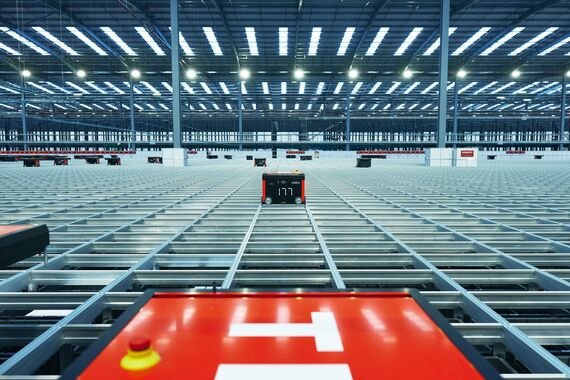
In the United Kingdom, Flexport is operating through two partner-run fulfillment facilities in Manchester. Both locations rely on AutoStore automated storage and retrieval systems, using robots that move across grids of stacked bins to deliver inventory directly to warehouse workers.
According to Flexport, the technology makes it possible to store approximately the same volume of goods in one-quarter of the floor space required by traditional warehouse configurations.
The company is not stopping with Canada and the UK. Flexport also plans to introduce fulfillment operations in continental Europe in 2027, building on the freight and customs infrastructure it already has in place across the region.
Overall, Flexport said its logistics network serves more than 13,000 companies and provides access to air, ocean, truck and rail transportation, as well as customs and fulfillment services.
Tariffs and customs enforcement add pressure to North American supply chains
Flexport’s international fulfillment expansion comes at a time when importers are dealing with a North American trade environment shaped by more than tariff rates alone.
Businesses are also facing increased scrutiny of importers, customs brokers, transshipment practices and country-of-origin rules, creating additional compliance challenges for companies moving goods across borders.
Those issues were discussed during Flexport’s Aug. 19 “Tariff Trends 2026” webinar, where Customs Director Marcus Eeman and Trade Advisory Director Jenn Park examined developments involving Section 338 and Section 232 tariffs, importer-of-record requirements, transshipment enforcement and refunds of IEEPA tariffs.
Canada received particular attention during the webinar.
At the time, the Trump administration had temporarily delayed planned Section 338 tariffs of 50% on roughly 5% of Canadian products while Washington and Ottawa continued negotiations. The products targeted included food and agricultural goods, softwood lumber, dairy, outerwear, hockey equipment and alcohol.
Eeman described the proposed duties as a potentially credible negotiating tool designed to pressure Canada into concessions over longstanding trade disputes.
He said the tariff threat appeared intended to “create a sense of urgency” around negotiations involving issues such as Canadian dairy quotas and U.S. Section 232 metals tariffs.
The Peace Bridge, linking Buffalo, New York, with Fort Erie, Ontario, handles more than one million truck crossings annually. The crossing serves as the primary freight corridor connecting the Toronto area with the U.S. Northeast.
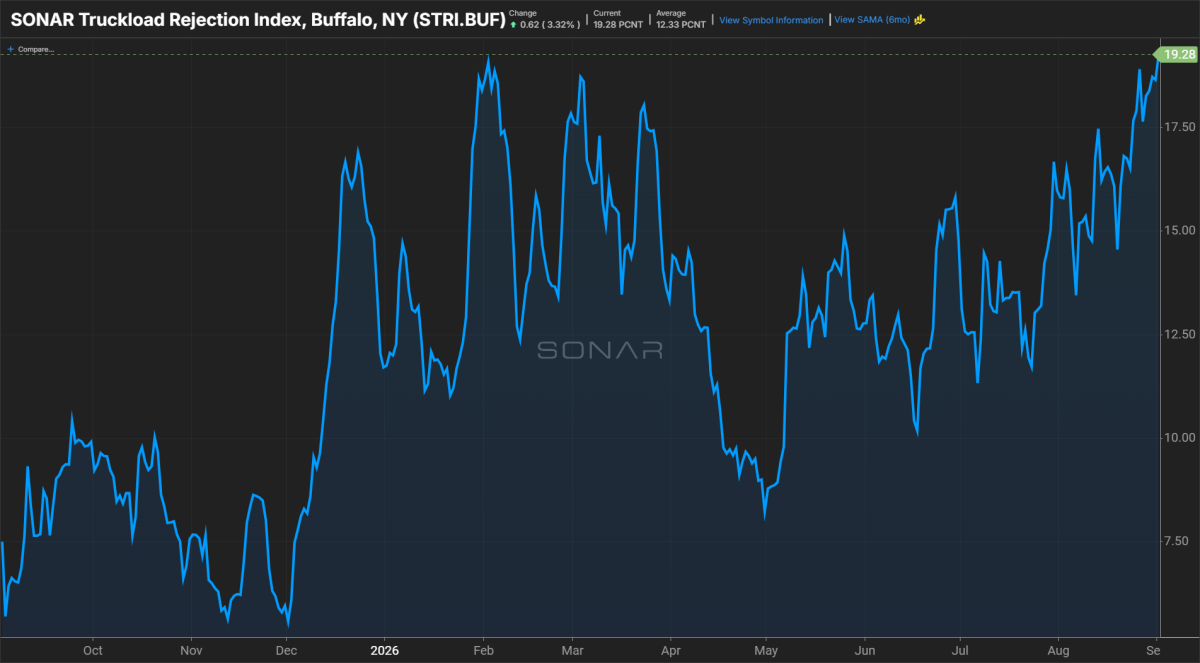
As of Wednesday, however, conditions in the Buffalo trucking market were proving difficult for shippers. The outbound tender rejection index (STRI.BUF) stood at 19.28%, significantly above the 14.19% national average, according to SONAR data.
Buffalo is also showing signs of tightening capacity. A recent positive move in the SONAR Weighted Rejection Index (SWRI) suggests that conditions could continue to deteriorate for shippers.
Customs compliance could become a bigger concern for importers
While tariffs remain a major source of uncertainty, Flexport’s Eeman argued that the next phase of trade disruption could increasingly center on customs compliance and the challenge of determining where products actually originate.
Flexport said U.S. Customs and Border Protection was preparing to scrutinize importer-of-record registrations, including companies using P.O. boxes or addresses that do not represent their actual principal places of business.
Businesses could also face problems if their contact information is incomplete, with missing details potentially resulting in importer records being deactivated or voided.
Customs brokers working with foreign importers are also facing additional due-diligence expectations. These include reviewing ownership structures, affiliated companies, U.S. assets and the importer’s ability to pay duties.
Flexport said these requirements could create additional compliance pressure for both customs brokers and foreign businesses selling into the United States.
The issue is particularly significant for North American supply chains, where companies routinely move components and finished products among Mexico, Canada and the United States before goods ultimately reach consumers.
Another potential change involves the long-standing “substantial transformation” standard used to determine a product’s country of origin.
Eeman said policymakers were considering whether that standard should be modified, which could change the way customs officials determine the origin of internationally sourced products.
“Maybe the chaos of, like, the last few years is mostly focused around tariffs,” Eeman said. “I think the chaos in the months and years coming ahead is probably going to be more around who gets to import, when they get to import, and how they know what those countries of origin are.”
Why it matters
Flexport’s expansion into Canadian and U.K. fulfillment gives shippers another option for positioning inventory closer to consumers. That capability becomes increasingly relevant as tariffs, country-of-origin requirements and tougher customs enforcement make cross-border supply chains more costly and complex.