



Europe is taking another step towards the large-scale integration of uncrewed aircraft, with Dronamics joining a major European initiative focused on safely bringing large remotely piloted aircraft into the continent’s airspace.
Launched on September 1 at EUROCONTROL’s headquarters in Brussels, the SESAR IRINA2 project brings together leading public and private aviation organisations from across Europe. Its objective is to establish the procedures, standards and protocols required to integrate remotely piloted aircraft systems (RPAS) into European airspace and enable their operation alongside conventional crewed aircraft.
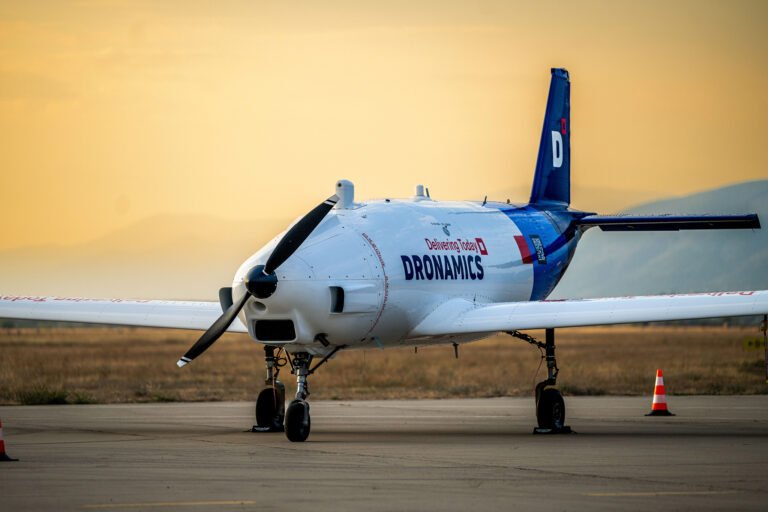
Dronamics has been selected to participate in the project alongside organisations including EUROCONTROL, SAAB, Thales, Honeywell and BULATSA, among others. As a developer and operator of large RPAS, the company will contribute the operational perspective of its flagship Black Swan cargo aircraft.
The Black Swan is one of only two European RPAS platforms that will directly contribute to shaping the project’s findings. Live flights involving the aircraft will be particularly important in developing procedures for cross-border RPAS operations and in examining how uncrewed aircraft can operate safely alongside manned aviation.
Tackling the barriers to large-scale uncrewed aviation
One of the main obstacles to expanding uncrewed aviation across Europe is that large remotely piloted aircraft such as the Black Swan are still largely restricted to segregated airspace.
The air traffic management procedures and Detect and Avoid capabilities required for these aircraft to safely share airspace with crewed traffic have not yet reached sufficient maturity for widespread operational deployment.
Dronamics’ participation in IRINA2 is therefore expected to play an important role in addressing these challenges and opening the way for the next stage of regular and commercial RPAS operations.
Building on the results of the original IRINA project, IRINA2 will further develop a coordinated conflict management concept combining onboard Detect and Avoid systems with air traffic control procedures. The project is targeting RPAS integration in both controlled and uncontrolled airspace, while seeking to advance these capabilities beyond Technology Readiness Level 6 (TRL6) towards operational deployment.
The project’s work will cover several key areas, including operational concepts and procedures, flight planning, cross-border RPAS operations and coordination between the civil and military aviation sectors.
IRINA2 will examine RPAS operations in airspace where Air Traffic Control (ATC) provides traffic separation, as well as in areas where ATC does not provide such separation.
The initiative builds on the first IRINA phase, which investigated the safe integration of Instrument Flight Rules (IFR) RPAS into European airspace and explored ways to reduce the reliance on segregated airspace for these operations.
Live Black Swan flights to support future regulation
Dronamics will bring the operational experience of a commercial large RPAS platform to the project. Its contribution will include developing the operational concept and helping define the requirements needed to integrate RPAS into controlled airspace.
Live Black Swan flights, carried out jointly with the Bulgarian Air Traffic Services Authority (BULATSA), will be used to test and examine a range of operational scenarios. These demonstrations will provide an opportunity to study interactions between RPAS and the Air Traffic Management system under real operational conditions.
The flights will also allow the project partners to assess the workload and performance of air traffic controllers when manned and unmanned aircraft are managed within the same operational environment.
The results of these validation exercises will subsequently support further certification and standardisation activities. Their findings are expected to feed into the work of the organisations responsible for aviation safety, regulation and technical standards, including the European Union Aviation Safety Agency (EASA), the European Organization for Civil Aviation Equipment (EUROCAE) and the International Civil Aviation Organization (ICAO).
Through IRINA2, Dronamics will therefore contribute not only to demonstrating how large cargo RPAS can operate across European airspace, but also to the development of the regulatory and standardisation frameworks required to make their safe integration a reality.