Air Nov 6, 2026
Four Airlines Join Forces to Strengthen Japan-Europe Air Cargo Connectivity
Lufthansa Cargo, SWISS WorldCargo, All Nippon Airways and Nippon Cargo Airlines sign a Memorandum of Understanding to explore expanded cooperation, improved network connectivity and greater cargo capacity between Japan and Europe.
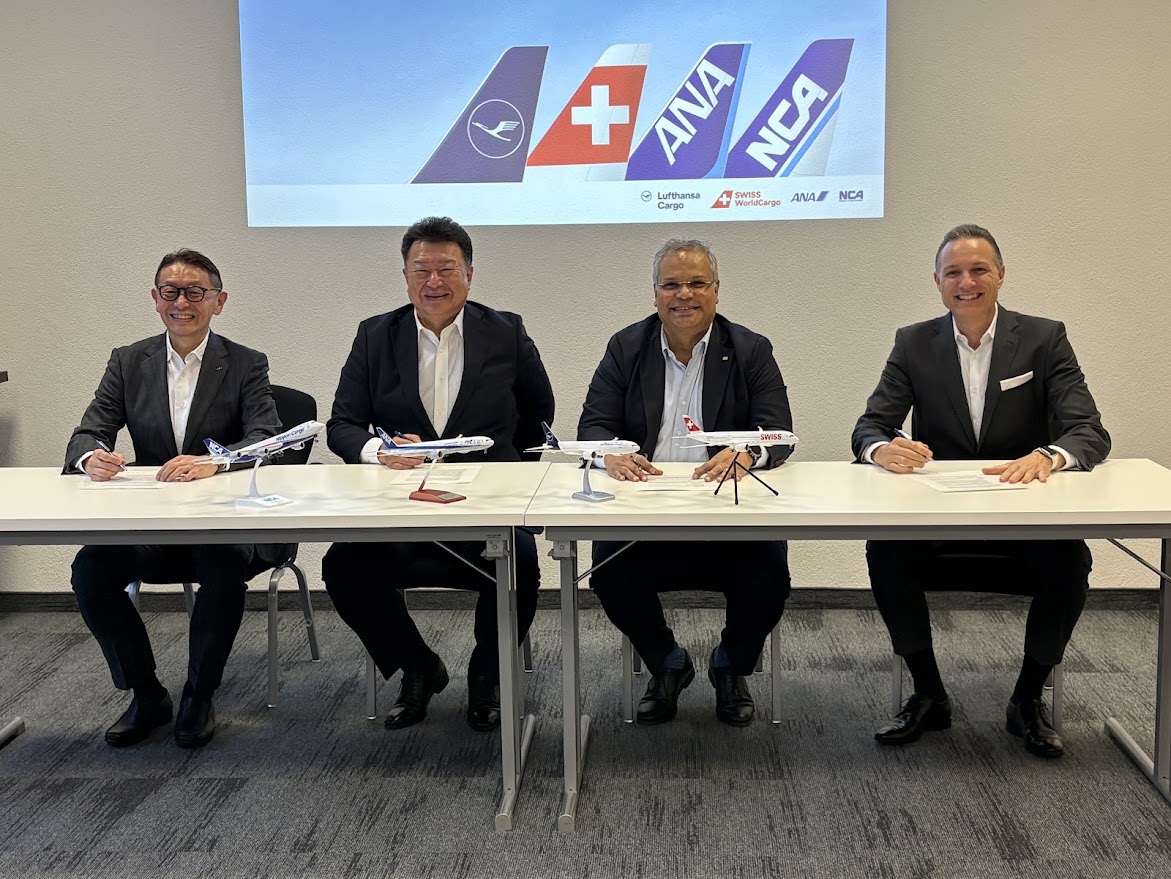
Four major airlines are planning to boost their ties on the Japan-Europe air cargo route. Lufthansa Cargo, SWISS WorldCargo, All Nippon Airways (ANA) and Nippon Cargo Airlines (NCA) have signed a Memorandum of Understanding (MoU) to explore new opportunities for collaboration with a view to expanding transport options, enhancing network connectivity and offering customers more cargo capacity.
The agreement sets out a framework for the four carriers to consider how their individual networks, operational know-how and cargo capabilities could be merged to offer more flexible solutions to shippers in the international arena. The move comes as demand grows for reliable and efficient air freight services linking major economic markets.
Lufthansa Cargo and ANA, which have been partners for 10 years,
The new agreement builds on the longstanding partnership between Lufthansa Cargo and All Nippon Airways. The two companies reinforced the operational link on the Japan-Europe trade lane with an integrated cargo joint venture launched in 2014.
This cooperation allowed the airlines to harmonize operations, align processes and share capacity enabling cargo movements between European and Asian markets.
However, the partnership was suspended in September 2023, following a restructuring of the cargo business unit of ANA Holdings. The agreement opens a new phase of negotiations based on the experience and foundations accumulated during the previous cooperation.
Now it is on a wider scale. Discussions are also under way to extend the cooperation to SWISS WorldCargo and Nippon Cargo Airlines, adding further European network coverage and dedicated freighter capabilities.
More choices for cargo customers, expanded networks
The four airlines plan to explore opportunities to offer more value to customers in both regions by leveraging their complementary route networks and specialized cargo capabilities.
"One of the main goals is to improve the link between Japan and Europe, offering shippers, freight forwarders and logistics providers a wider range of routing alternatives and capacity options.
The proposed cooperation could also increase flexibility in services, allowing customers to benefit from a broader range of transport solutions adapted to their different shipment needs. Special consideration will be given to the needs of companies operating with time-sensitive and care-intensive cargo, where reliability and quality of service remain important.
“The Japanese market and the long-standing relationship with ANA are important as the airlines look at the next stage of their cooperation,” said Lufthansa Cargo Chief Executive Ashwin Bhat.
“Japan is an important market for Lufthansa Cargo and our long-standing partnership with All Nippon Airways has enabled us to serve our customers in a reliable manner for many years. Together with SWISS WorldCargo and Nippon Cargo Airlines we now want to explore how we can use our respective brand strengths, networks and expertise to create even greater value for our customers. "With even more options and flexibility between Japan and Europe, we are further realizing our mission of Enabling Global Business," says Ashwin Bhat, CEO of Lufthansa Cargo.
Meeting the requirements of specialist and time-critical consignments
The possible partnership offers SWISS WorldCargo the chance to combine its European network and cargo expertise with the capabilities of the other participating airlines.
“Customers flying sensitive and time-critical goods between the two regions need reliable, high-quality air cargo services,” said Alain Chisari, Head of SWISS WorldCargo.
“Europe and Japan are both important markets for customers who rely on reliable, high-quality air cargo service for care-intensive and time-critical shipments. “Leveraging our strong European network and specialized cargo expertise with the capabilities of our partners could offer our customers an even broader range of transport solutions,” says Alain Chisari, Head of SWISS WorldCargo.
ANA also sees the agreement as a chance to extend the scope of cooperation to the two other carriers, building on its current relationship with Lufthansa Cargo.
Kenichi Wakiya, executive vise president, cargo marketing & services at All Nippon Airways and CEO of ANA Cargo, noted the importance of leveraging the respective strengths of the four airlines to better satisfy customer needs.
“ANA and Lufthansa Cargo have built a strong foundation over many years. We are pleased to be able to reopen our dialog and to extend our cargo joint venture to include Swiss WorldCargo and Nippon Cargo Airlines. “With the unique capabilities of all four carriers, we will be better able to meet the diverse logistics needs of customers in Japan and Europe,” says Kenichi Wakiya, Executive Vise President, Cargo Marketing & Services, All Nippon Airways & CEO, ANA Cargo.
Dedicated freighter expertise from Nippon Cargo Airlines
The involvement of Nippon Cargo Airlines adds yet another operational dimension to the proposed cooperation, especially given its experience in dedicated freighter operations and its established presence in the Japan-Europe air cargo market.
Nippon Cargo Airlines President and Chief Executive Officer Hiroyuki Homma said the company plans to supplement the networks of its partners, providing additional capacity and routing flexibility.
Joining forces with our partners, Nippon Cargo Airlines leverages its extensive experience in dedicated freighter operations and strong presence in the Japan-Europe cargo market. “We are fully committed to complement the networks to provide customers expanded capacity and flexible routing solutions,” said Hiroyuki Homma, President & Chief Executive Officer, Nippon Cargo Airlines.
New Era Dawns for Japan-Europe Air Cargo Route
The four carriers are now looking at how they could work together more closely on operations. The MoU doesn’t lock anything in. It simply gives them a framework to look for synergies, and how their networks, know-how and capacity might actually fit together to support the expansion is something the airlines will have to work out themselves.
For air cargo between Europe and Japan, this matters. Four established operators pooling their strengths could give shippers more routing choices, easier access to capacity and a bit more flexibility on one of the major intercontinental trade lanes.
Strategic alliances also came up in the discussions, as a way of strengthening global supply chains. Logistics needs keep shifting, and closer coordination between cargo operators may help networks absorb disruption and stay reliable on the routes that count most.
END OF REPORT