Air Nov 5, 2026
Global Air Freight Rates Slip 1.1% as Peak-Season Demand Continues to Support Prices
Air freight rates around the world are still 22.8% above year-ago levels, although they dipped slightly this week. Strong gains from India, Hong Kong and Shanghai helped to offset weaker showings on several major trade lanes.

Global air freight rates dropped slightly in the week ending November 2, 2026, falling 1.1% from the previous week. Despite this movement, prices remain significantly higher than a year ago, up 22.8% year-on-year, according to the latest figures published by TAC Index.
High jet fuel prices are also pushing up freight rates which are being propped up by continuing demand in the traditional peak shipping season. With several weeks still to go in the seasonal peak, rates are still above the highest levels seen in the last two peak seasons.
The global Baltic Air Freight Index (BAI00) followed suit, dropping 1.1% over the seven-day period but still posting a hefty annual increase.
Air freight rates fell on services to Europe from the main export routes out of China This performance comes at a time of weaker volumes and pricing following the European Union’s removal in July of its prior de minimis exemption for small parcels. By contrast, transpacific freight rates from China to the United States continued to rise strongly.
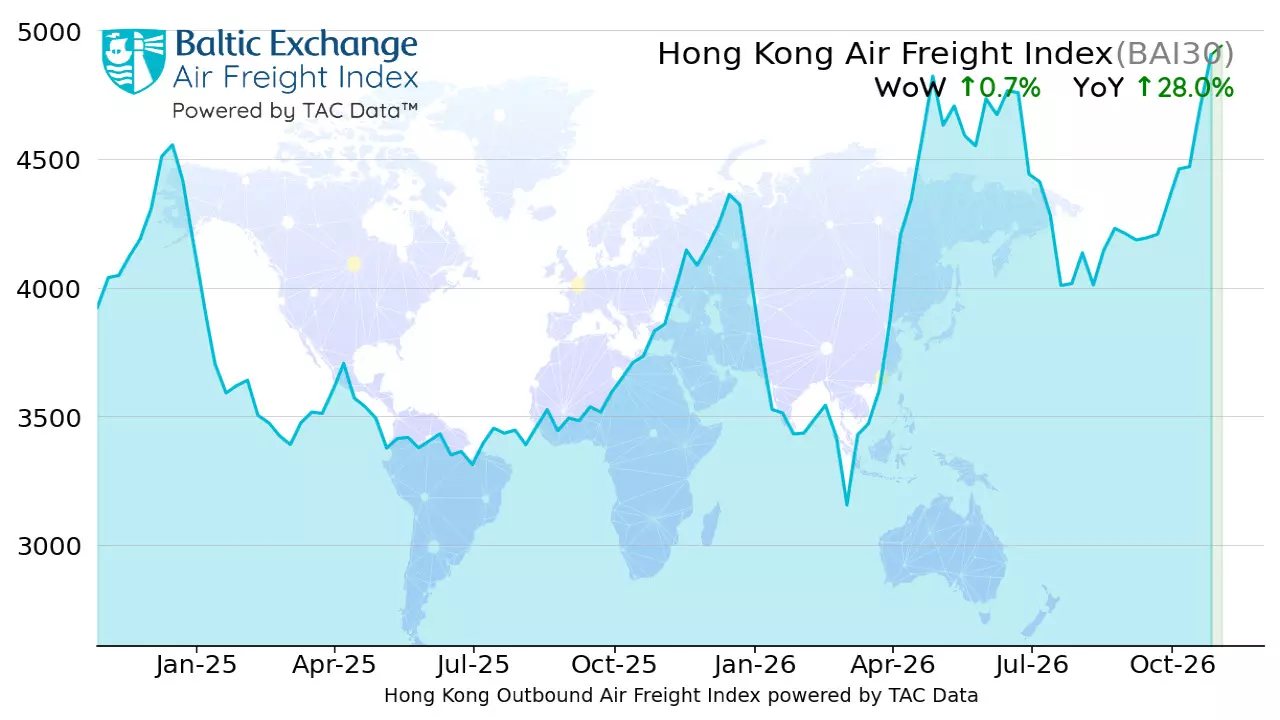
Hong Kong and Shanghai, meanwhile, maintained an upward trajectory. Spot rates departing Hong Kong increased during the week, while the overall outbound Hong Kong index (BAI30), which incorporates both spot and forward rates, advanced by 0.7%. This brought its annual increase to 28%.
Shanghai also recorded a positive performance. Its outbound air freight index (BAI80) climbed by 2.8% week on week, leaving rates 14.4% above their level in the corresponding period last year.
Other East Asian markets delivered mixed results. Taiwan registered further weekly increases, while rates from Seoul rose on routes to Europe but edged down on services to the United States. Nevertheless, both Seoul trade lanes remained considerably higher than a year earlier. Japanese exports to Europe also experienced a slight weekly decline, although rates continued to stand well above their previous-year levels.
In Southeast Asia, Bangkok recorded an increase in outbound freight rates, whereas Vietnam experienced modest overall declines. India stood out in South Asia, with rates strengthening slightly on both European and US routes. These movements brought the year-on-year increase in Indian air freight rates to approximately 80%.
European export markets experienced a more uneven week. Following recent increases on major transatlantic routes to the United States and services to the United Arab Emirates, rates declined overall. However, several other important trade lanes moved in the opposite direction, with increases recorded on routes serving China, Japan, India, Mexico, Brazil, Australia and South Africa.
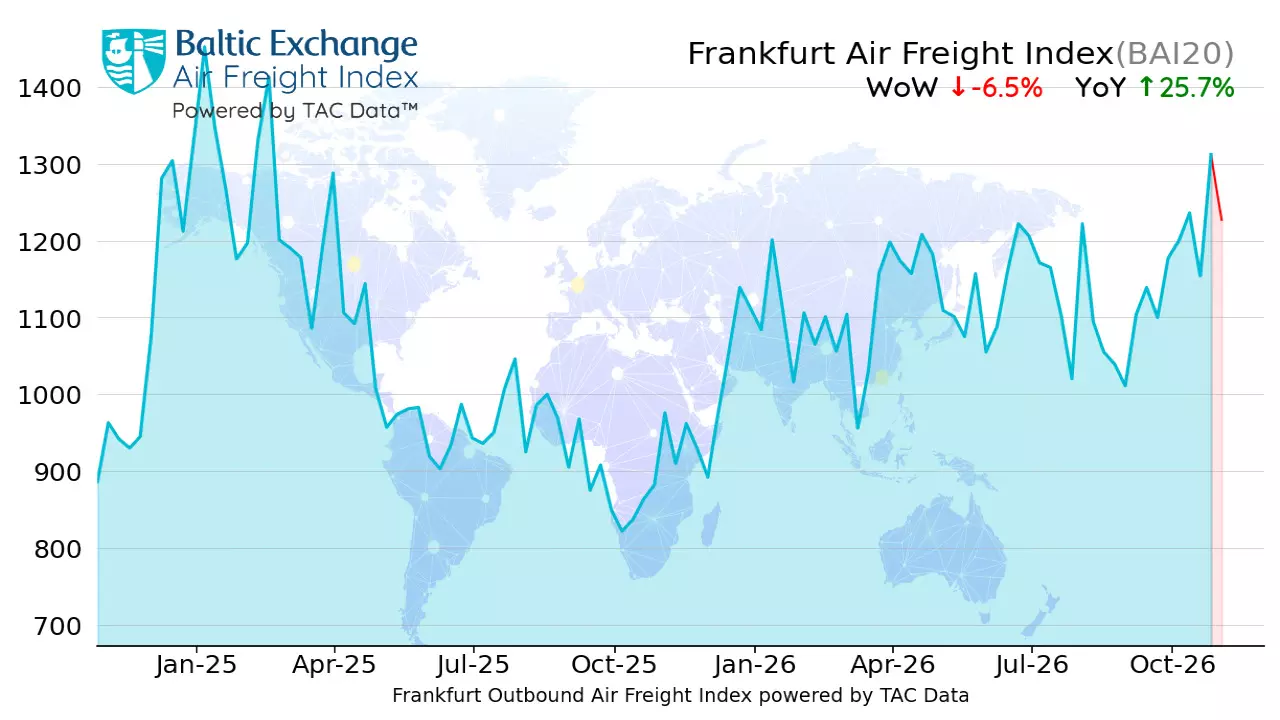
The Frankfurt outbound index (BAI20) dropped by 6.5% week on week, reversing some of its recent gains. Despite this correction, the index remained 25.7% higher than its level a year earlier.
London Heathrow recorded a sharper decline. Its outbound index (BAI40), which is more exposed to short-term fluctuations, fell by 23.2% over the week. Much of this decrease was attributable to significant reductions on routes to North America. Even after this substantial correction, the index remained 34.4% above its year-earlier level.
Also on the North American side there were different developments, depending on the destination. Freight rates to Europe and the United Kingdom continued to rise during the week, while other major international lanes experienced mixed results. Notably, services to China and South America dropped.
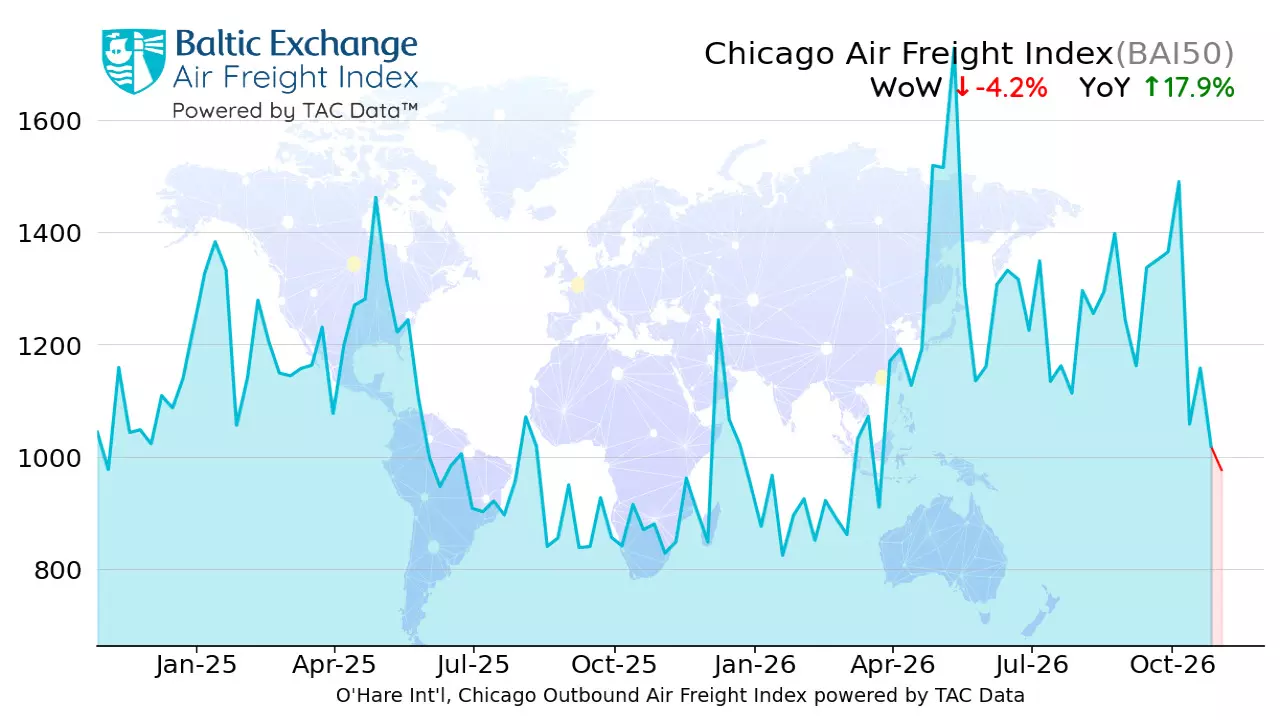
Chicago outbound volume index (BAI50) was down 4.2% from the prior week. But that was still 17.9% up on last year, showing the strength of the market, even after the latest adjustment.
Finally, air freight rates from Mexico to Europe also fell in the reporting period. Prices on this trade lane, however, remained considerably higher than those recorded over the same period last year.
The overall latest TAC Index numbers indicate that the global air cargo market is entering a short-term adjustment rather than experiencing a broad-based reversal. Freight rates across major international trade lanes remain buoyed by strong demand during the peak season and large year-on-year gains, although some of the main export markets have seen weekly falls.
END OF REPORT