Tech Nov 6, 2026
Harbinger secures $240 million to accelerate its expansion into energy, power and defense
Backed by Tiger Global, Capricorn and Ridgeline, the Series D financing will support the company's electric vehicle production ramp-up while extending its industrial technology platform into energy storage, power generation, autonomous systems and defense.
Harbinger has secured $240 million in Series D financing as the California-based manufacturer looks to expand its activities beyond electric commercial vehicles. The new capital will support its development across energy storage, power generation, autonomous technologies and defense, while helping the company increase manufacturing capacity to meet a major order from FedEx.
The financing round was co-led by Tiger Global, Capricorn’s Technology Impact Fund and Ridgeline, according to an announcement released Thursday by the company, headquartered in Garden Grove, California.
A significant part of Harbinger's immediate priorities remains the production of 2,000 electric trucks ordered by FedEx. Valued at more than $300 million, the agreement requires deliveries to be completed by the end of 2027. The newly raised funds will help the manufacturer scale up its medium-duty vehicle production while developing its additional business activities.
Harbinger describes itself as an American industrial technology platform company, with commercial vehicles representing one of five markets targeted by the latest investment.
For co-founder and CEO John Harris, electrification is increasingly becoming a central requirement across several industrial sectors.
“Electrification is at the core of everything we do, and increasingly, electrification is at the core of industry, defense, mobility, and AI,” Harris said in the company's announcement.
Internal engineering based platform for electric vehicles
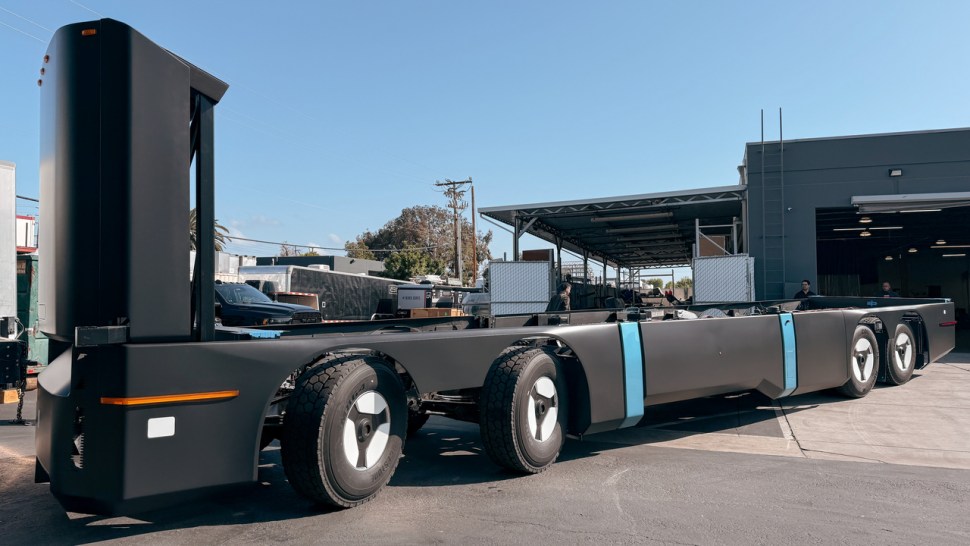
Harbinger currently produces Class 4, Class 5 and Class 6 chassis, in all-electric and plug-in hybrid configurations. The company produces many of its key components in-house, such as its powertrain, battery system, steering and braking technologies.
In March it expanded its product line with the launch of the HC Series Cab. And the model is equipped with a gasoline range extender, which can give up to 500 miles of range, depending on the setup. It can also provide up to 15 kilowatts of exportable electricity so operators and work crews can power equipment without a separate generator.
The company’s growth strategy also includes self-driving technology. Harbinger acquired Phantom AI, a developer of software for autonomous vehicles, fortifying its tech capabilities in the field.
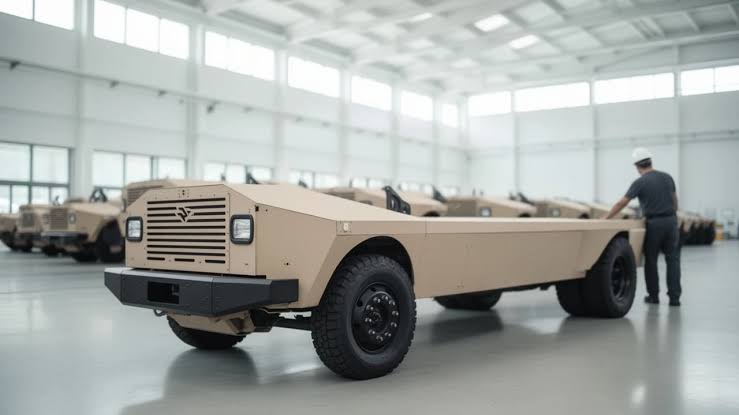
Defense is another emerging market. Harbinger won its first defense contract in the summer to develop the vehicle platform for an uncrewed Army supply vehicle as part of a contract won by American Rheinmetall.
The company has also begun selling its battery technology for energy storage applications, Bloomberg News said. But Harbinger’s latest announcement did not name any customers for its energy storage or power generation business.
Another round of funding after $160 million raised in Series C
The $240 million Series D follows a $160 million Series C financing by Harbinger in November 2025. That was when FedEx placed its first order for 53 electric trucks, a major step in the development of the commercial relationship between the two companies.
Since its launch in 2021, Harbinger says it has raised over $650 million in total funding.
The latest round also saw the participation of a number of institutional investors including Fidelity Management & Research Company, Squarepoint Capital and Xantium, who participated as crossover investors. Maniv and Greycroft also participated in the financing round.
Harris told Bloomberg News that Harbinger has gone after investors with crossover and public market experience in particular.
The company also announced in the release that it has received strategic backing from FedEx and THOR Industries through TechNexus. Harbinger has recently added Paul Melander, FedEx’s senior vise president of safety and transportation, to its board of directors.
Placement agents for the transaction were Goldman Sachs and Morgan Stanley.
The announcement also named BuildGroup, a strategic investor in data centers, as a participant. Tiger Global, meanwhile, said its investment decision was tied to the increasing infrastructure needs around artificial intelligence.
“Electrification is going to be key as demand for AI infrastructure grows,” said Griffin Schroeder, partner at Tiger Global.
“Harbinger is great at electrification, and electrification has become one of the most urgent bottlenecks of the AI era,” said Schroeder.
Cargo vans still dominate the deployment of zero-emission trucks
The expansion of Harbinger comes as the US market for zero-emission commercial vehicles continues to develop, though growth has been uneven across vehicle types.
The percentage of zero-emission vehicles among all US truck deployments reached a record 4.14% in the second half of 2025, according to CALSTART’s June 2026 Zeroing in on Zero-Emission Trucks market update.
This was despite a 35% year-on-year fall in total truck sales.
Cargo vans made up the vast majority of new zero-emission vehicle deployments, with 12,158 units out of a total of 12,996. Medium-duty step vans and trucks and all other vehicle categories combined added just 838 more units.
Harbinger’s Class 4 through Class 6 trucks are in the latter category, where deployment volumes are significantly less than that of cargo vans.
The numbers underscore the gap between the fast-growing electric delivery van segment and the slow-moving medium-duty electric truck market.
Production targets still a big challenge
Despite the new funding and expanding commercial partnerships, Harbinger still faces one of its most important manufacturing challenges: getting vehicles to customers at the speed they want.
"The company had just finished production of its 1,000th vehicle," Harris told Bloomberg News in September.
This milestone is a sign of its manufacturing progress, but the size of the FedEx deal is a much bigger commitment. That order alone calls for Harbinger to deliver 2,000 trucks by the end of 2027 – twice the number of vehicles it had built by the September milestone.
Also, there are a number of key financial and operational details that have not been revealed. Harbinger has not disclosed its current valuation, its current production capacity or how the new $240 million will be allocated between commercial vehicle manufacturing and its newer business segments.
The Army supply vehicle program is also still in prototype form. “These programs generally involve an initial production run of 3-10 aircraft and no contract values have been released.”
Harbinger intends to apply the engineering know-how it has developed through its vehicle manufacturing operations to each of its new target markets, the company said.
“The goal is to be more than just another product for our customers,” Harris says, “and we’re looking to redefine performance expectations for essential industrial systems.
“Harbinger’s job is not just to offer customers another option,” Harris said. “It is to reset expectations of what critical systems should deliver.”
Why this matters
The $240 million round of Series D funding gives Harbinger additional financial muscle as it looks to expand beyond the electric commercial vehicle market. With support from major investment firms FedEx and THOR Industries, the company is positioning its electrification expertise for applications across logistics, energy infrastructure, autonomous mobility and defense.
For fleet operators that are considering medium-duty electric delivery trucks, Harbinger’s growing financial and strategic backing is important. But the real test is whether it can turn that investment into industrial scale production.
Therefore, the delivery of 2,000 FedEx trucks by the end of 2027 will serve as a bellwether for Harbinger's ability to translate its technological ambitions and heavy funding into consistent commercial performance.
END OF REPORT